
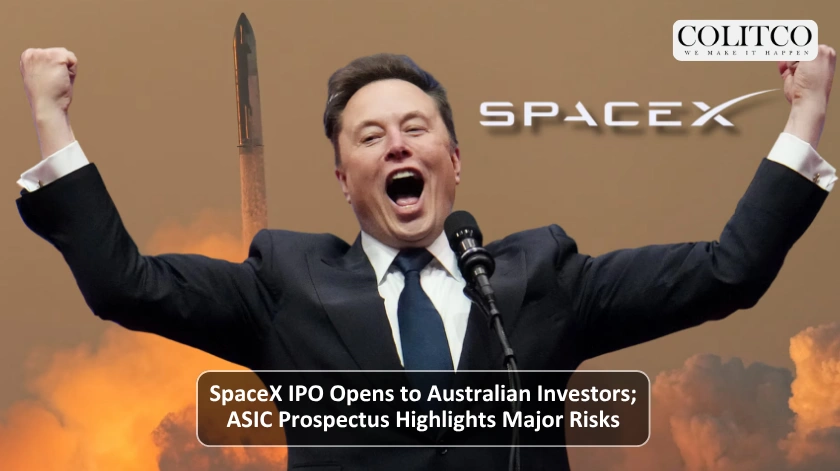
So, SPCX is finally launching on NASDAQ. Why the unusual spelling? SPCX is the ticker symbol under which SpaceX will trade on the NASDAQ. The company has set a fixed IPO price of US$135 per share, which could give it a massive – indeed, gargantuan – implied market valuation of approximately US$1.77 trillion. It will be one of the largest public listings ever attempted.
And Australian investors are being given a rare opportunity. They can participate directly in one of the most anticipated stock market listings in history.
As per the latest updates, the aerospace and satellite communications giant has lodged an Australian prospectus with the Australian Securities and Investments Commission (ASIC), which will allow eligible investors to apply for shares ahead of its expected Nasdaq debut later this week.
Nonetheless, you may need to suppress your excitement because the company and regulators have urged investors to carefully consider the risks before committing capital.
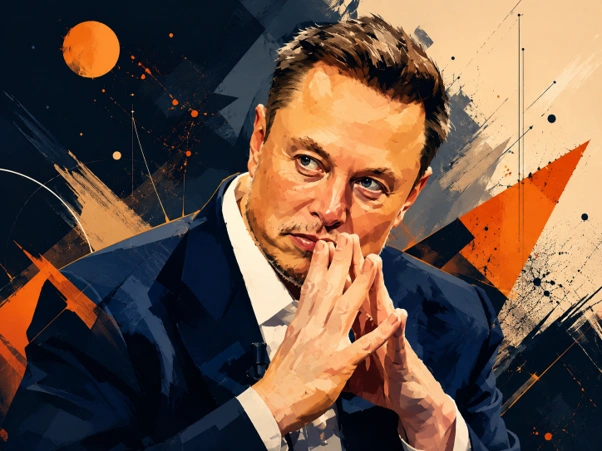
Figure: Elon Musk, founder, CEO, and chief engineer, SpaceX
Australian Investors Gain Direct Access
Not all major IPOs are open for Australians to invest in. In fact, in most cases, they are not. Overseas Initial Public Offerings (IPOs) are not automatically open to all Australian investors. However, SpaceX has created a dedicated retail offer for Australian investors through a locally compliant prospectus.
Applications are being processed through CommSec, and Macquarie Capital is acting as the Australian coordinator for the offer. There are certain requirements for the investors as well. They are required to hold an international trading account and complete the necessary US tax documentation before participating.
The offer is scheduled to close on 10 June. And, as we mentioned earlier, SpaceX is expected to begin trading on the Nasdaq under the ticker symbol SPCX on 12 June.
Needless to say, the opportunity has attracted significant attention from retail investors. However, SpaceX’s Australian prospectus contains a clear warning that the investment is considered highly speculative and that investors could lose part or all of their investment.
A Company Built Around Three Businesses
SpaceX has long been associated with science and tech ventures of Musk, like rocket launches and ambitious plans for Mars exploration, but the company’s operations today extend well beyond its launch business.
According to its public filings, the company operates across three primary divisions, one of which is space transportation and launch operations. There are two other businesses as well. One is Starlink satellite internet services, and another one is artificial intelligence-related businesses following the integration of xAI and X Corp.
You should not ignore the financial disclosures, too. The company generated US$18.7 billion in revenue in 2025, which came with a recorded net loss of approximately US$4.94 billion.
So you gotta be careful. The figures provide investors with the first detailed look at SpaceX’s finances as a public company and highlight the significant costs associated with its expansion plans.
Also Read: SpaceX $178M Missile Tracking Satellite Contract Expands Defence Reach
Starlink: The Silent Workhorse Behind SpaceX’s Success
Starlink is the standout performer among SpaceX’s three businesses. In a way, it’s the lifeblood of the company. What is it? It is a satellite internet constellation. It provides high-speed, low-latency broadband coverage to over 12 million active customers in more than 160 countries. And what are the financials?
Starlink generated more than US$11 billion in revenue during 2025 and accounted for the majority of the group’s earnings, which, as we have seen, is US$18.7 billion. 58.8% of the total revenue. Elon Musk has plans to expand Starlink’s satellite constellation in low-Earth orbit, which he made clear in his comment: “There will also ultimately be >100k V3/V4/V5 satellites for Starlink broadband and direct to cellphone connectivity.”
Musk has also predicted a very encouraging future for Starlink: “Starlink will one day carry the majority of Internet traffic. At that point, it is the Internet, and everything else just connects to Starlink.”
So, we can say, Starlink is the cash cow for SpaceX. It is the company that keeps the wheels turning and generates the steady cash flow needed to bankroll SpaceX’s big-ticket ambitions.
Also Read: SpaceX Secures NASA Contract To Launch Asteroid Tracking Telescope
Heavy Spending Continues Across Space and AI Projects
SpaceX’s other divisions are under financial pressure.
The company’s launch and spacecraft operations generated billions in revenue, but the heavy investment required to pursue its rocket dreams led to losses.
The business concerned here is Starship. What is Starship? It is widely regarded as the centrepiece of SpaceX’s long-term ambitions. The company aims to create a fully reusable spacecraft capable of carrying large payloads and eventually supporting missions beyond Earth. A Mars Dream.
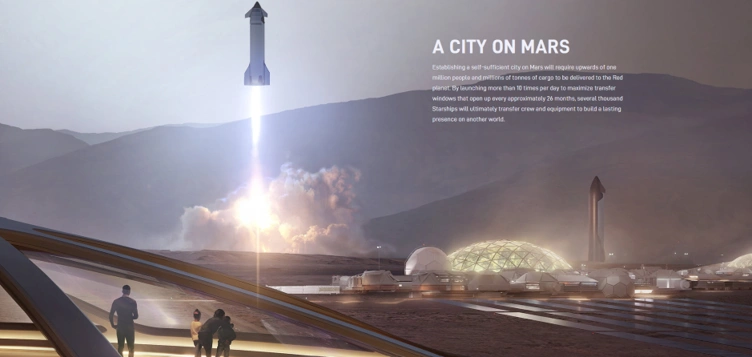
Figure: Mask has explicitly mentioned his dream to build a city on Mars on the SpaceX website. [SpaceX]
At the same time, the newly integrated AI division has emerged as another major source of expenditure.
Elon Musk’s AI investments are facing huge losses compared to other AI giants like Anthropic and OpenAI. The most significant AI investment of SpaceX and Elon Musk is xAI. xAI’s finances appear to be moving in opposite directions.
Earlier this year (2026), SpaceX acquired xAI, which the latest IPO filing of the company mentioned as a part of their AI segment. The AI segment also contains AI compute, Grok, and X. Below is an overall view to the financial performance of different businesses under SpaceX.
AI Segment Financial Performance
| Metric | Q1 2026 (Three Months Ended Mar 31, 2026) | FY 2025 |
| Revenue | US$818 million | US$3.20 billion |
| Operating Loss | (US$2.47 billion) | (US$6.36 billion) |
| Segment Adjusted EBITDA | (US$609 million) | (US$1.24 billion) |
Capital Expenditure by Segment
| Segment | Q1 2026 CapEx | FY 2025 CapEx |
| Space | US$1.05 billion | US$3.83 billion |
| Connectivity | US$1.33 billion | US$4.18 billion |
| AI | US$7.72 billion | US$12.73 billion |
What the Numbers Suggest
- The AI segment represented the group’s largest area of investment. I accounted for more capital expenditure than the Space and Connectivity businesses combined during the March 2026 quarter.
- Revenue growth has yet to offset the substantial costs associated with AI development, data centres, computing infrastructure, and model training.
- The figures indicate that the company is making a significant long-term bet on artificial intelligence. It is accepting sizeable short-term losses in pursuit of future market leadership.
Supporters argue these investments could position the company for future growth. But from a critical POV, the losses add considerable financial risk to an already ambitious business model.
Governance Structure Raises Questions
One aspect of the IPO attracting close scrutiny is SpaceX’s share structure.
Retail investors purchasing shares through the IPO will receive Class A shares carrying one vote per share. Elon Musk’s Class B shares, however, carry ten votes each.
As a result, Musk is expected to retain effective control of the company despite owning less than half of its economic interest.
Corporate governance specialists have long debated the merits of dual-class structures. Supporters argue they allow visionary founders to pursue long-term goals without short-term market pressure. On the other hand, critics contend they reduce accountability and limit the influence of ordinary shareholders.
There Can Be Potential Volatility After Listing
Market observers have also warned that trading could be highly volatile once SpaceX begins trading publicly.
Reports suggest the company may consider modifying or waiving the traditional lock-up period that typically prevents insiders from selling shares immediately after an IPO.
If large shareholders were able to sell stock shortly after listing, it could highly pressurise the share price during the early stages of trading. And not unexpectedly, retail investors may face huge losses.
This could contribute to sharp price swings in the days and weeks following the debut.
So better be careful. Do your research. And only then, dive in.
Disclaimer
This article is for informational purposes only and should not be considered financial, investment, or trading advice. The information presented is based on publicly available data and company disclosures believed to be accurate at the time of publication. Readers should conduct their own research and consult a qualified financial adviser before making any investment decisions. Investments in equities and other financial instruments involve risks, including the potential loss of capital. Past performance is not indicative of future results.
Sources
- https://www.spacex.com/
- https://www.sec.gov/Archives/edgar/data/1181412/000162828026036936/spaceexplorationtechnologi.htm
- https://finance.yahoo.com/sectors/technology/articles/elon-musk-says-starlink-one-110110174.html


