Yesterday, on June 3, 2026, Western Star Resources’ stock fell more than 11% on the CSE. But the thing to consider here is that the company had announced an encouraging update about onboarding KC Harvey Environmental to lead drill permitting at its Rowland Tungsten Property in Nevada. So, what exactly could be the reasons investors sold off their holdings?
Permitting Update Marks Progress, But No Immediate Catalyst
Most investors make a decision to buy or sell stocks based on immediate catalysts. They are often called short-term traders and retail investors. MEMX estimates that retail investors contribute approximately 30% to 37% of overall daily trading activity. So let us see what happened here.
Yesterday, June 3rd, Western Star, in its announcement, mentioned that it was partnering with KC Harvey Environmental to lead the procedure of drill permitting in the Rowland Tungsten Property. This property is fully owned by the company and is located in Elko County, Nevada, United States.
On the 3rd of June, Western Star announced that it had engaged environmental consultancy KC Harvey Environmental to lead the drill-permitting process for its 100%-owned Rowland Tungsten Property in Nevada. Furthermore, the company has also mentioned that it has commenced preliminary engagement with the Mountain City–Ruby Mountains–Jarbidge Ranger District of the Humboldt-Toiyabe National Forest in preparation for its Plan of Operations submission.
The Chief Executive Officer and President of the Company, Mr Blake Morgan, has mentioned, “Phase 1 field work confirming a materially larger exploration opportunity than the historical record suggested, our priority is to advance permitting in parallel with exploration so we are positioned to drill test the Rowland targets without delay.”
However, the announcement had no immediate catalyst. And, as we have discussed earlier, most retail investors depend on immediate catalysts to make their investment decisions.
So, what exactly are the reasons for such a fire-and-brimstone selloff? Let’s talk about that.
Reason #1: Investors Lock In Gains After Strong Share Price Run
One of the most likely reasons behind Thursday’s selloff was profit-taking.
Western Star’s shares have delivered exceptional returns over the past year. The stock climbed from a 52-week low of CAD 0.16 to as high as CAD 0.83. After a series of exploration and corporate updates, many short-term investors may have chosen to lock in gains once the latest announcement did not provide a near-term catalyst, such as drill results or a discovery.
Such consolidation is common among junior exploration companies after periods of rapid appreciation.
Reason #2: Market Shifts Focus to the Permitting Timeline
The announcement effectively moves Rowland into the permitting phase.
The announcement mentioned the appointment of a firm that would assist the company with the drill permitting process. The catch is that permitting is not a one-day process. It can take not just weeks but months to complete, as it is subject to both federal and state reviews. Investors in exploration-stage mining companies often become cautious during such regulatory waiting periods.
In that announcement, the company has mentioned that the role of KC Harvey would comprise preparing the Plan of Operations and supporting the National Environmental Policy Act (NEPA) review process with the U.S. Forest Service (which is a time-consuming procedure).
So, some investors might have made the decision to wait for permit approvals before increasing exposure to the stock.
Also Read: Inside Warren Buffett’s 70-Year Wealth-Building Journey: How to Grow Wealth in Any Market
Nevertheless, the Long-Term Performance of Western Star is Impressive
Although an 11% decline is considered a significant one, we must not forget Western Star’s astounding performance on share price in the past 52 weeks.
The stock price climbed from a 52-week low of CAD 0.16 to as high as CAD 0.83.
The stock price rose 135% in this period, which means the stock price has become 2.35 times. [If you had invested CAD 100 a year ago, it would have grown to CAD 235 by yesterday.]
The year-to-date performance is equally appreciable. The stock gained 176% during this period. This makes it a better performer than many other CSE or TSX-listed small-cap companies.
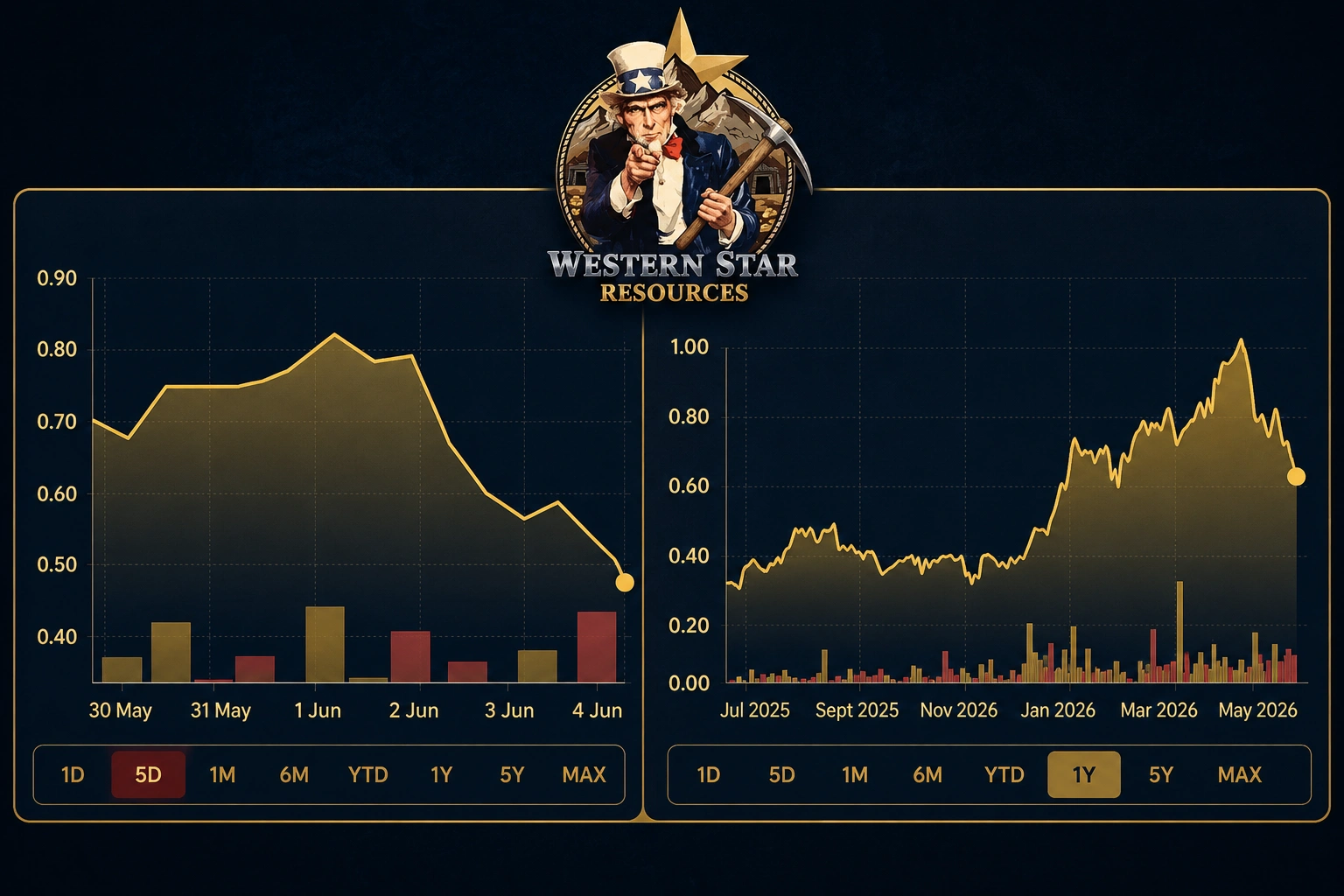
Figure: Western Star Resources share performance comparison in a short time frame (last 5 days) and in a long time frame (last 1 year).
The table below summarises the stock price performance of the company as of June 3rd, 2026.
| Metric | Value/Change (as of June 3, 2026) |
|---|---|
| Last Price | CAD 0.47 |
| Daily Change | -CAD 0.06 (-11.32%) |
| Market Capitalisation | CAD 21.31 million |
| 52-Week High | CAD 0.83 |
| 52-Week Low | CAD 0.16 |
| 1-Month Performance | -32.86% |
| Year-to-Date (YTD) Performance | +176.47% |
| 1-Year Performance | +135.00% |
Conclusion
The company has shown a negative stock performance over shorter time frames, such as -11.32% in a day, -20.34% over the last five days, and -32.86% in a month. Even so, its long-term performance appears to be strong. The update released by the company yesterday gives it the potential to once again emerge as an outlier in the mining sector. We have seen the mining sector perform exceptionally well across stock and securities exchanges in different countries throughout 2025 and 2026 so far.
Disclaimer
This article is intended for informational and educational purposes only and should not be considered financial, investment, legal, or professional advice. The content is based on publicly available information, company announcements, market data, and other sources believed to be reliable at the time of publication. Any opinions, interpretations, or analyses expressed in this article are those of the author and do not constitute recommendations to buy, sell, or hold any securities.
Investing in exploration-stage mining companies involves significant risks, including market volatility, commodity price fluctuations, regulatory approvals, financing requirements, and operational uncertainties. Past performance is not indicative of future results.
Readers should conduct their own independent research and consult a qualified financial advisor before making any investment decisions. Neither the author nor the publisher accepts any responsibility for any loss or damage arising from the use of the information contained in this article.
Sources
- https://thecse.com/listings/western-star-resources-inc/#disclosure
- https://webfiles.thecse.com/20260603_WSR_NR_KCHarvey_Permitting.pdf?jvguCk7Ha9yA.TQpVuDcnojUD8llrZaZ
- https://memx.com/insights/retail-trading-insights
- https://westernstarresources.com/investors/

Luke Carlino is a seasoned Copywriter, Content Strategist, and Social Media Manager specialising in Mining, Finance, and Business journalism. With more than a decade of industry experience, he brings rigorous editorial standards and commercial acuity to every project.