
Oil jumped more than 4% in early June, staying high ever since. And, that truce between Washington and Tehran? It exists. Well, just about.
Fighting flared again near Qeshm, missiles hit targets in Kuwait and Bahrain, while negotiations went silent – all feeding price spikes. The highest levels since late May reappeared fast.
Tuesday saw Brent near $96; West Texas Intermediate landed at $93.76. Both are climbing further in early trade on Wednesday, June 3.
For Australian motorists, that’s not just a headline. It’s money. And the timing could not be much worse.
What Happened to Oil Prices This Week
The US-Iran ceasefire struck on April 8 was supposed to be the beginning of something. Now, everyone’s just counting up the violations. On Monday, 1st of June, Iran’s official outlets reported a break in contact with the USA.
The reason? Tehran points fingers at Israel’s growing moves in Lebanon, saying those actions break the ceasefire deal.
Iran’s top negotiator has threatened escalation if the Lebanon strikes continue. Israel, for its part, says it’s not bound by any Iran-specific agreement when it comes to Hezbollah.
US President Donald Trump contradicted Tehran within hours. He told NBC News: “If they don’t want to talk, that’s okay with me,” then posted on social media minutes later that talks were “continuing, at a rapid pace.” Neither claim has been independently verified. Markets don’t like that kind of contradiction. Oil surged.
The Military Exchanges That Spooked Markets
Beyond the diplomatic noise, there was actual fighting. US Central Command confirmed it struck an Iranian military ground control station on Qeshm Island after Iran fired missiles at Kuwait and Bahrain.
The US military also disabled an oil tanker heading for an Iranian port using a Hellfire missile. Iran’s missiles at Kuwait fell short or broke apart en route. Three ballistic missiles fired at Bahrain were intercepted by US and Bahrain air defence forces.
None of that suggests either side is stepping back. That’s why Brent crude is sitting where it is today.
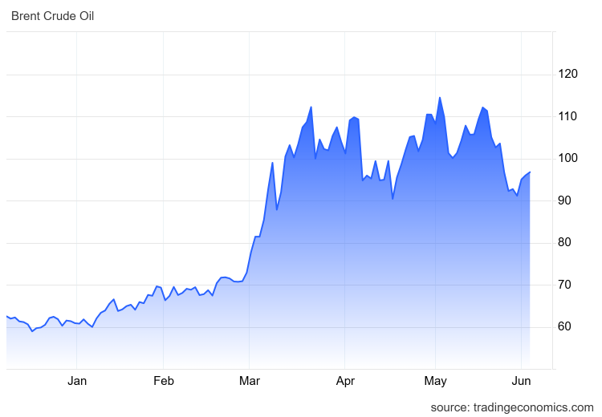
Brent crude prices have risen sharply amid renewed Middle East tensions.
How This Hits Australian Petrol Prices
There’s a fairly reliable rule of thumb. Here’s what that means at the pump: when oil goes up by US$10 a barrel, Aussie drivers usually see petrol jump by 7 to 10 cents per litre within a week or two.
That short delay happens because Australian petrol tracks Singapore’s Mogas 95 benchmark, and wholesale prices, called Terminal Gate Prices, get updated every day, but they’re always about a week or two behind global moves.
What happens in the Persian Gulf this week shows up at your local servo by mid-June.
The Numbers Right Now
Average regular unleaded petrol in Sydney is currently sitting at 177.4 cents per litre, according to the NRMA’s weekly fuel report. 57.3 cents less than the March 30 peak of 257.8 cents per litre is where we stand now.
This drop came because oil prices softened slightly during May. Alongside that shift, the federal fuel excise reduction introduced on April 1 played its part.
Fuel costs are shifting now. With oil priced from ninety to one hundred dollars, changes wait just around the corner. The full levy returns come summer’s start.
Tension near Hormuz isn’t easing either. Filling early makes sense – before the clock ticks past month’s end. Expect sharper numbers once July arrives.
The Excise Cliff on July 1
Here’s the part most Australians haven’t fully registered yet. The halved fuel excise expires at 11:59 pm on June 30, 2026.
From July 1, the excise reverts to the full indexed rate of approximately 52.6 cents per litre — up from the current 26.3 cents per litre. Because GST is applied on top of the excise-inclusive retail price, the actual bowser impact is closer to 28.9 cents per litre overnight.
Treasurer Jim Chalmers has already ruled out an extension, describing the measure as “always temporary.” No parliamentary vote is needed for it to expire — it just ends.
So Australian drivers face a double hit coming their way:
- Rising wholesale prices from a fresh oil market move, arriving at pumps in roughly two weeks
- A 28.9 cents per litre excise snap-back on July 1
If oil manages to stay above $95 Brent, and with the Strait of Hormuz still basically closed, that’s where things stand, July 2026 could go down as one of the most expensive months for fuel since the whole crisis began.
Why Is Petrol So Expensive in Australia? The Real Explanation
This question gets asked every time prices spike. The answer isn’t simple, but it’s important because it explains why Australia gets hit harder than many other countries when global oil markets move.
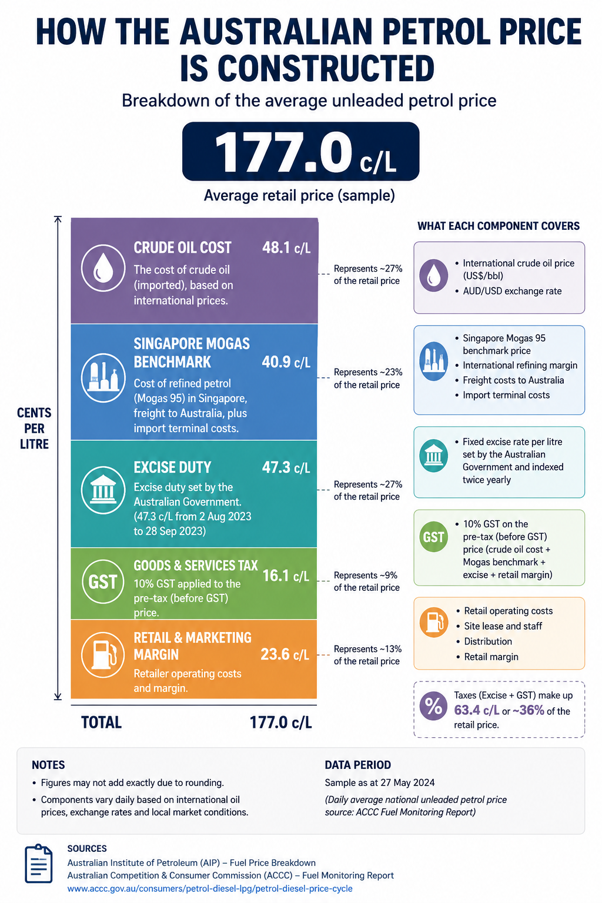
International oil prices typically take one to two weeks to flow through to Australian fuel stations.
Australia Prices Its Fuel in Singapore, Not Sydney
Most people assume Australian petrol is priced based on Australian conditions. It’s not. The price you pay at the bowser is set in Singapore, adjusted for the Australian dollar, taxed twice by the federal government and then passed through a wholesale and retail chain before it reaches the pump.
The key benchmark is Singapore Mogas 95. When that price rises — because of conflict in the Middle East, OPEC decisions, or a surge in Asian demand — Australian wholesale prices follow within days.
When the US-Iran conflict erupted on February 28, Singapore Mogas 95 rose from approximately 68 cents per litre to 106 cents per litre in just three weeks. That one move caused the March price crisis at Australian pumps.
Roughly 95% of the wholesale Terminal Gate Price is derived from the Singapore price. Excise, GST, shipping, freight, port charges, and retail margins sit on top.
The Exchange Rate Makes It Worse
Crude oil and refined fuel are both bought internationally in US dollars. Australia sells that fuel domestically in Australian dollars. That currency mismatch means every move in the AUD/USD exchange rate affects what you pay, even if global oil prices don’t budge.
A 5-cent fall in the Australian dollar can add 3 to 5 cents per litre to pump prices. Throughout much of 2026, the dollar has been under pressure, which has amplified every global oil price shock.
You Pay Tax on Tax
The federal fuel excise under normal conditions is approximately 53 cents per litre. That alone would make Australian fuel expensive by global standards. But the GST applies to the total retail price, including the excise component. You pay 10% on top of a price that already includes 53 cents in excise. That’s tax on tax. And it’s a permanent structural feature of Australian fuel pricing, not a quirk.
Australia Barely Refines Its Own Fuel
This is the vulnerability most motorists don’t think about. Australia depends on imports for about 80 to 90% of its refined fuel, mainly from refineries in Singapore and South Korea.
Only two local refineries are still up and running: Viva Energy in Geelong and Ampol’s Lytton plant in Brisbane, each only meeting about 10% of Australia’s demand. That leaves Australia almost entirely exposed when global supply chains are disrupted.
When the Strait of Hormuz effectively closes — as it has since late February — global refined product markets tighten. Australia, as a net importer with no buffer production, takes that squeeze directly.
How Does Australia Compare Globally?
Halfway through March 2026, most of Australia paid around $2.8 for each litre of fuel. That placed it in the middle of the global pack. The United States was at the equivalent of $1.91 per litre. The United Kingdom was at $2.87. Germany at $2.86. Singapore at $2.91. Hong Kong topped the chart at $3.99 per litre.
Australia isn’t the world’s most expensive — but it’s far from cheap. And unlike European countries with high fuel taxes as a policy choice, Australia’s structural reliance on imports makes its price spikes sharper and faster when geopolitical events hit.
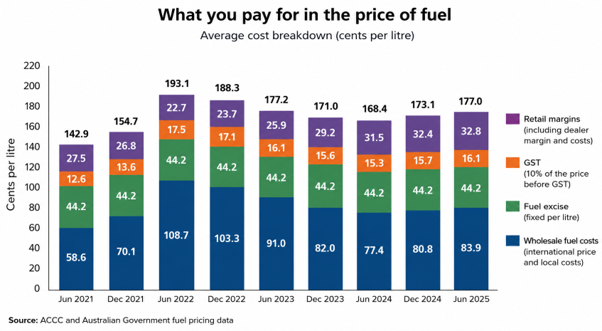
Taxes and wholesale costs make up the largest share of petrol prices paid by motorists.
What Happens Next — The July Crunch
The picture going into July is not comfortable. Oil is rising on fresh conflict signals. Even with the truce holding, traffic through the Strait of Hormuz remains shut. A proposed deal sits on Tehran’s desk – no word back yet.
Trump is publicly optimistic and privately editing ceasefire drafts. Neither blockade — Iran’s control of Hormuz, or the US counter-blockade of Iranian shipping — has been removed.
Senior market analyst Bob Parker from the International Capital Markets Association told CNBC that oil prices will likely remain between $90 and $100 a barrel “at least for the next couple of months” until there is greater clarity on any lasting peace agreement.
Right now things stand like this. Oil prices swing from ninety to a hundred bucks thanks to ongoing tensions near Hormuz. On July first, fuel taxes return in full force.
No relief expected at the chokepoint any time soon. Fueling by month’s end makes sense if possible. The pump price after? A whole new story.
Also Read: China Halts Talks on Fortescue Iron Ore Product Amid Contract Standoff
Frequently Asked Questions
Q: How much more will Australians pay for petrol after this latest oil spike?
A: Add 5 to 8 cents per litre at the bowser in the next two weeks. Every US$10 rise in crude typically adds 7 to 10 cents per litre to Australian pump prices. That’s before the July 1 excise snap-back hits.
Q: Why is petrol so expensive in Australia?
Three reasons stack up fast. Because Australia imports most of its fuel and prices are tied to Singapore’s Mogas 95 benchmark in US dollars, a weaker Aussie dollar makes every fill-up more expensive before you even get to taxes. Then you pay excise of approximately 53 cents per litre, plus 10% GST on top of that combined price. Tax on tax, every time you fill up.
Q: Does the US-Iran conflict directly affect petrol prices in Australia?
A: Yes, and quickly. Around 20% of the world’s traded oil moves through the Strait of Hormuz. When that route is disrupted, Singapore refined fuel prices climb. Australian Terminal Gate Prices follow within one to two weeks. What’s happening in the Persian Gulf today reaches your servo by mid-June.
Q: When does the fuel excise discount end?
A: Right at midnight, June 30, 2026. The excise climbs again: roughly 52.6 cents each litre. On top of that, GST adds weight, pushing prices at the pump close to 29 cents higher without delay. No warning. Just a sudden lift in cost before most even blink.
Q: Will the government extend the fuel excise cut past June 30?
A: Treasurer Jim Chalmers has said no. The measure was always temporary. If oil prices are still elevated come July and the Hormuz situation hasn’t resolved, that position will face serious political pressure — but nothing is legislated or committed to right now.
Q: Where’s petrol cheapest in Australia right now?
A: Right now, Adelaide fills up cheaper than anywhere else – just near 193 cents a litre for basic fuel. Over in Darwin, it’s different; prices climb close to 215.
Disclaimer:
This article is for general news and informational purposes only. It does not constitute financial, investment or consumer advice. Petrol prices are subject to rapid change based on global market conditions, government policy and exchange rate movements. Readers should verify current prices through official sources, including the ACCC, the Australian Institute of Petroleum and their state fuel monitoring authority, before making decisions.
Source:
https://www.aip.com.au/pricing/international-prices/international-market-watch
https://www.accc.gov.au/consumers/petrol-and-fuel/what-affects-fuel-prices
https://www.mynrma.com.au/cars-and-driving/fuel-finder/weekly-report

Luke Carlino is a seasoned Copywriter, Content Strategist, and Social Media Manager specialising in Mining, Finance, and Business journalism. With more than a decade of industry experience, he brings rigorous editorial standards and commercial acuity to every project.