BHP Group (ASX: BHP) shares climbed on Wednesday after the mining giant dropped a stronger-than-expected operational update for the nine months to 31 March 2026. The BHP share price surge reflects growing investor confidence in the company’s copper and iron ore output, its tightening cost controls, and a clear runway of growth projects that could reshape its earnings profile for years to come.
Here’s a full breakdown of what happened, what it means, and why markets responded the way they did.
BHP Share Price Surges: The Numbers Behind the Move
The BHP share price surge to $56.225 [as at 3:35 pm 22/04 (AEST)] puts the stock up more than 23% since the start of 2026 and a remarkable 54% over the past 12 months. That compares to a sector gain of just 2.84% over the same period, meaning BHP has left most of its peers in the dust.
Over the last month alone, the stock has climbed 18.44%, which suggests investors began pricing in a strong quarterly result well before today’s announcement.
Key share price performance at a glance:
- 1 Week: +0.22%
- 1 Month: +18.44%
- 2026 YTD: +23.60%
- 1 Year: +54.00%
- vs Sector (1yr): +2.84%
- vs ASX 200 (1yr): +40.79%
- Market Cap: ~$285.7 billion
With a market capitalisation of nearly $286 billion, BHP remains one of the most valuable companies on the ASX.
Record Production at Escondida and WAIO Sets the Tone
The standout headlines from the quarterly report came from two of BHP’s flagship assets.
Escondida, BHP’s massive copper operation in Chile, delivered record material mined and record concentrator throughput for the nine-month period. Despite processing lower copper grades, 0.91% compared to 1.05% in the prior year, the operational team offset the impact through improved recoveries, new reagent technology, and stronger leach production.
In iron ore, the Western Australian Iron Ore (WAIO) business also hit record production for the nine-month period, with output rising 1% year-on-year to 191 Mt (on a BHP share basis). Strong performance from the Central Pilbara hub, particularly South Flank, which exceeded its annualised nameplate capacity, drove that result.
BHP CEO Mike Henry called out these achievements directly, noting that both records reflect the “consistency of our operations and the strength of our high-margin diversified portfolio.”
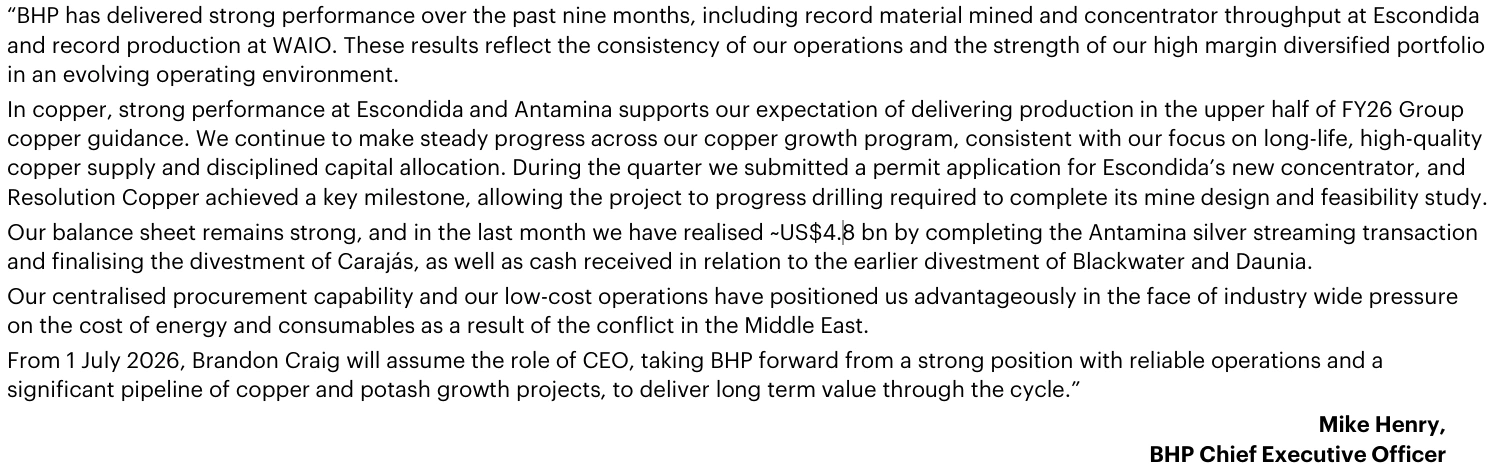
Figure 1: Comment from the CEO, BHP [BHP]
Copper Guidance Lifted: Now Tracking the Upper Half
Escondida Leads the Charge
BHP now expects its full-year Group copper production to land in the upper half of its FY26 guidance range of 1,900 to 2,000 kt. That’s an upgrade from the previous “in range” guidance and signals genuine operational momentum.
Escondida is also expected to finish in the upper half of its 1,200 to 1,275 kt guidance range. On top of that, BHP lowered its unit cost guidance for Escondida to between US$1.00 and US$1.20/lb, down from US$1.20 to US$1.50/lb, citing higher by-product credits and strong operational performance. That’s a meaningful reduction.
Antamina Upgraded, Spence Faces Headwinds
At Antamina (BHP’s 33.75% joint venture in Peru), copper production jumped 19% year-on-year to 116 kt off the back of higher feed grades. BHP has upgraded Antamina’s full-year copper guidance to 150–160 kt, up from 140–150 kt previously.
The less positive story comes from Spence (Pampa Norte) in Chile, where ore complexity and grade variability have hurt both concentrator and cathode output. Production guidance there dropped to 210–220 kt from 230–250 kt. BHP plans to invest in upgraded flotation cells to address the challenges, with a potential final investment decision in H1 FY27.
Also Read: BHP vs Rio Tinto: Port Hedland Expansion Efficiency
Iron Ore Holds Steady Amid Cyclone Disruptions
WAIO Weathers the Storm
The March quarter saw WAIO production dip 10% compared to Q2 FY26, largely due to Tropical Cyclone Mitchell and Tropical Cyclone Narelle forcing a temporary port closure. Despite this, full-year guidance at 251–262 Mt (284–296 Mt on a 100% basis) remains unchanged.
BHP also confirmed it has concluded iron ore sales contract negotiations with the China Mineral Resources Group (CMRG), providing greater sales visibility for the year ahead.
Samarco Tracking Top End of Guidance
Samarco, BHP’s 50%-owned Brazilian iron ore operation, produced 5.9 Mt for the year to March, up 37% on the prior year. BHP now expects Samarco to hit the top end of its 7 to 7.5 Mt full-year guidance range, driven by stronger concentrator performance and improved feed grades.
Capital Discipline: BHP Pockets ~US$4.8 Billion in Recent Transactions
BHP has been busy on the capital management front, and the results speak for themselves.
In April, the company completed a silver streaming transaction with Wheaton Precious Metals, receiving US$4.3 billion in upfront consideration. You can read more about the background to that deal in our earlier coverage of the BHP silver streaming agreement with Wheaton Precious Metals.
BHP also finalised the divestment of the Carajás copper assets in Brazil to a subsidiary of CoreX Holding, receiving US$240 million on completion with potential for an additional US$225 million in contingent payments.
Combined with cash received from the earlier divestment of Blackwater and Daunia coal assets, BHP has now realised approximately US$4.8 billion in proceeds over recent weeks. That strengthens its already solid balance sheet and gives management greater flexibility for future investment.
The company’s strong cash generation also underpins its capacity to reward shareholders. For more context on how BHP uses that cash flow to support investors, see our piece on BHP dividend income and passive income shares.
Copper Growth Projects Are Moving Forward
Escondida New Concentrator Permit Lodged
BHP submitted the Environmental Impact Declaration (DIA) permit for the Escondida New Concentrator in March 2026. This is the centrepiece of Escondida’s growth programme and would require a capital investment of between US$4.4 billion and US$5.9 billion to deliver an additional 220–260 ktpa of copper capacity.
Subject to environmental approval, the project could reach a final investment decision in CY27–28, with first production potentially between CY31–32.
Resolution Copper Clears a Key Hurdle
Resolution Copper, a joint venture between Rio Tinto (55%, operator) and BHP (45%), completed a land exchange in Arizona, United States, during the quarter. That milestone now allows the project to advance resource data collection and begin early underground development at one of the largest untapped high-grade copper deposits in the world.
Also Read: BHP CEO Change: Brandon Craig to Succeed Mike Henry in 2026
New CEO Takes the Reins from 1 July
In March, BHP’s Board confirmed that Brandon Craig will become Chief Executive Officer and a Director of BHP Group Limited from 1 July 2026, succeeding Mike Henry after six and a half years in the role.
Craig brings more than 25 years of operational and corporate leadership at BHP, most recently as President Americas, the period during which BHP became the world’s largest copper producer. His appointment signals continuity rather than disruption, with a clear focus on copper and potash growth.
For a deeper dive into this leadership transition, see our article on the BHP CEO change from Mike Henry to Brandon Craig.
Jansen Potash Progresses, Stage 2 Under Review
BHP’s Jansen Stage 1 potash project in Canada is now 78% complete, with first production targeted for mid-CY27. The project carries a total capital budget of US$8.4 billion and targets 4.15 Mtpa of potash output.
Jansen Stage 2, an incremental 4.36 Mtpa expansion, is currently under review, with an update expected in Q4 FY26.
Coal Operations Mixed: Weather Takes a Toll
BHP Mitsubishi Alliance (BMA) steelmaking coal production came in at 13.0 Mt year-to-date, up 1% on the prior year. However, Q3 was affected by record rainfall from Tropical Cyclone Koji, which disrupted mining operations. Full-year guidance remains at 18–20 Mt but is now expected to land in the lower half of that range. Unit costs are now tracking toward the top end of the US$116–$128/t range.
NSW Energy Coal (NSWEC) performed well, delivering 12.2 Mt year-to-date, up 11%, on the back of favourable mine sequencing and higher bypass coal. Full-year output is now expected in the upper half of the 14–16 Mt guidance range.
What This Means for Investors
The BHP share price surge today reflects the market’s confidence in a company that continues to execute on its operational targets, return capital to shareholders, and build a credible pipeline of long-life copper and potash projects for the decade ahead.
With record production at its two largest assets, upgraded copper guidance, a stronger balance sheet, and a clear succession plan at the CEO level, BHP looks well-positioned heading into the final quarter of FY26.
The global mining outlook remains constructive for copper in particular, given rising demand from electric vehicles, grid infrastructure, and data centres, all areas where BHP has deliberately positioned itself for long-term growth.
Frequently Asked Questions
What is BHP in mining?
BHP is one of the world’s largest diversified resources companies. It mines and processes copper, iron ore, steelmaking coal, and potash, with major operations across Australia, Chile, Peru, the United States, Canada, and Brazil. The company is dual-listed on the ASX (Australia) and the LSE (United Kingdom).
Is BHP the biggest mining company in the world?
BHP is consistently ranked among the top two or three largest mining companies in the world by market capitalisation, alongside Rio Tinto and Vale. As of April 2026, BHP holds a market capitalisation of approximately $285.7 billion, making it one of the most valuable mining businesses globally. It is also the world’s largest copper producer.
Does BHP have mines in Canada and the USA?
Yes. BHP operates the Jansen potash project in Saskatchewan, Canada, with first production targeted for mid-2027. In the United States, BHP holds a 45% interest in Resolution Copper in Arizona, a joint venture with Rio Tinto, which recently cleared a key land exchange milestone that allows it to advance toward feasibility and mine development.
Is BHP a good company to invest in?
BHP offers exposure to long-cycle commodities with strong structural demand drivers, particularly copper and potash. It has a track record of returning capital to shareholders through dividends and buybacks, and it maintains a strong balance sheet. That said, all investments carry risk, commodity prices, exchange rates, geopolitical conditions, and project execution can all affect BHP’s financial performance. Investors should conduct their own research or seek professional financial advice before making any investment decisions.
Disclaimer
This article is for informational purposes only and does not constitute financial advice. The information contained herein reflects publicly available data and reporting as at 22 April 2026. Past share price performance is not a reliable indicator of future results. The author and publisher of this article may hold positions in securities mentioned. Always consider your own financial situation, objectives, and risk tolerance before making investment decisions. For personalised financial advice, consult a licensed financial adviser.