

QBE Insurance Group Limited (ASX: QBE) released the quarterly AT1 capital update on 19 May, where it announced an issue of A$500 million on 19th May in perpetual floating rate capital notes. Under rules for Additional Tier 1 Capital set by the Australian Prudential Regulation Authority, the notes are qualified securities.
Figure 1: QBE Insurance Group headquarters signage [Courtesy: Key Media]
On the same date, the Company filed with the ASX a cleansing notice under section 708A (12H) (e) of the Corporations Act 2001 (Cth). The signing was by Company Secretary Carolyn Scobie, and was authorised by the QBE Disclosure Committee.
A$500 Million Raised Under the Note Issuance Programme
QBE Insurance Group, through the AT1 capital instruments QBE has issued under its current US$5,500,000,000 Note Issuance Programme. A$500 million principal amount in the aggregate, and every note is for A$1,000.
The notes are perpetual. They are subordinated in the capital structure to senior creditors but ahead of ordinary shareholders if a winding-up takes place. That positioning is deliberate and is a direct requirement of APRA’s Additional Tier 1 classification.
What the Commercial Terms Actually Say
The key terms are set out in the Pricing Supplement dated 15 May 2026:
- Interest is calculated on that amount at the relevant BBSW rate plus a margin of 2.50 per cent by a franking adjustment factor
- Payments twice a year on 19 May and 19 November, starting with 19 November 2026
- The notes are sold at par, 100 per cent of face value
- Mandatory conversion date is 19 May 2036
- Optional conversion dates include 19 May 2033, 19 November 2033 and 19 May 2034
- S&P and Fitch both expect to rate the notes BBB at issuance
How the Conversion Mechanism Works
This is where the QBE capital structure update gets more interesting than a standard bond. The notes are not redeemable at a noteholder’s request. QBE retains control over redemption and conversion, subject to APRA’s approval.
If APRA determines that QBE has become non-viable, or is at risk of doing so, the AT1 capital instruments QBE has issued convert automatically into ordinary QBE shares. The conversion price is based on the volume-weighted average price of QBE shares at the time, limited by a maximum conversion number.
The Non-Viability Trigger in Plain Terms
Based on the Issue Date volume weighted average price of A$22.70, the maximum conversion number is 220.2643 ordinary shares per note. That cap exists to protect existing shareholders from excessive dilution.
If conversion cannot be completed within five scheduled trading days after a non-viability determination, the notes are written off entirely. Noteholders lose their principal. There is no compensation. This is not a quirk of the structure. It is APRA’s design, and it sits at the heart of what makes Additional Tier 1 instruments what they are.
Who Managed the Issuance
This was noted by the Australian capital markets community on QBE AT1 capital update, with six financial institutions acting as joint managers. Barrenjoey Markets Pty Limited, Australia and New Zealand Banking Group, Barclays Bank PLC, Commonwealth Bank of Australia, National Australia Bank Limited and Westpac Banking Corporation.
The Subscription Agreement was signed on 15 May 2026. The notes were priced and issued four days later. Settlement went through Austraclear, with Euroclear and Clearstream also eligible for clearing purposes. The ISIN assigned is AU3FN0110086.
Who Can Actually Hold These Notes
This QBE capital structure update is not open to retail investors. The notes are restricted to professional and sophisticated investors under the Corporations Act 2001 (Cth). The minimum aggregate consideration per offeree is A$500,000.
The same restriction applies to transfers. If an investor later wants to sell, the buyer must also meet the wholesale threshold. QBE’s ordinary shares issued on conversion would be freely tradeable on the ASX once the required steps under the Corporations Act are completed. Until then, a restriction on trading applies.
The notes are also not available to retail investors in the European Economic Area or the United Kingdom, as noted in the product governance disclosures within the Pricing Supplement.
Interest Payments Are Not Guaranteed
One detail worth not glossing over. Interest on the AT1 capital instruments QBE has issued is non-cumulative. QBE can choose not to pay interest on any given date without it constituting an event of default.
These conditions contain no events of default at all, which is standard for APRA-eligible Additional Tier 1 instruments but not how most fixed income investors are used to thinking.
If an interest payment is missed, a dividend restriction takes effect. QBE cannot declare or pay ordinary share dividends or conduct buybacks until the next interest date, unless the missed amount is paid within ten business days. That mechanism provides some protection to noteholders, even without a formal default trigger.
Impact on QBE’s Balance Sheet
QBE noted in the cleansing notice that the issuance will increase total liabilities and total assets of the Company by A$500 million. It will also increase Additional Tier 1 Capital by the same amount.
The Company confirmed the issuance has no material impact on its overall financial position, given the size of its existing balance sheet. Board approval for the issuance was obtained in October 2025.
QBE Share Price
QBE Insurance Group Limited (ASX: QBE) is holding near its 52-week high right now. Here is where the stock sits:
- Last traded price: A$24.310 per share
- Market capitalisation: A$34.75 billion
- 52-week range: A$18.570 to A$24.310 per share
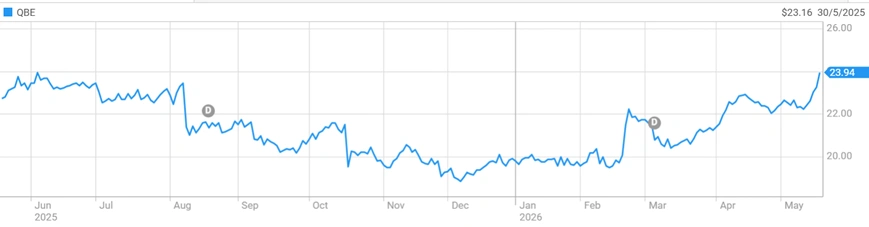
Figure 2: QBE Insurance Group (ASX: QBE) share price performance near its 52-week high [Courtesy: ASX]
Industry Outlook
Australia’s insurance sector is not standing still. The Australian trade credit insurance market recorded a gross written revenue of US$388.3 million in 2025. That number is expected to increase with a compound annual growth rate of 10.9 per cent over the next decade reaching US$893.3 million by 2033.
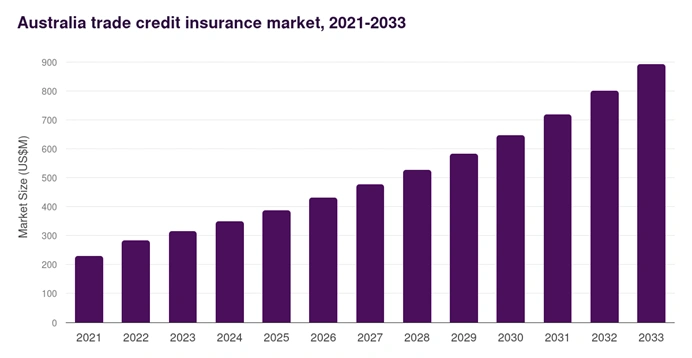
Figure 3: Australian trade credit insurance market growth outlook through 2033 [Courtesy: Grand View Research]
By revenue, large enterprises are currently the largest segment. SMEs are the fastest-growing segments. QBE Insurance Group is one of only five global market participants alongside Allianz, Coface, Zurich Insurance Group and Chubb. Of the worldwide trade credit insurance income, Australia contributed 3.0 per cent during 2025, and this number is anticipated to increase as domestic needs increase.
The broader insurance sector continues to attract institutional capital. Raising A$500 million at this point in the cycle reflects QBE’s confidence in its capital position and its ability to access wholesale funding markets on reasonable terms.
Future Direction and Impact on QBE Investors
The QBE AT1 capital update Australia investors are digesting carries a few clear implications:
- The A$500 million raise adds to QBE’s Additional Tier 1 Capital, directly improving its regulatory capital ratios under APRA’s prudential standards
- Optional redemption dates begin in May 2033, giving QBE a seven-year window before the first call date
- The mandatory conversion date in 2036 creates a defined horizon for the instrument’s life unless called earlier
- Interest payments are discretionary and non-cumulative, meaning QBE can preserve cash in stressed periods without triggering a default
- Holders of the AT1 capital instruments QBE have issued face write-off risk in extreme scenarios, which is the core trade-off for the BBB credit rating and BBSW plus margin return
- The QBE capital structure update does not affect the rights of ordinary shareholders unless a conversion or write-off event occurs
ALSO READ: West Dome Underground Delivers Strong Hit At Telfer
Frequently Asked Questions
Q1. What is the QBE AT1 capital update Australia announced on 19 May 2026?
Ans. QBE Insurance Group issued A$500 million in perpetual floating rate capital notes, classified as Additional Tier 1 Capital under APRA’s regulatory framework.
Q2. What interest rate applies to the AT1 capital instruments QBE has issued?
Ans. The notes pay the BBSW Rate plus a margin of 2.50 per cent per annum, adjusted by a franking factor, with payments on 19 May and 19 November each year from 19 November 2026.
Q3. Who can invest in the capital notes from this QBE capital structure update?
Ans. Only professional and sophisticated wholesale investors. The minimum investment threshold is A$500,000. Retail investors in Australia, the United Kingdom, and the European Economic Area are excluded.
Q4. What happens if QBE becomes non-viable under APRA’s assessment?
Ans. The notes convert automatically into QBE ordinary shares. If conversion cannot occur within five trading days, the notes are written off and noteholders lose their principal entirely.
Disclaimer
Please note that this article is for informational purposes only and does not include any financial or investment advice. The content is based on the ASX announcement released by QBE Insurance Group Limited on 19 May 2026. Market capitalisation and share price data are based on values available on ASX at the time of publication. Investors should carry out their own research. Colitco has no position in the companies or organisations mentioned.
Sources
https://www.asx.com.au/markets/company/QBE
https://www.grandviewresearch.com/horizon/outlook/trade-credit-insurance-market/australia