For a decade, the pitch for dividend investing barely changed. Park the money in the big banks. Collect the franked cheque twice a year. Ignore the noise.
That pitch has aged badly.
The RBA kept the cash rate steady at 4.35% in June, having raised the rate three times in 2026. As inflation is still hovering around 4%, the Board does not seem eager to make any reductions. You can read the current setting straight from the RBA cash rate page.
High rates do something quiet but brutal to income shares. They hand savers a rival that carries no price risk.
A twelve-month term deposit is paying up to about 5.4% a year right now. Guaranteed. Government backed to $250,000. No board meeting can slash it overnight.
Now look at the share almost every Australian income investor has owned at some point.
The Commonwealth Bank problem nobody wants to say out loud
Commonwealth Bank paid $4.85 a share in fully franked dividends for the 2025 financial year. Analysts tip a little more for 2026.
The dollar figure keeps climbing. The yield does not.
CBA shares ran up near $174. As long as the rise in the price exceeds the rise in the payout, the yield decreases. The forward yield is currently sitting right at around 2.84%.
Read that again. The country’s favourite dividend stock pays less cash than a savings account.
Add franking and the grossed-up figure lifts to roughly 4.1% for a full-rate shareholder. Still short of a term deposit, and you take on all the share price risk to get there.
That is the cost of buying a good company at the wrong price.
Why franking still tips the maths in Australia
Franking is the reason a 5% Australian dividend is not the same as a 5% dividend anywhere else.
The company has already paid tax on the profit. The shareholder gets a credit for it. So a fully franked 5% cash yield grosses up to around 7.1% before your own tax rate applies.
That credit is why the broad market still stacks up. The gross yield on the S&P/ASX 200 is expected to be between 5.5% and 6% in 2026.
What matters is the gross yield, not the cash one. Miss that and you will misprice every income stock on the board.
The yield trap that catches thousands every reporting season
Here is the counterintuitive bit. A very high yield is usually a warning, not a gift.
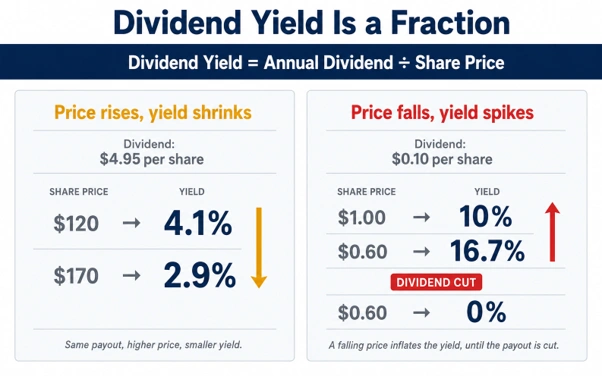 Why a bigger yield number can mean bigger risk.
Yield is just dividend divided by price. When a share price falls 40% and the dividend has not moved yet, the yield looks spectacular. Right up until the board cuts it to match reality.
Two live examples. WAM Capital has screened near a 10% yield. Dusk has flashed above 12%. Those numbers are not free money. They price in the risk that the payout does not hold.
Chase the biggest number on the screen and you often buy the dividend that is about to be cut.
| Income option | Cash yield | Grossed-up with franking | Price risk | Guaranteed |
| 12-month term deposit | up to ~5.4% | not applicable | none | Yes, to $250,000 |
| Commonwealth Bank (CBA) | ~2.9% | ~4.1% | yes | no |
| S&P/ASX 200 (broad market) | ~4% | ~5.5% to 6% | yes | no |
| Telstra (TLS) | ~3.8% | ~5.3% | yes | no |
How ASX dividend income compares with a term deposit in 2026. Cash figures are approximate and grossed-up yields assume full or near-full franking. [RBA, Canstar and Morningstar data.]
What actually works for stable cash flow in 2026
The test for any ASX dividend stock this year is blunt. Does the franked yield, plus realistic dividend growth, beat a term deposit after tax? If it does not, the share is not paying you enough for the risk.
A few patterns clear that bar.
Growth of the dividend beats size of the dividend.
Telstra yields under 4% now, mostly franked, after its share price ran up past $5. But it has lifted the payout every year since 2022 and has not cut since 2019. A rising 4% with franking on top can beat a frozen higher number once tax is counted.
Boring is a feature.
Supermarket, utility and infrastructure names throw off steady cash because people keep shopping, keep the lights on, and keep driving toll roads whatever the market does. Several of these sit among the quality names worth holding for a decade.
Miners are the wildcard.
BHP, Rio and Fortescue can distribute monstrous franked dividends during good times for the iron ore, and sharply reduce them otherwise. Take their dividends as a bonus, not a wage.
Watch valuation, not just yield.
A run of ASX 200 blue chips has drifted toward multi-year lows this year while the underlying businesses held up. Colitco has flagged a few of these blue-chip shares trading near multi-year lows, and that is often where the honest income hides.
For anyone who would rather not pick single names, dividend ETFs such as VHY, IHD and SYI hold a basket of payers in one trade and spread the risk. It is the low-effort route to dividend shares built for passive income.
The through line for 2026 is discipline. High cash rates raise the bar. A dividend now has to earn its place against a risk-free 5%, and only the payers with growth and a fair price clear it. That short list is exactly where the ASX income stocks worth watching this year tend to come from.
Also Read: Wesfarmers Mt Holland Lithium Expansion Gets Board Sign-Off
FAQs
Q: Are ASX dividend stocks still worth it with term deposits paying 5%?
A: Yes, if the franked, grossed-up yield plus growth beats the deposit after tax. If not, take the deposit.
Q: Why is CBA’s dividend yield so low?
A: The share price rose faster than the payout, which shrinks the yield.
Q: What is a grossed-up dividend yield?
A: The cash dividend plus the franking credit attached to it.
Q: Is a 10% dividend yield safe? Rarely.
A: A very high yield usually signals a payout at risk of a cut.
Q: Which ASX income sectors are steadiest in 2026?
A: Supermarkets, utilities and infrastructure tend to pay the most reliable cash.
Disclaimer: This article is general information only and does not take into account your personal objectives, financial situation or needs. It is not financial product advice. Colitco is not a licensed financial adviser. Share prices, yields and interest rates move and should be checked against current sources before any decision. Consider seeking advice from a licensed professional before investing. Colitco accepts no responsibility for any loss arising from reliance on this content. There may be a conflict of interest through commercial arrangements with companies covered and/or stock held.
Source: https://www.rba.gov.au/cash-rate-target-overview.html

Luke Carlino is a seasoned Copywriter, Content Strategist, and Social Media Manager specialising in Mining, Finance, and Business journalism. With more than a decade of industry experience, he brings rigorous editorial standards and commercial acuity to every project.