
President Donald Trump announced an open-ended extension of the US–Iran ceasefire on Tuesday, hours before the truce was set to expire. Markets responded cautiously, with stock futures climbing and oil hovering just below $100 a barrel.
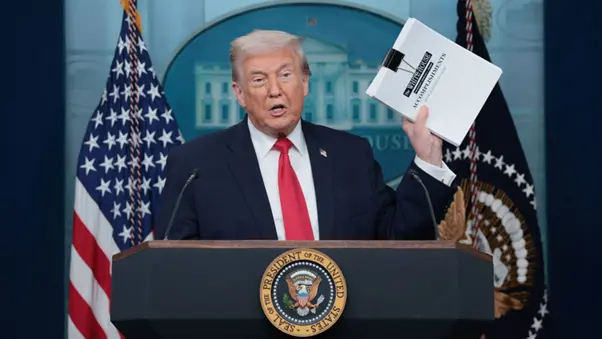
President Donald Trump announces an indefinite extension of the US–Iran ceasefire, easing immediate market fears. [CNBC]
Trump Extends US–Iran Ceasefire at Pakistan’s Request
President Donald Trump announced late Tuesday that the United States would extend its ceasefire with Iran indefinitely. The truce had been set to expire Wednesday evening, Eastern Time. Trump posted the announcement on Truth Social just minutes after US financial markets closed.
Trump said Pakistan had asked Washington to extend the ceasefire while Tehran works toward a “unified proposal.” He added that the extension would continue until “discussions are concluded, one way or the other.” He cited the Iranian government’s internal divisions as a key reason for granting more time.
Earlier in the day, Trump told CNBC he had no interest in extending the ceasefire. That statement had rattled markets and sent oil prices sharply higher. The late-evening reversal surprised investors and analysts who had braced for renewed conflict.
🇺🇸 TRUMP JUST SAID
Iran ceasefire is being extended at Pakistan’s request, but the military blockade stays in place.
“Iran must submit a unified proposal or strikes are back on the table.” https://t.co/96OiCqCcNn pic.twitter.com/xFl7nPaLRK
— Ash Crypto (@AshCrypto) April 21, 2026
Iran Rejects Ceasefire Extension, Raises Doubts on Deal
Tehran did not warmly receive Trump’s announcement. Tasnim News Agency, which is affiliated with Iran’s Revolutionary Guard, stated that Iran had not requested a ceasefire extension. The agency also repeated threats to break the US naval blockade by force.
An adviser to Iran’s lead nuclear negotiator said Trump’s statement carried little weight. The adviser suggested the move could be a tactical ploy rather than a genuine peace gesture.
Iran had already declined a second round of negotiations before the announcement.
The ceasefire, which began two weeks ago, has not led to a formal peace framework. No new talks are currently scheduled. The mixed signals from both sides have left the diplomatic path forward unclear.
JD Vance Cancels Pakistan Trip, Peace Talks Stall
Vice President JD Vance cancelled a planned trip to Pakistan, where he was expected to meet with Iranian officials. A US official told The New York Times that Iran had failed to respond to American negotiating positions. That triggered the cancellation.
Vance’s withdrawal from the Pakistan talks had a direct impact on markets earlier in the day. The S&P 500 erased a 400-point gain and closed 0.6% lower. The Dow Jones Industrial Average dropped 293 points after Vance’s plans became public.
Analysts noted that the breakdown in talks raised the risk of renewed conflict. Markets had been pricing in a gradual path toward a deal. The cancellation challenged that assumption sharply.
🚨⚡️ War drums are beating: the Middle East is on the edge of a volcano after the collapse of Pakistan negotiations!
Reuters:
U.S. Vice President JD Vance has officially cancelled his scheduled visit to Pakistan.
Tasnim:
Tehran has made a final decision not to attend the… pic.twitter.com/iB76eXaL4q
— RussiaNews 🇷🇺 (@mog_russEN) April 21, 2026
Global Stock Markets React to Iran War Ceasefire News
Stock futures in the United States climbed after Trump’s announcement. S&P 500 futures rose 0.6% to 7,135.75 points during Asian trading hours. Nasdaq 100 futures gained 0.7% to 26,802.75 points. Dow Jones futures climbed 0.5% to 49,575 points.
Japan’s Nikkei surged to a record high. South Korean and Taiwanese markets also reached record levels, driven partly by fresh enthusiasm for artificial intelligence stocks. MSCI’s
Asia-Pacific index outside Japan slipped 0.5% after touching a seven-week high the previous session.
European futures eased 0.2%, pointing to a subdued open in London and Frankfurt. The FTSE 100 was called 24 points lower ahead of Wednesday’s open after falling more than 1% in the prior session.
Brent Crude and WTI Oil Prices Swing Near $100 Threshold
Oil prices swung between gains and losses throughout the day. Brent crude settled Tuesday at $98.48 a barrel, up 3.1%. US West Texas Intermediate settled at $92.13. Both benchmarks dropped slightly in Asian hours after Trump’s announcement, with Brent slipping to $98.27 and WTI falling to $89.29.
The continued closure of the Strait of Hormuz kept oil prices elevated. The Strait normally channels roughly one-fifth of the world’s energy supply. The US Navy’s blockade of Iranian ports has kept the waterway shut since the war began in March.
Trump had earlier dismissed the high oil prices as “peanuts.” He told CNBC he was surprised prices were not significantly higher. Energy markets remained volatile as traders weighed ceasefire news against the ongoing blockade.
BREAKING: Brent crude oil just hit $100/bbl, up 6% in just 6 hours as JD Vance’s peace talks are officially halted.
Markets are pricing in a total energy shock. pic.twitter.com/iqVy6XfBU6
— Bull Theory (@BullTheoryio) April 21, 2026
Strait of Hormuz Closure Continues to Pressure Energy Supply
The Strait of Hormuz has remained closed since Iran effectively shut the waterway at the onset of the conflict. Around one-fifth of the world’s energy supply flows through the strait under normal conditions. Its closure has triggered a significant global energy shock.
Trump confirmed that the US Navy would continue its blockade of Iran’s ports and coastline. That decision means the strait will likely remain closed regardless of the ceasefire extension. Tanker traffic through the waterway has stood at a standstill.
Analysts noted that markets have largely priced in the Hormuz closure. StoneX’s Matt Simpson said risk appetite is likely to stay healthy and that equity investors would view dips favourably. However, he cautioned that a prolonged closure could reintroduce nervousness.
Markets Rebound From March Sell-Off as Risk Appetite Returns
Global markets have staged a sharp recovery from a steep sell-off in March, when the outbreak of the US–Iran war sent equities sharply lower. Markets across the globe have returned to pre-war levels this month. The prospect of a peace deal and the ceasefire have driven a broad risk-on rally.
The US dollar has weakened as the war risk premium fades. The currency had gained significantly during March as investors sought safe-haven assets. It has since surrendered most of those gains as sentiment stabilised.
Analyst Kathleen Brooks at XTB described the situation as “not your average ceasefire.” She noted that the market is betting the war will end and the Strait of Hormuz will reopen. She added that the longer the strait stays closed, the higher the chance of renewed market anxiety.
Unilateral Ceasefire Extension Raises Questions Over Iran Agreement
A key concern among analysts centres on whether the ceasefire extension is truly mutual. Trump’s announcement appeared unilateral. Neither Iran nor US ally Israel publicly confirmed that they had agreed to the new terms.
Kathleen Brooks at XTB noted that Trump “appears willing to give the Iranians more time to agree to the US peace deal.” She questioned, however, whether Iran would ultimately accept Washington’s terms. No scheduled negotiating session exists to test that question.
Markets reacted with measured optimism rather than strong conviction. The relatively mild overnight gains reflect an investor base that remains alert to the possibility of a renewed breakdown in talks. The situation continues to evolve rapidly.
What Analysts Watch Next in the Iran Oil Price Crisis
Market watchers say several factors will determine where assets move in the coming days. A formal Iranian response to Trump’s ceasefire extension stands as the most immediate variable. Any sign of renewed negotiations would likely lift risk assets further.
The Strait of Hormuz reopening remains the single biggest catalyst for oil prices. Brent and WTI would likely fall sharply if the waterway resumed normal operations. Analysts say that event alone could ease the global energy shock significantly.
Until those developments materialise, investors are likely to keep one eye on geopolitical headlines and one on energy data. The situation remains fluid, and any escalation could quickly reverse the tentative market recovery that has taken shape over April.
FAQS
Q1: Why did Donald Trump extend the US–Iran ceasefire indefinitely?
A1: President Donald Trump extended the ceasefire following a request from Pakistan, allowing more time for Iran to develop a unified negotiation proposal amid internal divisions.
Q2: How did global markets react to the ceasefire extension?
A2: Markets responded cautiously, with the S&P 500 and Nasdaq 100 futures rising slightly, while investor sentiment remained sensitive to geopolitical uncertainty.
Q3: Why are oil prices still near $100 despite the ceasefire?
A3: Oil prices remain elevated due to the ongoing closure of the Strait of Hormuz, a key route that typically carries about one-fifth of global oil supply, keeping supply concerns high.
Q4: What impact did JD Vance’s cancelled Pakistan trip have?
A4: JD Vance’s cancellation of his Pakistan trip signalled stalled negotiations, which increased market uncertainty and briefly pushed major indices lower.
Q5: What are analysts watching next in the Iran ceasefire situation?
A5: Analysts are focused on Iran’s formal response, potential resumption of negotiations, and whether the Strait of Hormuz reopens, as these factors will heavily influence oil prices and global market stability.
Disclaimer
This article is published by Colitco for informational purposes only and does not constitute financial, investment, or legal advice. While efforts have been made to ensure accuracy, no guarantee is provided regarding completeness or reliability, and information may change without notice. Readers should conduct their own research and seek professional advice before making decisions, as Colitco accepts no liability for any loss or damage arising from reliance on this content.
Sources
https://finance.yahoo.com/sectors/energy/articles/oil-prices-hold-near-100-052518921.html


