
Strata Minerals Limited (ASX: SMX) (“Strata” or the “Company”) has identified new gold targets at its 100% owned Zelica Gold Project in Western Australia.
The targets come from early interpretation of a high-resolution airborne magnetic survey, detailed in an ASX announcement on 28 October 2026.
They sit beyond the known Zelica deposit, where the Company recently reported a maiden resource of 814,000 tonnes at 1.61g/t gold for 42,000 ounces.
Pre-development work at the Zelica Mine site continues alongside development and mining partner BML Ventures.
Announcement Highlights
- ~27.8km² surveyed at 50m line spacing across the Zelica Project area
- Less than 15% of the 5km Zelica gold corridor has been systematically tested
- Multiple untested structural trends with magnetic characteristics similar to the known Zelica mineralisation
- A large-scale dilational jog associated with the Murphy Well Prospect gold mineralisation
- ~1.5km of additional prospective strike at West Nest, beyond a ~550m surface gold anomaly
- Maiden resource of 814,000t at 1.61g/t Au for 42,000oz, open at depth and along strike
What the Magnetic Survey Covered
MAGSPEC Surveys Pty Ltd completed the survey across the Zelica Project area. It covered about 27.8km² at 50m line spacing.
The Company describes the result as first-pass, high-resolution airborne magnetic coverage across most of the broader project.
Its 22 July 2026 update noted that most of the area had not previously been covered by modern, high-resolution airborne geophysical surveys.
The survey was done between 25 and 28 July 2026. Southern Geoscience Consultants then processed the data into enhanced products for geological and structural interpretation.
Those products included reduced-to-pole imagery, vertical derivatives, tilt-angle and analytic signal.
The Company’s location plan places Zelica among established Western Australian gold operations.
These include Genesis Minerals’ Gwalia and Ulysses, Saturn Metals’ Apollo Hill, Gold Fields’ Granny Smith, AngloGold Ashanti’s Sunrise Dam and Matsa Resources’ Red October.
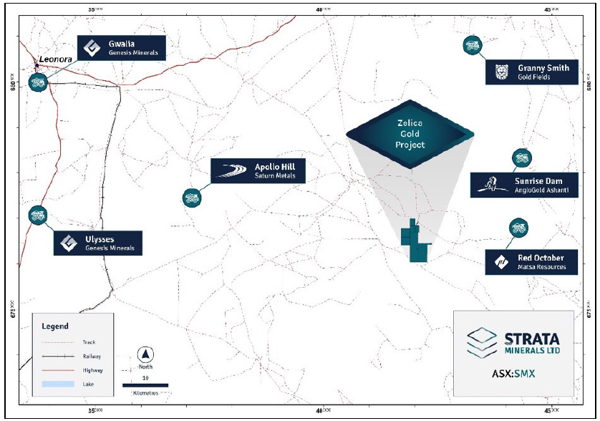
Figure 1: Project location plan showing the Zelica Gold Project relative to nearby gold operations. [Source: Strata Minerals Limited]
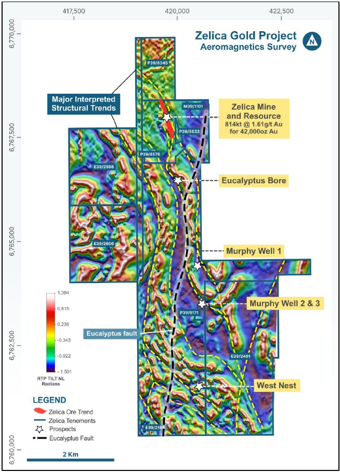
Figure 2: Aeromagnetic survey completed over the Zelica Gold Project, with major interpreted structural trends and prospects marked. [Source: Strata Minerals Limited]
Untested Trends Beside the Zelica Resource
The Company links the known Zelica mineralisation to a magnetic-low corridor.
That corridor is likely to coincide with quartz-veined and sheared metasedimentary and schist units along the basalt contact.
Several comparable sub-parallel magnetic-low trends sit on either side of it. They remain untested by drilling or surface geochemical sampling.
The Company says transported cover and historical mining disturbance have limited the effectiveness of conventional surface exploration here.
Their magnetic character, orientation and position make them targets for further evaluation.
The Company wants to determine whether they reflect additional shearing, favourable metasedimentary units and basalt contacts prospective for quartz-vein-hosted gold.
The recent expansion of the project has also added largely untested ground to the east and west.
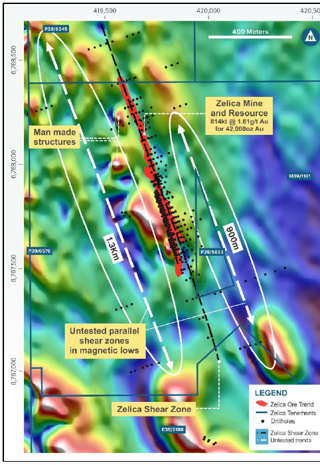
Figure 3: Untested trends identified in magnetic low zones parallel to the Zelica Mine and Resource. The Company’s map labels the two trends at 1.3km and 900m. [Source: Strata Minerals Limited]
Murphy Well: A Large-Scale Dilational Jog
The regionally significant Eucalyptus Fault is interpreted to extend through the broader Zelica Gold Project.
The new data indicates the fault is deflected around a competent domain of mafic volcanic rocks. That creates a series of dilational jogs.
In structural geology, a dilational jog is a bend in a fault that opens as the rock moves, creating space where mineralising fluids can collect.
The Murphy Well 1, 2 and 3 Prospects coincide with this interpreted setting. Gold mineralisation there was previously identified through historic workings, geological mapping and surface sampling, as reported on 9 June 2026.
The Company describes the prospects as key areas for programs of follow-up exploration.
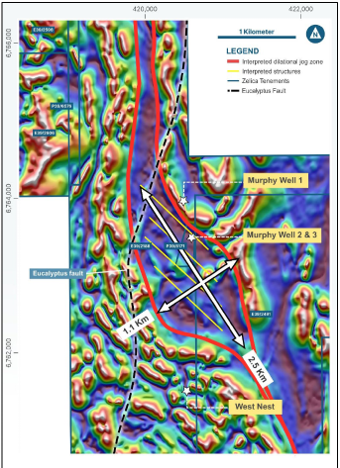
Figure 4: Murphy Well Prospects coincident with a major dilational jog across the Eucalyptus Fault. The Company’s map labels the jog’s dimensions at 1.1km and 2.5km. [Source: Strata Minerals Limited]
West Nest: About 1.5km of Untested Strike
Geological mapping and surface sampling earlier this year identified gold-bearing quartz-vein systems and associated mineralised structures at West Nest.
Existing surface gold anomalism extends over about 550m and remains open.
The new magnetic interpretation supports those findings. Mapped structures correlate with a prospective magnetic-low corridor.
That corridor runs about a further 1.5km beyond the anomaly, into ground not yet tested by soil geochemistry or drilling.
Targeted surface sampling is planned to evaluate the extension and refine targets for potential drill testing.
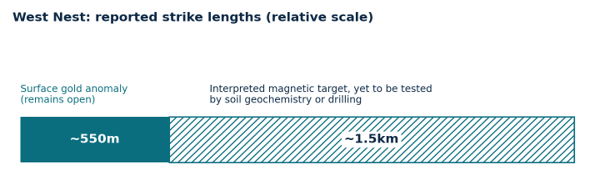
Figure 5: Reported strike lengths at West Nest, drawn to relative scale. Colitco graphic based on the Company’s announcement. [Source: Strata Minerals Limited, ASX announcement, 28 October 2026]
Why Magnetic Data Matters in the Eastern Goldfields
Zelica sits in the Laverton Greenstone Belt of the Eastern Goldfields Province.
A CSIRO-published Exploration Geophysics paper from 1987 described deep weathering and extensive cover over about 350,000 square kilometres of greenstone and granitic rocks in the province.
It reported that airborne magnetic and radiometric surveys helped interpret the geology through that cover.
Spending on this type of work is rising nationally. ABS data shows Australian gold exploration expenditure reached $565.6 million in the June 2026 quarter.
That was up 23.6%, or $107.9 million, on the March quarter. It compares with $402.5 million in the June 2025 quarter.
Exploration on new deposits rose 27.3% to $274.5 million. Metres drilled on new deposits rose 68.9% to 821.8km.
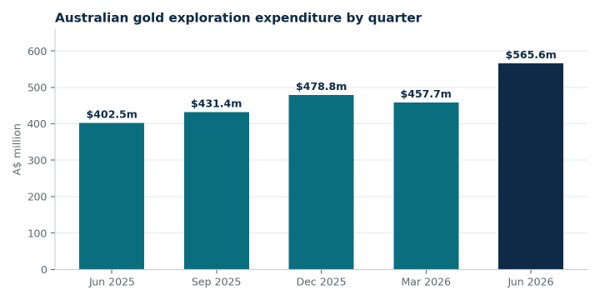
Figure 6: Australian gold exploration expenditure by quarter, June 2025 to June 2026, in $ million (original series). [Source: Australian Bureau of Statistics, Mineral and Petroleum Exploration, June 2026]
Less Than 15% Tested: A Growing Target Pipeline
The Company says less than 15% of the 9.5km Zelica gold corridor has been systematically tested to date.
It expects its pipeline of exploration targets to grow as interpretation continues. The Company lists these building blocks:
- Known shallow oxide gold mineralisation at the Zelica Mine site
- Interpreted mineralised structures associated with magnetic-low corridors
- Multiple previously untested parallel structural trends
- ~550m West Nest surface gold anomaly
- ~1.5km untested West Nest magnetic extension
- A large structural dilational jog coinciding with surface gold mineralisation
- Ongoing interpretation and further targeting
- Less than 15% of the ~9.5km gold corridor systematically tested
Managing Director Peter Woods said:
“The value of this survey is that it gives us a much clearer view of the broader Zelica system and is already highlighting previously untested structural trends beyond the known mineralisation where we have just defined a maiden mineral resource that is open at depth and along strike. That strengthens our confidence in the scale of the opportunity and gives us new areas to systematically evaluate.
With less than 15% of the 9.5 km gold corridor systematically tested, there remains substantial ground to explore. Our focus now is on integrating the magnetic data with our mapping and geochemistry to prioritise the strongest targets for follow-up exploration and potential drilling, as we simultaneously continue to advance pre-development activities at Zelica Mine site.”
Next Steps for Exploration
The Company says follow-up exploration planning is underway. Its upcoming activities will focus on:
- Targeted surface geochemistry across the newly identified magnetic target areas and the broader tenure
- Follow-up geological mapping to refine structural and lithological interpretations
- Target prioritisation that integrates magnetic, geological, drilling and geochemical datasets
- Potential drill testing of priority areas
- Continued exploration of the broader ~9.5km Zelica gold corridor
- An initial grade control drilling program at the Zelica Mine
The JORC table adds that further work will include project-wide infill and extensional soil sampling grids across historic gold-anomalous zones and geophysical targets.
Work after surface sampling will include aircore and reverse circulation drilling along and across mineralised trends.
Development Continues in Parallel at Zelica Mine
Exploration is one of two tracks. The other is pre-development at the Zelica Mine site.
Zelica is held under a granted mining licence. The Company has partnered with BML Ventures under a Mining Services and Profit Share Agreement.
The Company describes the agreement as a capital-light pathway to potential production.
The Company’s 2 October 2026 update listed magnetic survey results among its Q4 2026 milestones. With the maiden resource reported on 14 October, two of those milestones are now out.
| Q4 2026 priority | Position |
| Maiden JORC 2012 Mineral Resource Estimate | Reported 14 October 2026 |
| Magnetic survey results and additional targets across the 9.5km corridor | Reported 28 October 2026 |
| Results from recent metallurgical test work | Q4 2026 priority |
| Ongoing mine planning, pit optimisation and pre-development activities | Q4 2026 priority |
| Submission of Mine Development Closure Proposal | Q4 2026 priority |
| Initial grade control drilling program | Q4 2026 priority |
| Progressing approvals and permits | Q4 2026 priority |
Table 1: Q4 2026 priorities listed by the Company and their position at 28 October 2026. [Source: Strata Minerals Limited, ASX announcements, 2 and 28 October 2026]
Zelica Gold Project Snapshot
| Item | Detail |
| Ownership | 100% owned by the Company |
| Location | Yundamindra District, Western Australia, between Leonora and Laverton |
| Geological setting | Laverton Greenstone Belt, Eastern Goldfields Province. Shear zone interpreted as part of the regionally significant Celia Fault system |
| Host rocks | Highly deformed quartz-sericite-carbonate schist enclosed by basalt |
| Mineralisation | Near-surface oxide gold in 2 to 13m thick quartz vein arrays, over ~1km of strike to ~150m vertical depth. Open along strike and at depth |
| Maiden resource | 814,000t at 1.61g/t Au for 42,000oz |
| Gold corridor | ~9.5km, with less than 15% systematically tested |
| Infrastructure | Within ~50km of multiple +1Moz gold deposits and several processing mills |
| Tenure | Granted mining licence M39/1101. Project tenements M39/1101, P39/5833 and L39/261. No material issues with tenure status |
| Development partner | BML Ventures, under a Mining Services and Profit Share Agreement |
Table 2: Zelica Gold Project snapshot. [Source: Strata Minerals Limited, ASX announcement, 28 October 2026]
Investors’ Outlook
The survey gives the Company a technical map to work from across the 9.5km corridor.
It sits alongside a defined resource, a granted mining licence and a development and mining partner.
| Last Price | vs Sector | Market Cap |
| $0.015 | +14.79% | $6.13M |
Table 3: SMX share price performance and market capitalisation. [Source: ASX]
The Company’s next step is to integrate the magnetic data with its mapping and geochemistry. Catalysts to watch include:
- Targeted surface geochemistry across new magnetic target areas, including West Nest
- Target prioritisation and potential drill testing of priority areas
- Metallurgical test work results
- Initial grade control drilling at the Zelica Mine
- Mine Development Closure Proposal submission and approvals
- Further targets as interpretation continues across the 9.5km corridor
More coverage of the Company is available in our Strata Minerals archive.
Disclaimer: This report has been prepared by Colitco in collaboration with Strata Minerals Limited as part of a commercial content and investor communications arrangement. Colitco may receive compensation for the production and distribution of this content. This article is intended for informational purposes only and does not constitute financial product advice, investment advice, or a recommendation to buy or sell any securities. The content reflects information available at the time of publication and may not be updated. All figures, data and statements have been sourced from Strata Minerals Limited’s official ASX announcements and publicly available sources. Readers should conduct their own independent research and seek professional financial advice before making any investment decisions. Past performance is not a reliable indicator of future results. Exploration results and Mineral Resource estimates are not a guarantee of future resource definition or commercial production.

Luke Carlino is a seasoned Copywriter, Content Strategist, and Social Media Manager specialising in Mining, Finance, and Business journalism. With more than a decade of industry experience, he brings rigorous editorial standards and commercial acuity to every project.