

China’s discoveries at Dadonggou and Wangu have drawn attention to the country’s future gold supply. Their reported size is substantial, although size alone says little about annual output or mining costs. In this article, China’s gold production, Australia’s operating position and the steps between finding a deposit and selling its gold are examined.
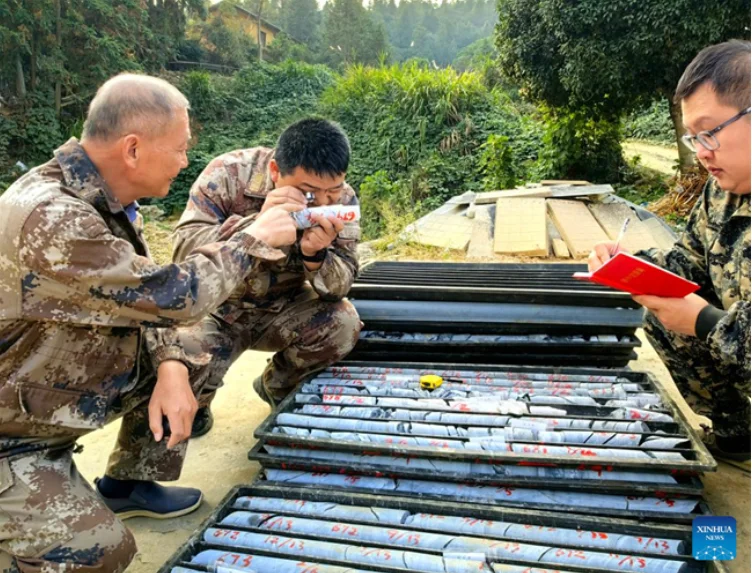
Figure 1: Technicians inspect rock samples at the Wangu gold field in Pingjiang County, Hunan, on 5 November 2024. Archive photograph. Credit: Xinhua/Su Xiaozhou, via the Hunan Provincial Government.
Dadonggou Contains a Lot of Gold in a Lot of Rock
The Dadonggou announcement came on 14 November 2025. China’s Ministry of Natural Resources reported 1,444.49 tonnes of contained gold in Liaoning province, within approximately 2.586 billion tonnes of ore.
The average grade was 0.56 grams per tonne.
That last number deserves as much attention as the deposit’s size. At the reported average, each tonne of ore contains a little over half a gram of gold before processing losses. Recovering it requires a large mining and processing operation.
Still, the contained-gold figure does not establish an annual supply forecast. A production schedule, recovery assumptions and development budget are needed before outsiders can make that assessment.
Compare Production Figures on the Same Basis
A useful China vs Australia gold production comparison starts with the same year and statistical source.
The US Geological Survey’s February 2026 publication provided these rounded estimates:
| Country | 2024 mine production | 2025 estimated mine production |
|---|---|---|
| China | 377 tonnes | 380 tonnes |
| Australia | 284 tonnes | 280 tonnes |
These are estimates from that publication, rather than final 2026 figures. Other datasets can differ because of methodology and later revisions.
They nevertheless establish an important point: China’s production lead existed before the new discoveries could contribute additional output.
Comparing Dadonggou’s total contained gold with one year of Australian production would be misleading. One measures a deposit that may be worked over many years. The other measures gold mined during a particular reporting period.
New Chinese Supply Could Meet Chinese Demand
China’s role in gold extends well beyond mining.
More locally mined gold could replace some imports, depending on demand, recycling and other sources of supply. It would not necessarily emerge as a matching increase in exports competing directly with Australian bullion.
Nor does a discovery establish a gold-price forecast. Buyers respond to investment conditions, jewellery demand and other influences while mines take years to develop.
For Australia, the eventual market effect would depend on additional recoverable output and the conditions prevailing when that output becomes available. The discovery date alone offers little guidance.
Australian Miners Still Have Their Own Costs to Meet
A discovery overseas does not change those requirements.
Geoscience Australia notes that much of the gold mined locally occurs at concentrations below five grams per tonne. Grade matters, but so do the amount of waste moved, processing performance and the infrastructure already available.
This is where Australia gold production needs to be examined company by company. Two mines selling into the same gold market can finish a quarter with very different cash results.
Colitco’s analysis of Evolution Mining’s gold margins explores how costs and the metals produced affect the operating result.
Existing Infrastructure Can Give Australian Projects a Head Start
A deposit near an operating plant may have development options unavailable to a remote discovery.
Roads, power connections, workshops and processing equipment can reduce the amount of new infrastructure required. The ore must still suit the plant, and there must be enough capacity to treat it.
That advantage is specific to each project. It cannot be assumed simply because the deposit is in Australia.
The relationship between existing assets and new development is examined in Colitco’s coverage of how Telfer supports Greatland’s expansion.
For investors, this provides a more practical comparison than deposit size alone. How much must be built, and how much can the developer already use?
Watch the Development Commitments
China’s discoveries become more commercially significant as developers publish plans and commit money.
| Information to watch | What it helps establish |
|---|---|
| Detailed resource and reserve statements | Geological confidence and the economically mineable portion |
| Annual production schedule | How much gold could reach buyers each year |
| Recovery estimates | How much contained gold the plant expects to extract |
| Capital budget and funding | The cost of reaching production and how it will be paid |
| Construction and commissioning milestones | Whether the expected delivery dates remain achievable |
The terminology also needs checking. Geological reporting systems differ between countries, so a figure described as a “reserve” in one announcement should not automatically be treated as equivalent to an Australian JORC Ore Reserve.
A Longer-Term Challenge, With More Evidence Needed
China’s deposits give its mining industry substantial opportunities to investigate and develop. Australian producers have reason to follow that work.
The stronger test, however, comes with funded construction, credible operating costs and sustained output. Those details determine whether a discovery becomes a competitive source of gold.
Colitco’s assessment is that the announcements support a longer-term supply discussion. They do not yet demonstrate that Australian mines will lose sales or become less profitable. For shareholders, progress at the Chinese projects belongs alongside the costs, reserves and delivery record of the Australian companies they follow.
ALSO READ: Evolution Mining FY26 Results: The Gold Margins Are Speaking
FAQs
Q1. Does China produce more gold than Australia?
Ans. Yes. The USGS February 2026 publication estimated 2025 output at 380 tonnes for China and 280 tonnes for Australia.
Q2. Is Dadonggou’s reported gold content an annual production figure?
Ans. No. It measures contained gold across the deposit. Annual recoverable output depends on the eventual mining and processing plan.
Q3. Is Wangu’s reported 138g/t the deposit’s average grade?
Ans. No. It was a maximum reported grade and should not be applied across the whole deposit.
Q4. Do these discoveries guarantee lower gold prices?
Ans. No. Their effect depends on development timing, actual production and demand conditions when additional supply reaches the market.
Disclaimer
This page offers basic financial information, not advice. Forecasts for production and development may alter. Different jurisdictions use different resource nomenclature. Readers should study original disclosures before investing.

Luke Carlino is a seasoned Copywriter, Content Strategist, and Social Media Manager specialising in Mining, Finance, and Business journalism. With more than a decade of industry experience, he brings rigorous editorial standards and commercial acuity to every project.