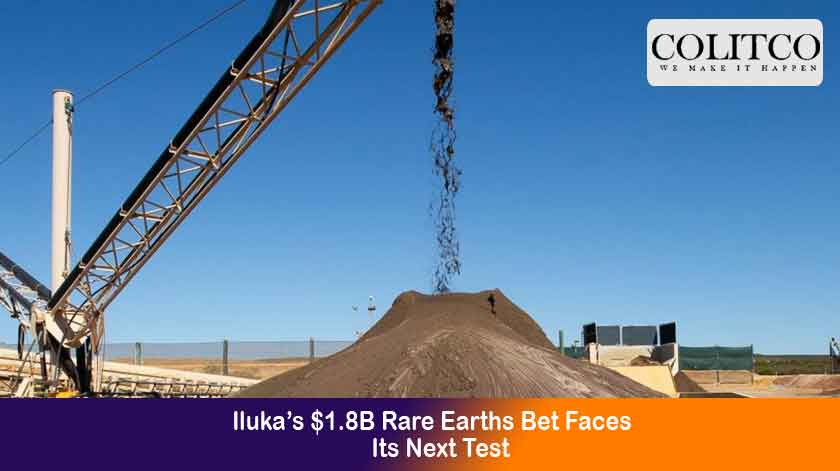
The Iluka Resources rare earths project reached 65% completion by 30 September 2026. In its quarterly review released on 28 October, Iluka reported accrued capital expenditure of A$1.237 billion and retained its A$1.7–1.8 billion capital estimate.
The A$1.8 billion figure in the headline is therefore the upper end of the current estimate. It is not a newly announced increase.
Eneabba will produce separated light and heavy rare earth oxides. Iluka is also investigating the next processing step, converting those oxides into metals, and reported progress on that work during the quarter.
For shareholders, the immediate questions concern construction delivery, the remaining expenditure and how the plant performs once commissioning begins.
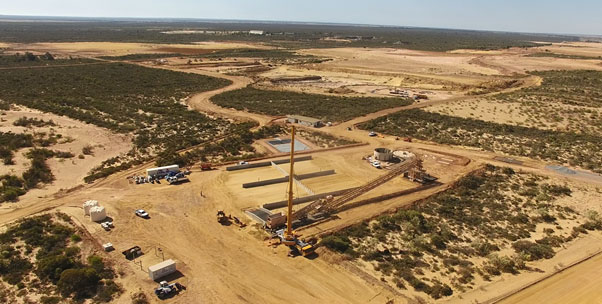
Figure 1: Eneabba plant and stockpile area in Western Australia. Archive photograph showing existing site infrastructure, rather than the refinery’s September 2026 construction status. Credit: Iluka Resources.
The Main Structures Are Finished, but Installation Work Continues
Much of Eneabba’s large equipment is now visible on site.
Concrete installation, major equipment placement and assembly, pipe racks, large tanks and the main solvent-extraction buildings are complete. All mixer-settlers are in position.
Inside those buildings, work continues. Much of the mixer-settler piping in the first solvent-extraction building has been installed. Pipework for the second is progressing through fabrication.
Small tanks, filters, ammonia-recovery equipment, valves and instruments have also arrived.
These details help explain what 65% completion means. The buildings and major equipment are largely established, while structural, mechanical, piping, electrical and instrumentation work remains underway.
The next updates should show how far those activities have progressed towards a connected plant ready for testing.
The Cost Estimate Holds at A$1.7–1.8 Billion
The Iluka Resources project cost estimate remains unchanged in the September review.
| Eneabba measure | Position at 30 September 2026 |
| Overall completion | 65% |
| Accrued capital expenditure | A$1.237 billion |
| Current capital estimate | A$1.7–1.8 billion |
| Difference between accrued expenditure and estimate | A$463m–A$563m |
The final row is a calculation from the reported figures. It is not an additional company forecast or a statement of uncommitted expenditure.
Accrued expenditure can include amounts recognised before payment. Readers should therefore avoid treating A$1.237 billion as a simple cash-paid total.
Nor should construction progress be measured by dividing expenditure by the budget. Equipment purchases and installation costs arise at different stages.
Colitco’s earlier coverage of Iluka’s rare earths outlook provides background on how Eneabba fits into the company’s changing business.
Completion Will Be Followed by a Different Test
Iluka’s published project information schedules commissioning for 2027. The September quarterly review reports construction progress without announcing a revised commissioning date.
Once construction is finished, attention will move to operating performance. The refinery must demonstrate that its connected processing stages can consistently deliver the required products.
The Iluka Resources Eneabba refinery is intended to produce separated neodymium, praseodymium, dysprosium and terbium oxides. Its design also allows feedstocks from Iluka’s own portfolio and potential third-party suppliers.
That flexibility is part of the commercial opportunity. During commissioning and ramp-up, readers will need evidence on throughput, recovery, product specification and operating costs to assess how the facility is performing.
Colitco’s earlier Eneabba refinery report examines the project’s place in Australia’s processing industry.
Metallisation Adds Another Step to the Plan
The quarterly review contains a separate development beyond refinery construction.
Iluka produced dysprosium and terbium metal to specification during Q3. It then purchased metallisation equipment intended to enable future production capacity of 200 tonnes a year of these metals.
Metallisation follows oxide production in the supply chain. It could allow Iluka to offer customers products that have undergone another processing stage.
The announcement does not say that the 200-tonne annual capacity is operating. It also does not report commercial sales from that equipment.
Work on neodymium and praseodymium metallisation continues in parallel. For now, the reported achievement is successful heavy rare earth metal production to specification and the equipment purchase needed to pursue commercial scale.
Mineral Sands Still Carries the Current Trading Result
While Eneabba is being built, Iluka continues to manage subdued conditions in its mineral sands business.
Both synthetic rutile kilns remained idle, and the Cataby mine was also idle. Restart decisions depend on market conditions.
That debt figure relates specifically to Mineral Sands. Eneabba has a separate government-backed, non-recourse financing arrangement.
| Mineral sands measure | September quarter |
| Zircon, rutile and synthetic rutile production | 76,100t |
| Combined sales | 115,200t |
| Mineral sands revenue | A$219m |
| Reported zircon sand price | US$1,685/t |
| Mineral Sands net debt at quarter-end | A$249m |
Limited premium zircon availability nevertheless supported pricing. Iluka expects its reported zircon sand price to reach approximately US$1,825 per tonne in Q4, including shipments priced under earlier contracts.
Balranald Has Its Own Operating Milestones
Balranald’s ramp-up is another part of the near-term workload.
During Q3, Iluka focused on improving ore extraction and recovery. Changes to one mining rig were completed in October, after which that unit consistently achieved its targeted extraction rate.
The same changes are planned for the second rig in November. Q4 work will focus on improving the consistency of recovered grade.
The first 30,000 tonnes of Balranald heavy mineral concentrate were shipped to Western Australia in September and are scheduled for processing in November.
These milestones concern the existing mineral sands business. Their progress will help readers assess operating performance while Eneabba continues to absorb construction expenditure.
What the Next Update Needs to Establish
The September review leaves Eneabba’s cost range intact and documents further construction progress. The next useful evidence will be completion of the remaining installation work and a clearer account of commissioning preparations.
Metallisation also needs its own follow-up: equipment installation, operating readiness and the route towards commercial output.
A completed building, a product produced to specification and a plant delivering sustained commercial output each answer a different question.
ALSO READ: ASX 200 Resources Companies: Capricorn, Ora Banda and Iluka
FAQs
Q1. How much is the Eneabba refinery expected to cost?
Iluka retained its A$1.7–1.8 billion capital estimate in the September 2026 quarterly review.
Q2. How far has construction progressed?
Overall completion reached 65% at 30 September 2026. Accrued capital expenditure was A$1.237 billion.
Q3. What will Eneabba produce?
The refinery is intended to produce separated rare earth oxides, including neodymium, praseodymium, dysprosium and terbium.
Q4. Is Iluka already producing 200 tonnes of rare earth metal annually?
No. Iluka purchased equipment enabling future capacity of 200 tonnes a year of dysprosium and terbium metal. The report does not say that capacity is operating.
Disclaimer
This post provides information, not financial advice. Timelines, estimations, and projections might vary. Readers should read corporate releases before investing.

Luke Carlino is a seasoned Copywriter, Content Strategist, and Social Media Manager specialising in Mining, Finance, and Business journalism. With more than a decade of industry experience, he brings rigorous editorial standards and commercial acuity to every project.