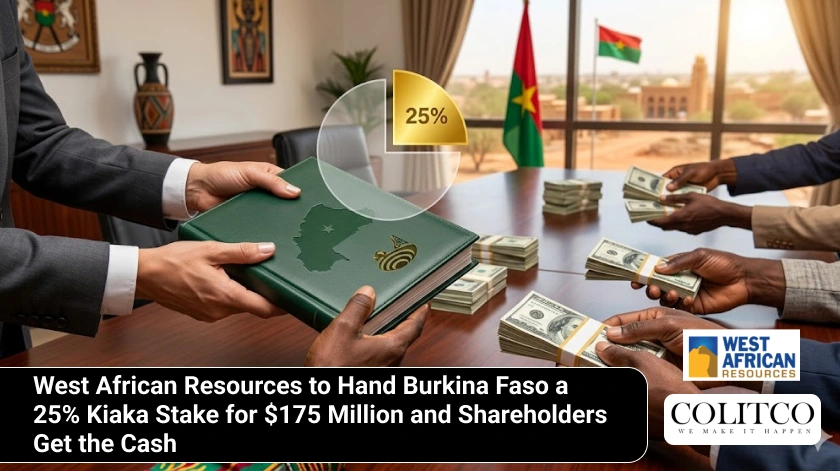
West African Resources Limited (ASX: WAF) confirmed on 21 April 2026 that the Burkina Faso government has issued a formal decree to acquire an additional 25% equity interest in the Kiaka Gold Operations.
The purchase price is approximately 70 billion CFA francs, roughly AUD $175 million.
Every dollar of that is going straight back to shareholders as a special dividend.
What Actually Happened With the Kiaka Mine Stake
The Government of Burkina Faso issued a decree authorising its state-owned mining vehicle, Société de Participation Minière du Burkina Faso (SOPAMIB), to execute the purchase for approximately 70 billion CFA francs, equivalent to roughly AUD $175 million.
The transaction brings Burkina Faso’s total ownership in Kiaka SA to 40%.
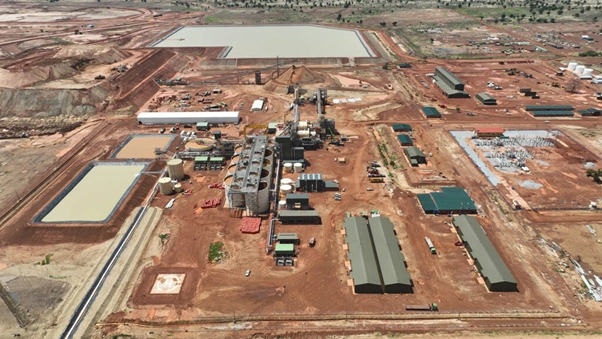
Kiaka Gold Project in Burkina Faso [West African Resources Limited]
The state already held a 15% free-carried interest under the country’s revised 2024 Mining Code. The code grants the state a free 15% stake in mining projects, and also allows the state to acquire “at least 30%” in additional paid interests.
After months of pressure, the final number came in at 25%, less than the 35% initially demanded, and well short of the 50% that was being floated as recently as September 2025.
WAF’s Executive Chairman and CEO, Richard Hyde, noted that the publication of the decree provides much-needed regulatory certainty for the project.
That statement alone tells the story. This deal ends months of market anxiety.
Why This Matters Beyond the Dollar Figure
The negative side arrived in late November 2025 and again in February 2026, when the company disclosed discussions with the Burkina Faso government over a potential additional 25% equity stake in Kiaka SA. That ownership question produced the biggest reaction because it goes to the heart of valuation.
Put simply, investors couldn’t price the stock properly without knowing how much of Kiaka WAF would ultimately keep.
If investors are unsure how much of Kiaka West African Resources will ultimately own, they will apply a discount, no matter how strong recent profits look.
Those profits are genuinely strong. West African Resources posted a record year with 300,383 ounces of gold output, AUD $1.54 billion in revenue and AUD $567 million in net profit after tax in 2025.
Now that ownership question is largely resolved, the discount should narrow.
How the Deal Reached $175 Million
The negotiations have been long and, at times, messy.
In September 2025, West African Resources announced that it had received notice from the government regarding the acquisition of a 35% interest in the mine. The Australian company disclosed in November 2025 that it had opened negotiations with Ouagadougou to reach a compromise.
The Council’s report now refers to a 25% stake instead of the 35% initially mentioned.
WAF pushed back, kept its lenders in the loop, and managed to bring the figure down. The final decree locks in 25%.
These talks were being led on the state’s side by mining investment vehicle SOPAMIB, which has also expressed interest in partnering with West African Resources on future mining projects to boost national participation, jobs and social benefits.
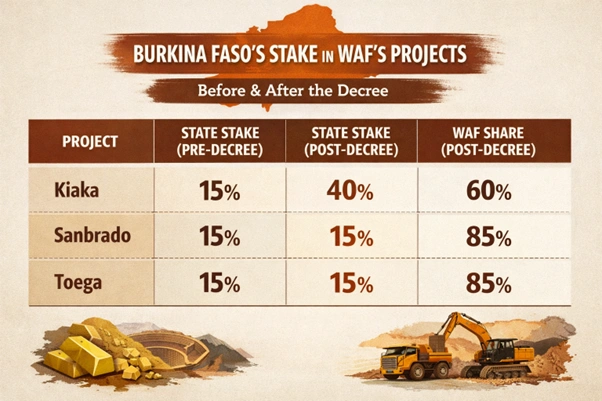
Government equity positions across WAF’s Burkina Faso portfolio
The Special Dividend Commitment
This is arguably the part that investors care about most.
WAF has pledged to distribute the total cash proceeds from the sale back to its shareholders in the form of a special dividend.
AUD $175 million back to shareholders. The company is not keeping the cash.
The transaction is expected to be finalised by the end of the 2026 calendar year.
WAF has also moved to lift its trading halt on the ASX, confirming full compliance with listing rules and allowing normal trading to resume today.
Sanbrado and Toega Are Untouched
One critical detail that the market needs to hear clearly: this deal is Kiaka-only.
The company stressed that its Sanbrado and Toega projects are not part of these ownership discussions and that operations at both Sanbrado and Kiaka continue unaffected, underscoring operational stability despite potential changes in Kiaka’s shareholding structure.
Sanbrado remains WAF’s primary cash engine. The Sanbrado mine has been in production since March 2020.
Kiaka itself is already producing. The Kiaka project recently entered production and is one of Burkina Faso’s largest new gold developments, with output expected to average about 234,000 ounces per year for 20 years from 2025.
Even with 40% government ownership, that is still a meaningful stream of production flowing to WAF, and a long one at that.
The Broader Picture: Resource Nationalism in West Africa
This deal does not happen in isolation. Burkina Faso sits inside a broader regional trend.
This is not an isolated demand. It follows recent legal disputes, such as those involving Endeavour Mining and Lilium Mining, which resulted in increased state ownership and financial settlements favouring the government.
The Burkina Faso government, led by military ruler Captain Ibrahim Traoré, has been asserting greater control over the country’s mineral assets since taking power. The revised 2024 Mining Code was the legal vehicle for that push.
For companies operating in the country, the lesson is straightforward: the state will get a bigger share. The question is always how big.
The Kiaka negotiations illustrate a pragmatic balance between state participation and private capital. Rather than abrupt expropriation or unilateral restructuring, the government appears to be pursuing a legally grounded, negotiated path toward increased ownership.
WAF navigated that well. The final 25% versus an initial ask of 35% represents genuine negotiating success.
Investor Outlook: Production Growth Remains the Core Story
West African Resources is entering a period of robust production growth. The company is targeting total gold output of between 430,000 and 490,000 ounces in 2026, supported by the first full year of production from Kiaka alongside its Sanbrado mine. Kiaka alone is expected to deliver between 240,000 and 280,000 ounces.
The company is also aiming to keep all-in sustaining costs below $1,900 per ounce, suggesting the potential for solid margins even amid fluctuations in global gold prices.
Chief Executive and Chairman Richard Hyde has described 2026 as a “landmark year”, with dividends and a potential share buyback already under consideration, separate from the special dividend commitment tied to the Kiaka sale.
With gold prices holding firm above USD $3,400 per ounce and two producing mines running at full capacity, WAF’s operational story remains intact.
The ownership uncertainty that had weighed on the stock for nearly a year is now gone. What remains is a profitable, dual-mine gold producer targeting half a million ounces annually, with a guaranteed $175 million cash return to shareholders on the horizon.
For investors watching ASX-listed gold miners operating in West Africa, WAF’s experience is worth studying. Perseus Mining’s recent presidential approval for underground expansion at Yaouré in neighbouring Côte d’Ivoire shows that, with the right jurisdiction and the right engagement, West Africa remains workable. For WAF, the path was harder. But it appears to have reached the other side.
Also Read: L1 Gold Fund IPO Raises $950 Million, Set to Hit the ASX This Week
FAQ
Q: What is West African Resources selling and to whom?
A: West African Resources (ASX: WAF) is selling a 25% equity stake in its Kiaka Gold Operations to the Burkina Faso government through SOPAMIB, the state’s mining investment vehicle, for approximately AUD $175 million.
Q: Why is the Kiaka mine stake being sold?
A: The sale is the result of negotiations following the Burkina Faso government’s exercise of rights under its revised 2024 Mining Code, which allows the state to acquire additional paid equity in operating mining projects. The government initially sought 35% but settled on 25%.
Q: What will West African Resources do with the $175 million?
A: WAF has committed to distributing the full proceeds from the Kiaka mine stake sale to shareholders as a special dividend.
Q: Are Sanbrado and Toega affected by this deal?
A: No. The Burkina Faso government’s acquisition request is limited to the Kiaka project. WAF’s Sanbrado and Toega operations remain at 85% WAF ownership and are unaffected.
Q: When is the transaction expected to close?
A: The transaction is expected to be finalised by the end of the 2026 calendar year.
Q: What does this mean for WAF’s production guidance?
A: WAF’s production guidance of 430,000 to 490,000 ounces for 2026 remains unchanged. Kiaka is expected to contribute 240,000 to 280,000 ounces in its first full year of production.
Disclaimer: This article is for informational purposes only and does not constitute financial advice. West African Resources Limited (ASX: WAF) is a publicly listed company, and any investment decisions should be made in consultation with a licensed financial adviser. Colitco accepts no responsibility for any loss arising from reliance on this content.
Source: