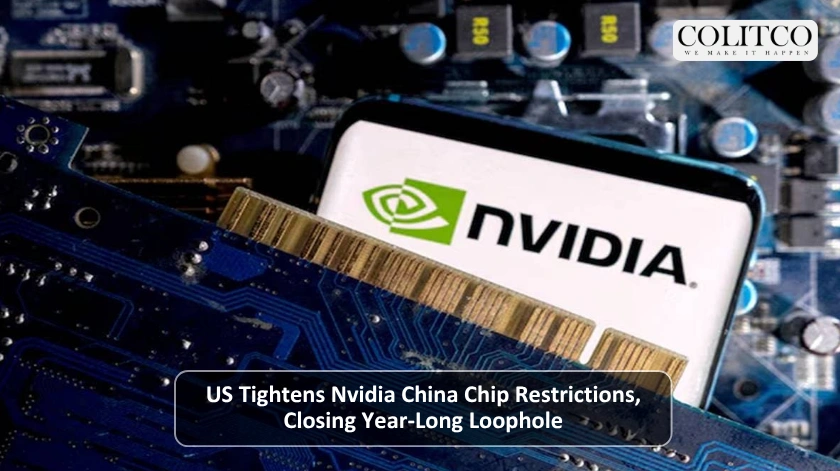
The US Department of Commerce issued new guidance over the weekend, tightening Nvidia China chip restrictions and closing a loophole that may have allowed advanced AI processors to reach Chinese-linked firms abroad. The move rattled markets ahead of Monday’s open, with Nvidia and AMD shares under pressure.
A Loophole That Lasted Nearly a Year
The Bureau of Industry and Security (BIS) published the guidance on Sunday, clarifying that existing license requirements cover all entities with a parent company or headquarters in China — regardless of where those entities operate. The clarification came after the Trump administration chose not to enforce the Biden-era AI Diffusion Rule in May 2025, a decision that left the door open for nearly 12 months.
Former US State Department official Chris McGuire flagged the scale of the problem. He noted the gap allowed overseas subsidiaries of Chinese companies to purchase Nvidia’s Blackwell chips without a license, adding that “Chinese companies have been buying these chips, very likely at scale.”
NEW: BIS just issued guidance stating that licenses are required for advanced AI chip exports to China-headquartered firms located outside of China (e.g. a Tencent subsidy in Malaysia). The reason they had to issue this statement is BIS’ non-enforcement of certain export controls… pic.twitter.com/qtrubV3exw
— Chris McGuire (@ChrisRMcGuire) May 31, 2026
Industry sources told Reuters that hundreds of thousands of advanced chips may have reached Chinese-linked buyers through third countries during that window. Singapore and Malaysia ranked among the suspected routing hubs.
Which Chips Are Now Restricted
The Nvidia China chip restrictions apply to the company’s most powerful processors. Affected products include Nvidia’s Blackwell and Rubin families, as well as AMD’s MI350x accelerator. These chips are considered critical for training and running advanced AI models.
Nvidia responded through a spokesperson, stating the guidance aligns with its existing approach. “Consistent with our existing approach, licences are required to ship controlled products to PRC-headquartered companies,” the company said. AMD and Intel did not immediately respond to requests for comment.
Nvidia
The new guidance does not require data centers to stop using chips already deployed. It also does not force service providers to cut off maintenance on existing advanced computing systems. That limits the immediate operational disruption, but compliance requirements for exporters tighten from here.
Market Reaction and Stock Pressure
Nvidia and AMD shares came under pressure ahead of Monday’s session. Prior episodes of tightened Nvidia China chip restrictions had sent Nvidia down 1.8% and AMD down 2.2%. A more contained reaction was possible this time, given the guidance is a clarification rather than a full ban.
Nvidia’s direct revenue exposure to China has already narrowed sharply. The company reported zero Data Center Hopper shipments to China in fiscal Q1 2027, compared with $4.6 billion a year earlier.
Total Data Center revenue still hit a record $75.2 billion for the quarter, driven by Blackwell 300 demand from US and allied customers. However, separate reports suggest that over 20% of Nvidia’s fiscal year 2026 compute revenue still flowed from China through intermediaries, which adds complexity to the revenue picture.
AI-linked crypto tokens also faced potential sympathy weakness. These tokens have historically tracked US semiconductor sentiment, and any sour mood in chip stocks tends to carry over into the digital asset market.
Compliance Burden Rises for Distributors
The new guidance raises the bar for exporters, distributors, and cloud resellers. Every sale now requires verification of the ultimate parent company, not just the destination country. That know-your-customer requirement adds cost and friction to the supply chain.
The BIS guidance builds on a series of layered restrictions. Entity list additions and earlier Middle East export controls have stacked atop the existing China framework since 2024. Federal prosecutors had previously charged operators of a $2.5 billion GPU smuggling ring tied to similar chip diversion patterns, showing enforcement is active.
The Nvidia China chip restrictions are set to reshape near-term sales strategies for chipmakers. Next quarter’s earnings will give investors the first hard read on how much revenue exposure remains.
Also Read: Inside the Pro Medicus 2026 Results
FAQS
Q1. What are the new Nvidia China chip restrictions about?
A1. The US BIS issued guidance requiring export licenses for advanced AI chips sold to any entity with a Chinese parent company, even if that entity operates outside China.
Q2. Which chips does the new guidance cover?
A2. The restrictions cover Nvidia’s Blackwell and Rubin processors and AMD’s MI350x accelerator.
Q3. How long was the loophole open?
A3. The loophole existed for nearly a year, from May 2025 when the Trump administration stopped enforcing the Biden-era AI Diffusion Rule.
Q4. Does the guidance affect chips already in use?
A4. No. Data centers are not required to stop using chips already deployed or cut off servicing on existing systems.
Q5. How could the Nvidia China chip restrictions affect stock prices?
A5. Nvidia and AMD shares faced pressure ahead of Monday’s open. A contained dip is possible, though Nvidia’s direct China revenue has already dropped sharply following earlier restrictions.
Disclaimer
The information provided is not trading advice, Colitco and it’s author holds no liability for any investments made based on the information provided on this page. We strongly recommend independent research and/or consultation with a qualified professional before making any investment decisions.
Sources
https://finance.yahoo.com/sectors/technology/articles/us-moves-block-nvidia-ai-002939330.html

Luke Carlino is a seasoned Copywriter, Content Strategist, and Social Media Manager specialising in Mining, Finance, and Business journalism. With more than a decade of industry experience, he brings rigorous editorial standards and commercial acuity to every project.