
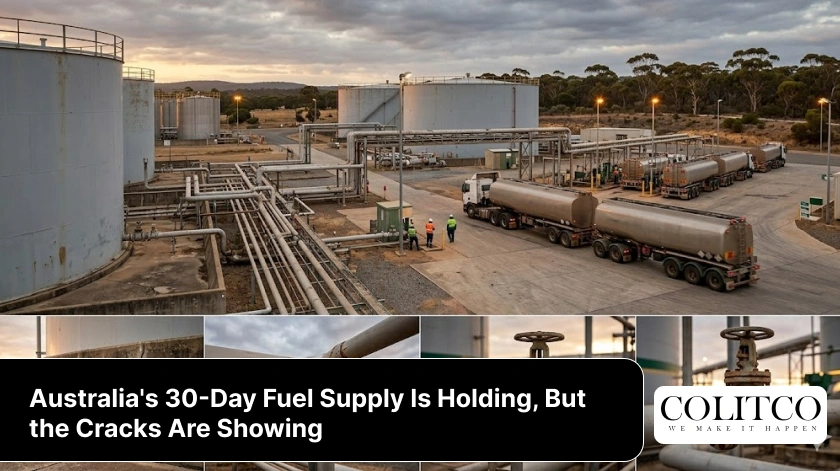
Australia’s fuel reserves sit at a precarious edge. The country holds just 30 days’ worth of diesel, the lowest of any International Energy Agency (IEA) member nation, and the ongoing disruption to global oil shipping routes is testing every litre of it.
The Australia 30-day fuel supply buffer that Prime Minister Anthony Albanese’s government calls “secure” is real. But security and comfort are two very different things.
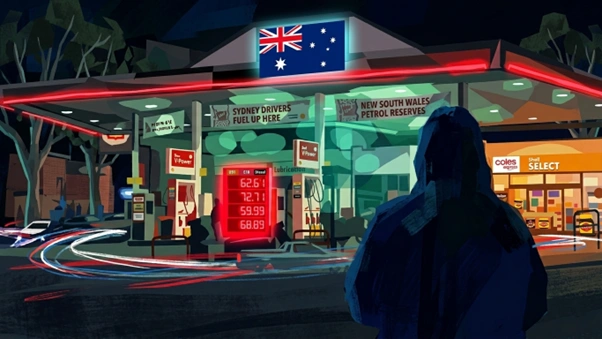
Figure 1: Australia’s diesel reserves have reached a precarious 30-day low, the shortest supply of any International Energy Agency (IEA) member.
How Did Australia End Up Here?
The Strait of Hormuz Choke Point
The trigger for this crisis traces back to February 28, 2026, when the US-Israel military campaign against Iran effectively closed the Strait of Hormuz, a narrow waterway through which roughly one-fifth of the world’s seaborne oil trade moves.
Australia relies on the Strait for approximately 50% of its diesel imports. The crude gets refined in Singapore, South Korea, and Malaysia before it heads south. When tanker traffic through Hormuz collapsed, those shipments stopped or got deferred across the entire supply chain.
The result hit fast. By early April 2026, around 300 service stations across the country ran out of diesel, according to Bloomberg.
A Structural Weakness Years in the Making
This wasn’t a bolt from the blue. Australia imports roughly 90% of its petrol, diesel, and jet fuel. Only two domestic refineries remain open after a string of closures in recent decades, leaving the nation almost entirely dependent on “just-in-time” import chains from Asia.
The IEA recommends its members hold 90 days of fuel reserves. Australia sits at:
- ~39 days of petrol
- ~29–30 days of diesel
- ~30 days of jet fuel
That gap between 30 and 90 days represents years of policy choices that favoured cheap imports over energy sovereignty. The Australia petrol crisis now unfolding is a direct consequence of those decisions.
What the Government Has Done
Albanese Takes Action on Multiple Fronts
The Albanese government has moved quickly, though critics argue it should have moved sooner. Key responses include:
- Halving the fuel excise tax from April 1 to June 30, cutting pump prices by approximately 26.3 cents per litre
- Reducing the Heavy Vehicle Road User Charge to zero for three months to protect the trucking and logistics industry
- Releasing 20% of Australia’s petrol and diesel reserves, targeted at regional areas facing the worst shortages
- Establishing a National Fuel Supply Taskforce, chaired by Anthea Harris, former CEO of the Australian Energy Regulator
- Securing a supply agreement with Singapore, with PM Lawrence Wong committing to “make maximum efforts” to keep fuel flowing
Albanese also made emergency visits to Singapore, Brunei, and Malaysia to lock in bilateral supply deals. Energy Minister Chris Bowen confirmed that more than 50 fuel-laden ships are now en route to Australian ports, with arrivals expected to sustain supply well into May.
“Our fuel supply is currently secure, but I want us to be over-prepared,” Albanese told reporters.
The Alternative Supply Hunt
With Asian suppliers reducing exports to protect their own reserves, Australia turned to longer and more expensive routes. Four vessels carrying diesel departed the US Gulf Coast, a journey of around 13,000 miles that takes up to two months. Three more ships left the US West Coast.
Japan’s Inpex also stepped up condensate supply to help offset the shortfall. The government began exploring sources from South America and Algeria to diversify beyond Southeast Asia.
The Impact on Ordinary Australians
Prices at the Pump
Fuel prices surged sharply from late February. National average unleaded petrol reached 250.8 cents per litre in late March, up roughly 32% from pre-conflict levels. Diesel climbed above 245 cents per litre nationwide, with isolated reports of prices hitting $3–$4 per litre in some areas.
The excise cut brought prices down. By early April, average unleaded prices dropped to around 224.4 cents per litre, reflecting the 26.3-cent reduction passed on at the bowser.
Those rising gas prices from regional conflict have translated directly into higher costs for transport, agriculture, and manufacturing, which economists warn will feed into supermarket shelves in the weeks ahead.
Regional Australia Bears the Brunt
The crisis has landed hardest on farmers and regional communities. Diesel shortages interrupted planting and harvest operations. Trucking firms warned of higher freight costs. In New South Wales, Premier Chris Minns reported over 100 stations without diesel at the peak of the crisis.
Panic buying made things worse. Demand spiked by up to 25% in some locations, draining bowsers even as national stock levels held steady. Officials continue to urge Australians to buy only what they need.
What Comes Next?
The 90-Day Question
The Australia 30-day fuel supply figure remains the central policy failure this crisis has exposed. Back in 2020, a then-opposition Albanese himself acknowledged Australia needed a 90-day strategic reserve. Six years later, the country still doesn’t have one.
Western Australia is now considering establishing its own dedicated diesel reserve. The federal opposition, including National Party leader Matt Canavan, has called for greater domestic resource development, pointing to oil fields in South Australia and Queensland.
The longer-term play may also involve oil price pressures accelerating the shift to electric vehicles, as consumers look for ways to insulate themselves from future fuel shocks.
The Path Forward
For now, the government says all fuel shipments through to May are secured. Bowen stopped short, however, of guaranteeing supply beyond May if Hormuz disruptions resume.
Whether this crisis finally forces a serious rethink of Australia’s energy sovereignty, including the 90-day reserve target, refinery investment, and supply chain diversification, remains the defining question. The 30-day buffer held this time. It may not hold the next.
Sources
- https://www.heygotrade.com/en/news/asia-pacific-fuel-crisis-australia-diesel-reserves-malaysia-tankers/
- https://www.theguardian.com/australia-news/live/2026/apr/13/australia-news-live-anthony-albanese-prime-minister-fuel-supply-diesel-oil-cost-of-living-inflation-budget-ntwnfb
- https://www.abc.net.au/news/2026-04-14/debunking-four-myths-around-australias-fuel-crisis/106558264
- https://www.aljazeera.com/news/2026/3/30/australia-to-halve-fuel-tax-as-global-energy-crisis-deepens


