
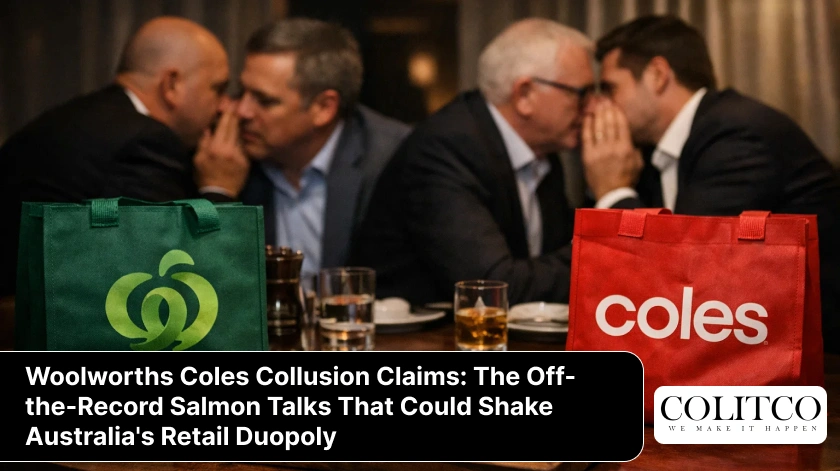
Environmental advocate and prominent businessman Geoff Cousins has levelled a serious accusation against the Woolworths chairman, alleging that the chair of one of Australia’s two largest supermarket giants held off-the-record discussions with his counterpart at Coles about their mutual salmon labelling crisis.
The allegations, first reported by the Australian Financial Review on 15 April 2026, raise urgent questions about whether Australia’s two dominant grocery retailers, which together control more than 65 per cent of the national supermarket market, were coordinating conduct that could amount to Woolworths Coles collusion claims under Australian competition law.
The core of the allegation is straightforward but legally charged: both Woolworths and Coles sell Atlantic salmon factory-farmed in Macquarie Harbour, on Tasmania’s remote south-west coast. That salmon had long been labelled “responsibly sourced” — a claim now both companies have committed to dropping. Cousins alleges that the chairs of the two companies spoke privately about this precise issue, including product labelling strategy, before any public announcement was made.
The Environmental Context: Macquarie Harbour and the Maugean Skate
To understand why these talks matter, both ethically and legally, one must understand the ecological catastrophe unfolding in Tasmania’s Macquarie Harbour.
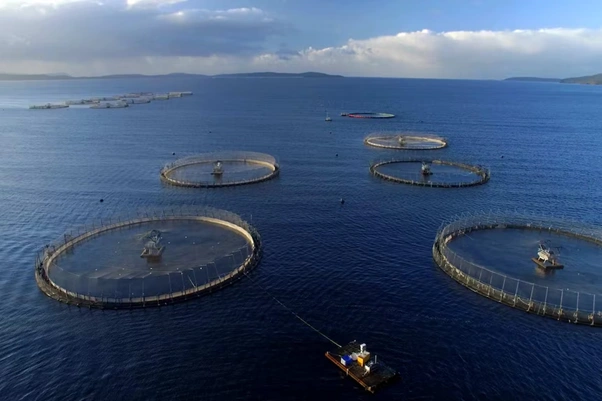
Figure 1: Image of Macquarie Harbour [Credit: ABC News/Sophie Zoellner]
The Maugean skate (Zearaja maugeana) is a prehistoric ray found nowhere else on Earth. Scientists describe it as the “Thylacine of the Sea.” The key facts are alarming:
- Maugean skate numbers dropped by nearly half between 2014 and 2021, leaving an estimated fewer than 1,500 in the wild.
- The salmon farms lining Macquarie Harbour have drastically lowered dissolved oxygen levels in the water, suffocating the skate’s habitat.
- A catastrophic storm event in 2019 lifted oxygen-depleted water to the surface, wiping out a significant portion of the remaining population.
- Federal conservation advice identifies intensive salmon farming as the most direct threat to the species’ survival.
- More than 80 environmental organisations globally called on certification bodies to revoke the “responsibly sourced” sustainability certifications for Macquarie Harbour salmon.
Despite this, both Woolworths and Coles continued to sell the product under a “responsibly sourced” label until shareholder activism, public pressure, and now these alleged inter-company discussions forced the labelling to change.
Cousins’ Role and the Shareholder Campaign
Geoff Cousins is no stranger to corporate activism. He has been a lead filer on shareholder resolutions, first against Coles, and now drawing scrutiny toward Woolworths, demanding both supermarkets stop sourcing salmon from Macquarie Harbour. The resolutions were filed jointly with Tasmanian NGOs Neighbours of Fish Farming and Environment Tasmania, alongside activist investor platform SIX.
In 2024, nearly 40 per cent of Coles shareholders voted in support of a world-first nature resolution targeting the Maugean skate, the highest-ever result for a nature-related shareholder resolution put to a retailer globally. At Woolworths’ AGM, Cousins directly challenged the Woolworths chairman on the company’s continued stocking of Macquarie Harbour salmon under a “responsibly sourced” label, famously stating, “You’ve mentioned best practice many times today, but when it comes to this issue, you say vote against it.”
Now, Cousins alleges those behind-closed-doors discussions between the two chairmen went beyond individual corporate strategy, potentially crossing into the territory of coordinated conduct between competitors.
The Competition Law Question: Were These Talks Lawful?
This is the crux of the matter. Under Australia’s Competition and Consumer Act 2010 (CCA), competition law does not merely prohibit formal cartel arrangements; it extends further:
- Cartel conduct is strictly prohibited and includes agreements between competitors to fix prices, restrict supply, or coordinate market conduct. Breaches carry criminal penalties of up to 10 years’ imprisonment and civil fines now up to $100 million per contravention (increased from $50 million under new legislation effective 28 March 2026).
- Concerted practices — introduced into Australian law in 2017 — capture a lower threshold of cooperation between competitors, potentially including informal information exchanges, where the conduct has the purpose, effect, or likely effect of substantially lessening competition.
- According to the ACCC, a “concerted practice” applies to any form of cooperation between parties, potentially including information exchanges, even without a formal “meeting of the minds.”
The critical legal question is this: if the chairs of Woolworths and Coles discussed product labelling strategy, one of the mechanisms by which they market and differentiate their salmon products to consumers, does that constitute a concerted practice that substantially lessened competition in the Australian grocery market?
Bob Brown Foundation, the Hobart-based environmental organisation, announced on 16 April 2026 that it will seek legal advice on exactly this question. Bob Brown himself stated: “A reference to the Australian Competition and Consumer Commission is, of course, one matter for us to determine.” The foundation’s Antarctic and Marine Campaigner Alistair Allan added that both companies are aware of the “irrefutable scientific evidence” that Macquarie Harbour fish farms pose a catastrophic threat to the Maugean skate’s survival.
The Broader Regulatory Storm Around Woolworths and Coles
These Woolworths Coles collusion claims do not emerge in a vacuum. Both supermarkets are already operating under intense regulatory scrutiny:
- The ACCC commenced separate Federal Court proceedings in September 2024, alleging that both retailers engaged in misleading “Prices Dropped” and “Down Down” discount campaigns — temporarily spiking prices before promoting artificially reduced “was” prices. The ACCC alleged the conduct involved 266 product lines at Woolworths over 20 months, and 245 product lines at Coles over 15 months.
- New regulations effective 1 July 2026 will ban both supermarkets — the only two retailers meeting the “very large” threshold of $30 billion revenue — from charging prices that are excessive relative to supply costs plus a reasonable margin.
- The ACCC doubled maximum penalties for competition and consumer law breaches effective 28 March 2026, sending an unambiguous signal that regulatory tolerance for anti-competitive conduct has reached its limit.
- ACCC Chair Gina Cass-Gottlieb put supermarkets on notice that enforcement action on excessive pricing can be expected as early as the second half of 2026.
What Both Companies Have Said and Done
Importantly, both Woolworths and Coles have now committed to removing the “responsibly sourced” label from their Tasmanian Atlantic salmon products. Coles had already dropped the label from its own-brand Tasmanian salmon by late 2025, following sustained shareholder pressure. Woolworths followed.
The question now is not just about labelling — it is about whether the process by which they arrived at that shared decision involved conduct that a court or the ACCC might consider coordinated.
Investors’ Outlook
Both stocks have had markedly different trajectories over the past year, with Woolworths significantly outperforming Coles as it navigates its ongoing leadership and operational challenges.
Coles (ASX: COL)
| Metric | Value |
| Last Price | $22.705 |
| Change (Day) | +$0.045 (+0.20%) |
| 1 Week | +3.25% |
| 1 Month | +11.41% |
| 2026 YTD | +5.90% |
| 1 Year | +7.56% |
| vs Sector (1yr) | +3.30% |
Coles has shown strong near-term momentum, with a 11.41% gain over the past month. The stock outperforms its sector benchmark by 3.30% over one year, reflecting relative stability despite the ongoing Federal Court proceedings and shareholder activism around salmon sourcing.
Woolworths (ASX: WOW)
| Metric | Value |
| Last Price | $36.635 |
| Change (Day) | -$0.115 (-0.31%) |
| 1 Week | -0.39% |
| 1 Month | +2.53% |
| 2026 YTD | +24.69% |
| 1 Year | +17.31% |
| vs Sector (1yr) | +13.25% |
| vs ASX 200 (1yr) | +1.87% |
Woolworths has dramatically outperformed the broader market in 2026, gaining 24.69% year-to-date. However, the collusion allegations introduced this week represent fresh reputational and legal tail-risk, particularly given the heightened penalty environment now in force. The slight day-on-day dip of 0.31% may reflect early market reaction to these developments.
Both stocks carry elevated ESG and regulatory risk profiles heading into the second half of 2026, as the ACCC’s enforcement pipeline, the July 2026 price regulation regime, ongoing Federal Court pricing cases, and now potential competition law scrutiny over inter-company communications converge simultaneously.
Disclaimer: This article is for informational purposes only and does not constitute financial or legal advice. Share price data is accurate as at time of publication. Past performance is not indicative of future results.
Frequently Asked Questions (FAQs)
What exactly did Geoff Cousins accuse the Woolworths chairman of doing?
Ans: Cousins alleged that the Woolworths chairman held off-the-record talks with the Coles chairman about their shared Tasmanian salmon labelling strategy — specifically, the disputed “responsibly sourced” claim on salmon farmed in Macquarie Harbour. The concern is that two direct competitors may have coordinated a commercial response rather than acting independently.
Is it illegal for the chairs of Woolworths and Coles to speak to each other?
Ans: Not automatically. However, under Australia’s Competition and Consumer Act 2010, informal communications between competitors can breach the law if they amount to a “concerted practice” that has the purpose or effect of substantially lessening competition. The ACCC does not require a formal agreement — even information exchanges can cross the line.
What is the Maugean skate and why does it matter to this story?
Ans: The Maugean skate is a prehistoric ray found only in Tasmania’s Macquarie Harbour. Intensive Atlantic salmon farming in the harbour has severely degraded water quality, pushing the species toward extinction. Both Woolworths and Coles sourced and labelled this salmon as “responsibly sourced” — a claim environmentalists, scientists, and shareholders have fiercely contested for years.
What action could the ACCC or Bob Brown Foundation take next?
Ans: The Bob Brown Foundation has announced it will seek legal advice and is considering referring the matter to the ACCC. If the regulator investigates and finds a breach of the concerted practices provisions, both companies face civil penalties of up to $100 million per contravention under penalty laws strengthened in March 2026 — making the regulatory stakes exceptionally high.
Sources
- https://www.afr.com/companies/retail/geoff-cousins-accuses-woolworths-chairman-of-collusion-with-coles-20260415-p5zo2o
- https://bobbrown.org.au/bbf-says-coles-woolworths-salmon-talks-are-environmentally-unethical-if-not-illegal/
- https://www.accc.gov.au/media-release/accc-takes-woolworths-and-coles-to-court-over-alleged-misleading-prices-dropped-and-down-down-claims
- https://www.beefcentral.com/trade/accc-tackles-coles-woolworths-in-federal-court-over-discount-claims/
- https://theconversation.com/supermarket-price-gouging-will-be-banned-from-july-will-consumers-actually-end-up-better-off-272060
- https://www.whitecase.com/insight-alert/australia-increases-penalties-competition-and-consumer-law-breaches
- https://www.bakermckenzie.com/en/insight/publications/2026/02/australia-acccs-2026-27-compliance-and-enforcement-priorities
- https://www.grondalbruining.com.au/blog/competition-law-in-australia-an-introduction/
- https://www.claytonutz.com/toolkits/doing-business-in-australia/antitrust-competition-and-trade-practices-regulation
- https://www.noff.au/l/are-you-selling-diseased-salmon-as-responsible-tasmanian-communities-confront-woolworths-agm/


