

Meridian Energy Limited (ASX: MEZ) released its monthly operating report for March 2026 on 17 Apr 2026. The report covers both monthly and quarterly performance, showing broad operational strength across generation, retail, and water storage metrics.

Figure 1: Meridian Energy company logo [Courtesy: Meridian Energy]
The Meridian Energy share price update comes as the Company delivered its third-quarter results alongside monthly figures. Retail sales volumes, customer connections, and hydro generation all moved higher compared to the prior year period.
Retail Sales Growth Reflects Broad Customer Demand Across All Segments
Meridian Energy financial data for March 2026 shows retail contracted sales volumes of 876GWh for the month. This was 11.4% higher than March 2025, with growth recorded across every customer segment.
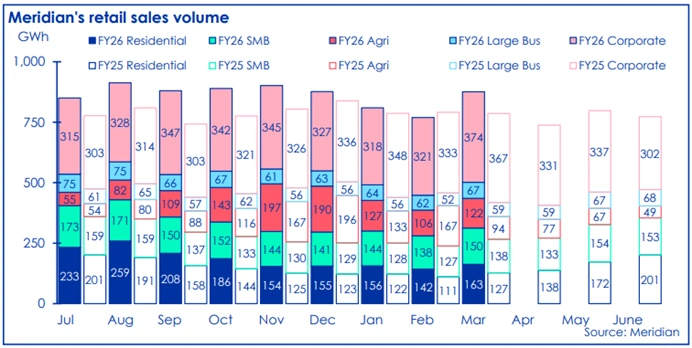
Figure 2: Retail sales volume by customer segment (FY25 vs FY26) [Courtesy: Meridian Energy]
Sales Growth Spread Across Every Customer Category
Compared to March 2025, segment performance for the month was as follows:
- Residential sales volumes: 163GWh, up 27.8% on March 2025
- Small and medium business sales volumes: 150GWh, up 8.2% on March 2025
- Agricultural sales volumes: 122GWh, up 30.7% on March 2025
- Large business sales volumes: 67GWh, up 14.1% on March 2025
- Corporate and industrial sales volumes: 374GWh, up 1.7% on March 2025
Customer Connections Reach Nearly 465,000 Across New Zealand
Total New Zealand customer connections stood at 464,985 as at 31 Mar 2026. This represents growth of 17.7% compared to the same time last year. Year-to-date retail sales volumes are 9.2% higher than the same period in the prior financial year.
Generation Output Climbed Sharply as Hydro Conditions Remained Supportive
Meridian Energy’s total generation for March 2026 was 1,211GWh. This was 30.7% higher than the same month last year. Hydro generation accounted for 1,085GWh, while wind generation contributed 124GWh.
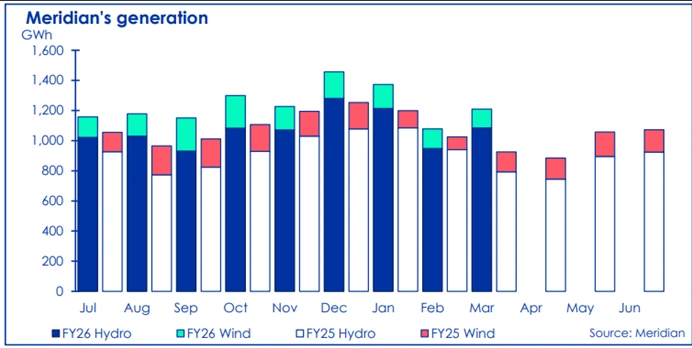
Figure 3: Monthly electricity generation by source (hydro and wind) [Courtesy: Meridian Energy]
Average Generation Price Fell Sharply Compared to the Prior Year
The average price Meridian received for its generation in March 2026 was $146.5 per MWh. This was 51.5% lower than the same month last year. The average price paid to supply retail customers in March 2026 was $154.2 per MWh, also 53.3% lower than March 2025.
Year-to-Date Generation Tracking Well Above Prior Year
Meridian Energy financial data shows total generation for the nine months to 31 Mar 2026 was 11,145GWh. This is 14.3% higher than the same period last year, reflecting stronger hydro and wind output across the financial year.
Water Storage and Inflows Hold Near Historical Averages Heading Into Winter
Meridian Energy’s March 2026 monthly total inflows were 74% of the historical average. Waiau catchment inflows were 80% of the historical average for the month, 30% higher than the same month last year.
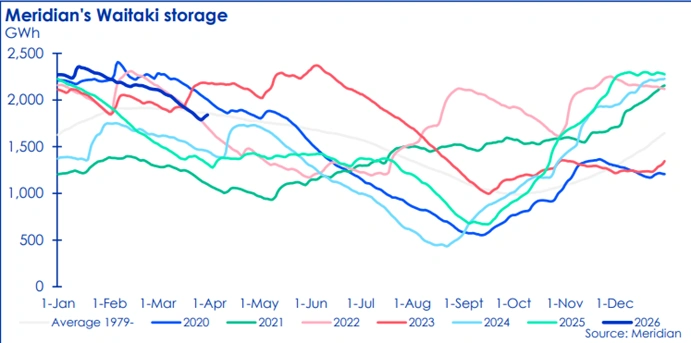
Figure 4: Waitaki hydro storage levels compared with historical trends [Courtesy: Meridian Energy]
Waitaki Storage Well Above Year-Ago Levels Despite March Dryness
Waitaki catchment water storage moved from 2,114GWh to 1,840GWh during March 2026. Waitaki water storage at the end of March 2026 was 99% of the historical average and 40% higher than the same time last year. Water storage in the Waiau catchment was 73% of average at the end of March 2026.
Year-to-Date Inflows Rank Among Best on Record
To date this financial year, total inflows are 123% of the historical average. This ranks as the 6th highest financial year inflows on record. CEO Mike Roan commented on the storage position heading into the cooler months.
“We have maintained momentum through the March quarter after a very strong half-year result, and the lakes are looking really good as we get closer to winter. These things can change, however, at this stage we have 40% more water than we did at the same time last year,” Roan said.
ASX Electricity Futures Prices Continue Falling Through the Quarter
March 2026 saw further decreases in ASX electricity futures prices. Roan noted the significance of the continued price decline.
“The continued fall in ASX prices is significant and a sign that power will get more affordable as the massive ongoing investment in new renewable generation lands. We expect this to flow through into contracted electricity prices,” he said.
National electricity demand in March 2026 was 4.5% higher than in March 2025. New Zealand Aluminium Smelters Limited (NZAS) average load during March 2026 was 575MW, compared with 524MW a year ago.
Capital Expenditure Guidance Revised Downward for FY26
Meridian Energy’s FY26 capital expenditure guidance has been revised to between $280 million and $310 million. The previous guidance range was $330 million to $360 million. The updated breakdown is as follows: stay in business, capital expenditure of $100 million to $110 million, and growth capital expenditure of $180 million to $200 million.
Total capital expenditure for the nine months to 31 Mar 2026 was $153 million, compared with $128 million for the same period last year.
Meridian Energy Share Price Update
Meridian Energy Limited (ASX: MEZ) is currently trading at $4.680 per share, with a market capitalisation of $12.28B. The 52-week range stands at $4.370 to $5.550 per share.
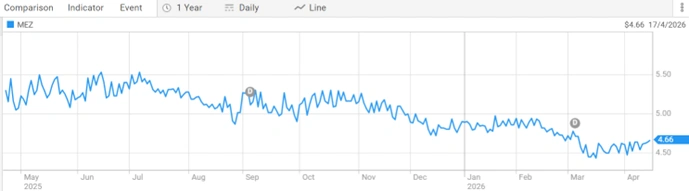
Figure 5: Share price performance over the past year [Courtesy: ASX]
Industry Outlook
New Zealand’s renewable energy sector continues to attract significant capital investment, with new generation assets expanding capacity and contributing to falling wholesale electricity prices.
Hydro-dominant generators like Meridian Energy remain well-positioned as water storage levels hold near or above historical averages heading into the winter demand period.
Growing national electricity demand, up 4.5% year on year in March 2026, reflects both population growth and the broader electrification trend across residential and commercial sectors.
Future Direction and Impact on MEZ Investors
For investors tracking the Meridian Energy share price update, the March 2026 report confirms operational momentum across generation, retail sales, and customer growth.
The downward revision to FY26 capital expenditure guidance, from $330 million to $360 million previously, down to $280 million to $310 million, may be read as a positive signal for near-term cash management.
The Meridian Energy performance analysis for Q3 shows generation was 16.4% higher year on year, at a 71.2% lower average price. Customer numbers at the end of Q3 were 17.7% higher than the same time last year.
The key risk factor to monitor remains the sustained decline in ASX electricity futures prices, which, while benefiting consumers, continues to compress generation revenue margins. Meridian Energy financial data through the nine months to March 2026 reflects this tension, with significantly lower average prices received despite higher volumes.
ALSO READ: Resolution Minerals Advances Antimony Ridge Metallurgy with High-Purity Antimony Trioxide Production
Frequently Asked Questions
Q1. What did Meridian Energy report for March 2026 retail sales?
Ans. Meridian Energy reported retail contracted sales volumes of 876GWh for March 2026, up 11.4% compared to March 2025, with growth across all customer segments.
Q2. How does Meridian Energy’s hydro storage look ahead of winter?
Ans. Waitaki water storage at the end of March 2026 was 99% of the historical average and 40% higher than the same time last year, placing the Company in a strong position heading into the winter demand period.
Q3. Why has Meridian Energy revised its FY26 capital expenditure guidance?
Ans. FY26 capital expenditure guidance was revised down to $280 million to $310 million from the previous $330 million to $360 million. The Company has not provided a specific reason beyond the updated guidance figures in the March 2026 operating report.
Q4. What is the current Meridian Energy share price?
Ans. Meridian Energy (ASX: MEZ) is currently trading at $4.680 per share with a market capitalisation of $12.28B and a 52-week range of $4.370 to $5.550 per share.
Q5. What is driving the fall in ASX electricity futures prices?
Ans. CEO Mike Roan attributed the decline to high levels of investment in new renewable generation and system security provided by agreements signed for Huntly capacity.
Disclaimer
This article is intended for informational purposes only and does not constitute financial or investment advice. All content is based on Meridian Energy Limited’s monthly operating report released on 17 Apr 2026 and supplementary publicly available sources. Share price and market capitalisation data reflect figures provided at the time of publication. Investing in securities involves risk, including the possible loss of principal. Readers should conduct their own research and seek independent financial advice before making any investment decisions. Colitco does not hold any position in the companies or organisations mentioned.
Sources
https://www.meridianenergy.co.nz
https://www.asx.com.au/markets/company/MEZ


