Researchers have spent decades trying to crack the drug discovery problem. It costs billions of dollars, takes over a decade, and still fails roughly 90% of the time. IBM thinks quantum computing can help change that, and the evidence is starting to back them up.
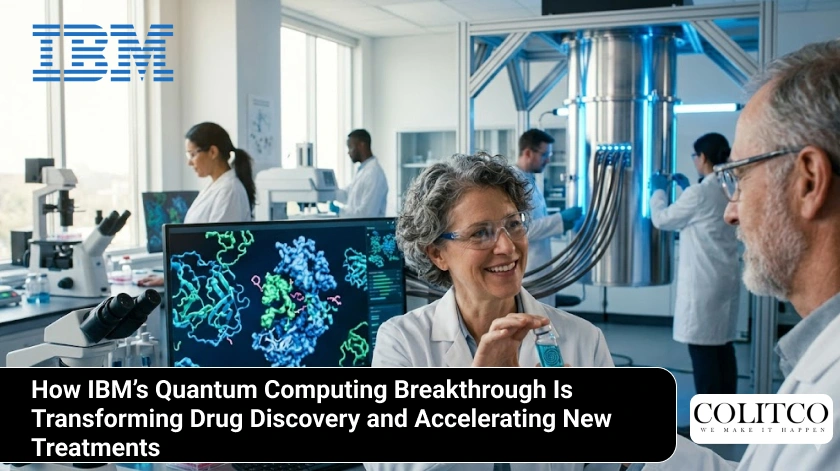
In April 2026, IBM announced that five of the six Phase III finalists in the Wellcome Leap Quantum for Bio (Q4Bio) Challenge used IBM quantum hardware to run their experiments. The winning team, headed by quantum software firm Algorithmiq, with IBM providing quantum computing support and the Cleveland Clinic contributing biological expertise, walked away with a $2 million prize for their work on quantum-powered cancer drug simulations.

Figure 1: In the Wellcome Leap Q4Bio Challenge, Algorithmiq, supported by IBM and the Cleveland Clinic, won $2 million for quantum-driven cancer drug simulations.
What IBM Quantum Is Actually Doing Differently
IBM Quantum Computer Explained: The Basics
Before diving into the breakthroughs, it helps to understand what makes this technology different.
A classical computer processes information as bits, either a 0 or a 1. To get the IBM quantum computer explained in plain terms: quantum computers use qubits, which can exist as ‘0’, ‘1’, or both at the same time. This property, called superposition, lets quantum systems explore enormous numbers of possibilities simultaneously.
That matters enormously in drug discovery, where researchers must sift through astronomical numbers of molecular combinations to find compounds that actually work.
According to IBM’s Institute for Business Value, the number of possible 50-atom molecules exceeds 10 to the power of 50. Add in all the physical configurations a molecule can take, and that number blows out to 10 to the power of 80. No classical computer comes close to handling that.
Hybrid Workflows: The Practical Bridge
IBM isn’t waiting for perfect quantum hardware to arrive before producing results. Instead, the company builds hybrid quantum-classical workflows, systems where classical computers handle the bulk of the computation and quantum processors tackle the hardest sub-problems.
This approach is central to what IBM calls the “era of quantum utility.” A classical system might set up the problem and analyse the results, while the quantum processor solves the specific, computationally brutal core-like problem, such as calculating the lowest-energy configuration of an mRNA sequence.
It’s a smart strategy, and it’s working.
The Breakthrough That’s Turning Heads in Healthcare
Algorithmiq, Cleveland Clinic, and IBM Win $2M Q4Bio Prize
The Q4Bio Challenge, run by the non-profit Wellcome Leap, pushed research teams to demonstrate quantum algorithms on real hardware, not just simulations. Teams needed to run circuits on more than 50 qubits with depths between 1,000 and 10,000 gates.
Algorithmiq developed an end-to-end hybrid quantum-classical framework that ran large-scale molecular simulations on IBM quantum hardware, up to 100 qubits, to model light-activated cancer drug processes. This type of treatment, called photodynamic therapy, relies on drugs that activate under light to destroy cancer cells.
Sabrina Maniscalco, CEO of Algorithmiq, has mentioned in this context: “This work provides one of the clearest indications to date that quantum computing can begin to impact real, chemically relevant problems, rather than simplified benchmarks.”
IBM’s quantum systems made that scale possible.
Moderna and IBM: Folding mRNA at Record Scale
One of the most publicised IBM quantum partnerships is with Moderna. The two companies have spent years exploring how quantum algorithms can improve mRNA medicine design, the same technology behind some of the most effective COVID vaccines.
In 2024, their joint team successfully used IBM’s 156-qubit Heron processor to predict the stable secondary structure of a 60-nucleotide mRNA sequence. That broke the previous quantum record of 42 nucleotides.
By 2025, the same team extended their approach to problems involving 156 qubits and 950 non-local gates, a significant jump in complexity.
Wade Davis at Moderna described the method as treating mRNA folding like “a giant puzzle” where quantum computing evaluates many patterns simultaneously. For vaccine designers, finding the optimal mRNA fold directly affects how well the resulting protein instructs the immune system.
The Wider Impact Across Drug Development
Five of six Q4Bio finalists chose IBM hardware for their experiments. Each team tackled a different corner of healthcare:
- University of Oxford and Sanger Institute encoded the Hepatitis-D genome onto an IBM Heron r2, a world first for quantum genomics
- Infleqtion, University of Chicago, and MIT ran hybrid quantum-classical workflows to discover novel cancer biomarkers
- Stanford and Michigan State University used IBM hardware to model ATP and GTP hydrolysis, reactions that power most cellular processes
- University of Nottingham and Phasecraft applied quantum algorithms to covalent inhibitor design targeting Myotonic dystrophy type 1, a currently untreatable condition
Fred Chong, Professor at the University of Chicago, said that Heron QPUs were the only available hardware meeting the challenge’s requirements. That’s a striking endorsement.
What IBM’s Hardware Roadmap Looks Like
IBM has moved away from simply racing to stack up qubits. Instead, the company focuses on quality: better gate fidelity, lower error rates, and modular architectures.
Key milestones in the roadmap include:
- Nighthawk (2025): 120 qubits with enhanced connectivity and 30% more circuit complexity than previous generations
- Kookaburra (2026): IBM’s first modular processor combining quantum memory with logic operations
- Starling (2029): Targeting 200 logical qubits running 100 million gates — 20,000 times more operations than today’s systems
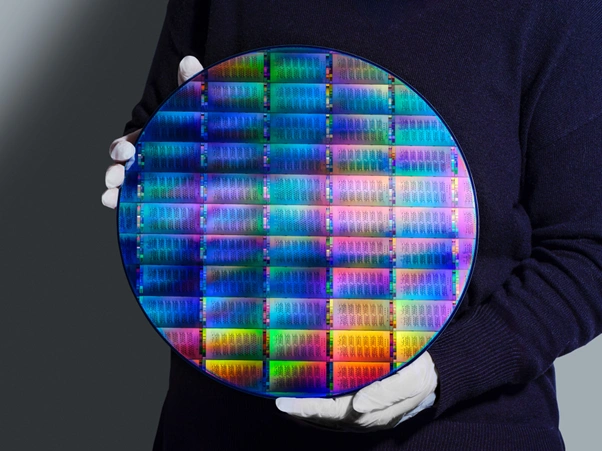
Figure 2: 300mm IBM Quantum Nighthawk wafer with an IBM researcher holding it [Credit: IBM]
Jay Gambetta, IBM Research Director, has mentioned that quantum and classical resources working together can achieve what neither can alone.
IBM’s push also intersects with how broader AI tools transform business intelligence. While quantum handles molecular-level physics, AI-driven data tools like IBM SQL Data Insights Pro help organisations make sense of the massive datasets that drug pipelines generate. And as quantum systems grow in scale, cybersecurity considerations become increasingly critical, particularly for the sensitive biological and clinical data that pharmaceutical research depends upon.
Why the Investment Community Is Paying Attention
IBM stock closed at $253.47 on 17 April 2026, up nearly 1% on the day, with trading volume above its daily average. The market cap sits at $237.76 billion. Here is a quick outlook on IBM’s stock market performance on the NYSE:
- Last Price: US$253.47
- Performance:
- Day: + 0.98%
- 1 month: -1.03%
- 6 months: -9.89%
- 1 year: +6.14%
- Year-to-date: -14.43%
- Market capitalisation: US$237.76 billion
- 52-week range: US$220.72 – US$324.90
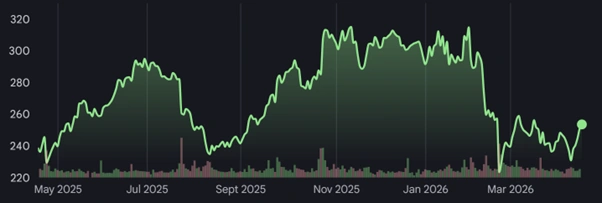
Figure 3: 1-year share price performance of International Business Machines Corporation (IBM), NYSE: IBM [Credit: Google Finance]
McKinsey estimates quantum computing could generate $200 to $500 billion in value for the pharmaceutical sector alone by 2035. Novo Holdings, the parent company of Novo Nordisk, committed $200 million to quantum life-science startups in 2024. Industry surveys indicate eight of the top ten biopharma companies already run quantum computing pilot programs.
IBM sits at the centre of much of that activity.
Sources
- https://www.prnewswire.com/news-releases/how-ibm-quantum-is-enabling-healthcare-and-biology-research-302745181.html
- https://intuitionlabs.ai/articles/ibm-quantum-drug-discovery
- https://www.tipranks.com/news/ibms-quantum-computing-tech-is-making-drug-development-more-efficient
- https://newsroom.ibm.com/2023-04-20-Moderna-and-IBM-to-Explore-Quantum-Computing-and-Generative-AI-for-mRNA-Science
- https://siliconangle.com/2022/11/16/ibm-teams-algorithmiq-use-quantum-computers-drug-discovery/
- https://quantumcomputingreport.com/moderna-and-ibm-demonstrate-quantum-classical-approach-for-mrna-secondary-structure-prediction/
- https://www.mckinsey.com/industries/life-sciences/our-insights/the-quantum-revolution-in-pharma-faster-smarter-and-more-precise
- https://newsroom.ibm.com/2025-06-10-IBM-Sets-the-Course-to-Build-Worlds-First-Large-Scale,-Fault-Tolerant-Quantum-Computer-at-New-IBM-Quantum-Data-Center
- https://newsroom.ibm.com/2025-11-12-ibm-delivers-new-quantum-processors,-software,-and-algorithm-breakthroughs-on-path-to-advantage-and-fault-tolerance
Last modified: April 20, 2026