
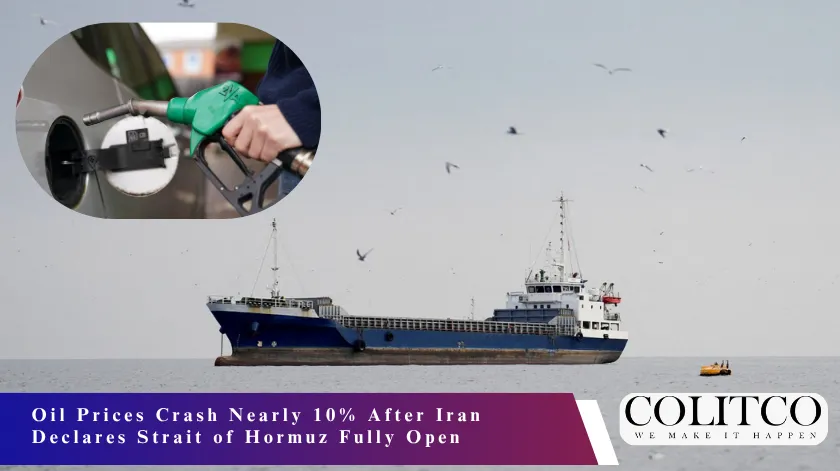
Iran’s Foreign Minister Opens the Strait for Commercial Vessels
Oil markets reacted sharply on Friday after Iranian Foreign Minister Seyed Abbas Araghchi announced that the Strait of Hormuz was open to all commercial vessels. He made the announcement via a post on the social media platform X.
In line with the ceasefire in Lebanon, the passage for all commercial vessels through Strait of Hormuz is declared completely open for the remaining period of ceasefire, on the coordinated route as already announced by Ports and Maritime Organisation of the Islamic Rep. of Iran.
— Seyed Abbas Araghchi (@araghchi) April 17, 2026
The announcement marks a significant shift. Iran had maintained tight control over transit through the strait since the conflict began. The declaration came alongside continued ceasefire negotiations between Washington and Tehran.
Trump Responds — U.S. Stocks Rally on the News
U.S. President Donald Trump quickly acknowledged the announcement on his Truth Social platform. He wrote in capital letters that Iran had declared the strait fully open and ready for passage, adding a note of thanks.
Markets responded immediately. U.S. stock futures climbed to record highs after the post. Traders read the combined messaging from both Tehran and Washington as a concrete step toward restoring energy flows through one of the world’s most critical shipping lanes.
Crude Oil and Energy Futures Plunge Across the Board
West Texas Intermediate crude fell 12%, settling near $83 per barrel. International benchmark Brent crude dropped more than 11%, reaching approximately $88.72, its lowest level in over a month.
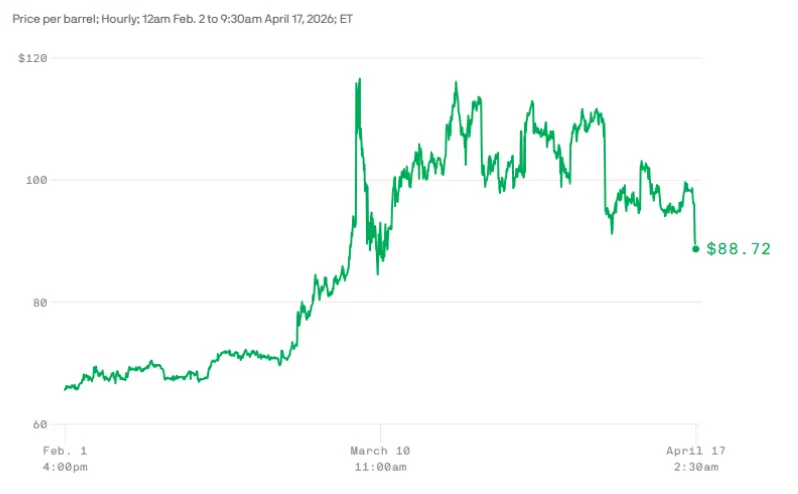
Global oil markets plunge as traders react to easing supply risks. [Axios]
The selloff extended beyond crude oil. Heating oil futures, a proxy for jet fuel, fell 13%. Wholesale RBOB gasoline futures declined 7%. The scale of the drop reflected how much of a risk premium energy markets had built into prices since the strait’s effective closure in early March 2026.
Background: The Largest Oil Supply Disruption in Modern History
The roots of the crisis trace back to late February 2026. The United States and Israel launched strikes against Iran on February 28. Iran responded by blocking the Strait of Hormuz — disrupting roughly 20% of the world’s seaborne oil supply.
The closure triggered what analysts have described as the largest single oil supply disruption on record. Energy prices climbed steeply. Brent crude neared $100 per barrel in the days before Friday’s announcement. The disruption also halted significant volumes of liquefied natural gas exports from Gulf producers, compounding the supply crisis for Europe and Asia.
Context: Strait of Hormuz
The Strait of Hormuz connects the Persian Gulf to the Gulf of Oman. Before the conflict, more than 100 vessels transited the waterway daily. It carries roughly one quarter of all globally traded seaborne oil.
Ceasefire Timeline — and What Comes After April 21
The United States and Iran agreed to a two-week ceasefire on April 8. Under the agreement, Iran was to allow ships to pass through the strait in exchange for the pause in hostilities. However, traffic through the waterway stayed well below pre-war levels even after that deal.
The ceasefire expires on Tuesday, April 21. Trump told reporters on Thursday that the two countries would likely meet again over the weekend for further negotiations. No official date was confirmed. The outcome of those talks could determine whether the strait stays open beyond next week.
Earlier ceasefire talks failed, partly over the nuclear issue. Vice President JD Vance, who led the U.S. delegation, said Iran had not provided an “affirmative commitment” that it would not pursue a nuclear weapon.
Shippers and Analysts Urge Caution Over Strait Access
Despite the price reaction, analysts urged caution. Iran’s statement lacked specific operational details. Questions remained about whether ships would need to pay a toll to Iran in exchange for safe passage through the “coordinated route” the foreign minister referenced.
Joseph Webster, a senior fellow at the Atlantic Council, noted the practical difficulties. “Shipping logistics through the Strait of Hormuz are complicated even in peacetime,” he said. He added that shippers would be reluctant to pay tolls, particularly with the conflict potentially resuming once the ceasefire ends.
Attacks on vessels in the Persian Gulf during the conflict had already driven tanker traffic to historic lows. Only a handful of supertankers made the journey through the strait in recent days, compared with more than 100 vessels per day before the war.
European Leaders Welcome the Opening — With Conditions
Western leaders welcomed the development but attached clear conditions to their support. The European Union’s top diplomat, Kaja Kallas, called for free and unobstructed passage under international law.
“Under international law, transit through waterways like the Strait of Hormuz must remain open and free of charge. Any pay-for-passage scheme will set a dangerous precedent for global maritime routes.”
— Kaja Kallas, EU High Representative for Foreign Affairs

Kaja Kallas speaks during a European Union meeting, calling for unrestricted passage through the Strait of Hormuz under international law. [Politico]
French President Emmanuel Macron, speaking from a summit, said the reopening needed oversight from a neutral and independent party. UK Prime Minister Keir Starmer stated plainly: “The Strait should be reopened immediately with no tolls and no restrictions.”
Global Economic Impact — Food, Fuel, and Fertiliser Costs
The broader economic consequences of the Strait’s closure extended well beyond fuel prices. The disruption cut off over 30% of global urea exports, a key ingredient in fertilisers produced from natural gas in Gulf countries. Food analysts warned of rising costs for staple crops such as corn and wheat.
Gas prices in the United States have risen by more than a dollar per gallon since the start of the conflict. In Canada, prices climbed roughly 30% between March and April. Jet fuel prices in North America more than doubled, prompting airlines to add baggage surcharges and shipping companies like FedEx and the U.S. Postal Service to impose fuel fees.
Europe faced particular pressure from the halt in Qatari liquefied natural gas exports. QatarEnergy declared force majeure on its supply contracts in early March. Internal sources told Reuters that restarting LNG liquefaction after a shutdown could take several weeks, leaving European markets exposed.
What Traders and Markets Watch Next
Friday’s price drop signals that markets see real potential for easing supply disruptions. However, analysts note that confidence in the strait’s reopening depends on more than a social media post. Actual vessel movements, insurance coverage, and security guarantees need to follow before shipping volumes recover meaningfully.
The next critical date is April 21, when the ceasefire expires. If talks over the weekend progress, traders will watch whether Iran and the United States extend the truce or allow it to lapse. A breakdown in negotiations could reverse Friday’s market moves quickly.
For now, the announcement offers the first concrete signal that one of the world’s most consequential energy chokepoints may be reopening, even if the path forward remains uncertain.
FAQS
Q1: Why did oil prices drop sharply on April 17, 2026?
A1: Oil prices fell nearly 10% after Iran announced that the Strait of Hormuz was fully open to commercial vessels, easing fears of global supply disruptions.
Q2: What is the importance of the Strait of Hormuz?
A2: The Strait of Hormuz is one of the world’s most critical oil transit routes, carrying about a quarter of globally traded seaborne crude oil.
Q3: How much did Brent and WTI crude prices fall?
A3: Brent crude dropped over 11% to around $88.90 per barrel, while WTI crude fell about 12% to approximately $83 per barrel.
Q4: What caused the earlier surge in oil prices?
A4: Prices had surged after Iran restricted access to the Strait of Hormuz following military tensions involving the United States and Israel in late February 2026.
Q5: Is the Strait of Hormuz fully reopened permanently?
A5: No, the reopening is currently tied to a temporary ceasefire set to expire on April 21, 2026, making the situation uncertain.
Q6: How are global markets reacting to the announcement?
A6: Energy markets dropped sharply, while U.S. stock futures rose, reflecting optimism that oil supply disruptions may ease.
Q7: What risks remain despite the reopening?
A7: Uncertainty remains over shipping safety, possible tolls, insurance costs, and whether the ceasefire will be extended beyond April 21.
Q8: How did the crisis impact global economies?
A8: The disruption increased fuel costs, raised fertilizer prices, and contributed to higher food and transport expenses worldwide.
Disclaimer
This article is published by Colitco for informational and news reporting purposes only and is based on publicly available information and official statements at the time of writing. While efforts are made to ensure accuracy, Colitco does not guarantee completeness or reliability. This content does not constitute financial, investment, legal, or professional advice, and readers should conduct their own research or consult qualified professionals before making decisions. Colitco is not liable for any losses arising from the use of this information, and views expressed by quoted individuals do not necessarily reflect those of Colitco.
Sources


