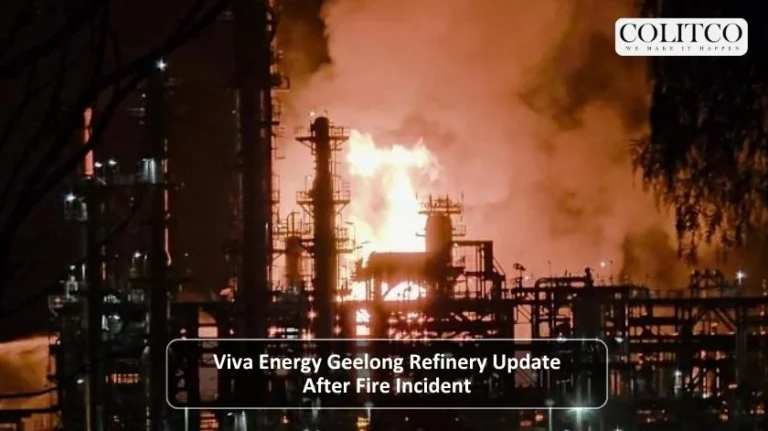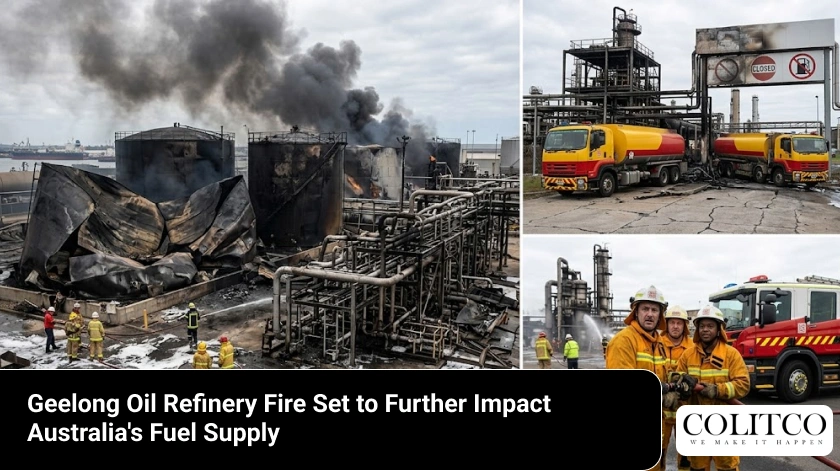
A major fire at the Viva Energy oil refinery in Geelong, Victoria, has raised fresh concerns about Australia’s already strained fuel supply. The blaze, which broke out just before midnight on Wednesday, burned for 13 hours before emergency crews extinguished it on Thursday. No injuries were reported, with dozens of on-site workers evacuated safely before the fire spread.
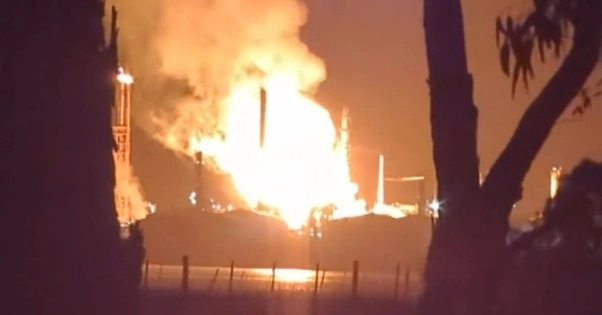
Fire crews battle a major blaze at the Viva Energy Geelong oil refinery, which burned for over 13 hours before being contained. [9News]
The refinery is one of only two operating oil refineries in Australia. It supplies approximately 50 per cent of Victoria’s fuel and 10 per cent of national demand. The incident comes as Australia faces an ongoing global fuel crunch driven by conflict disrupting supply routes in the Middle East.
Fire Caused by Equipment Failure at Geelong Refinery
Fire Rescue Victoria confirmed that equipment failure caused the blaze. An investigation is now underway to determine the exact circumstances. The affected site, the Viva Energy Corio refinery, processes up to 120,000 barrels of oil per day and employs more than 1,100 people.
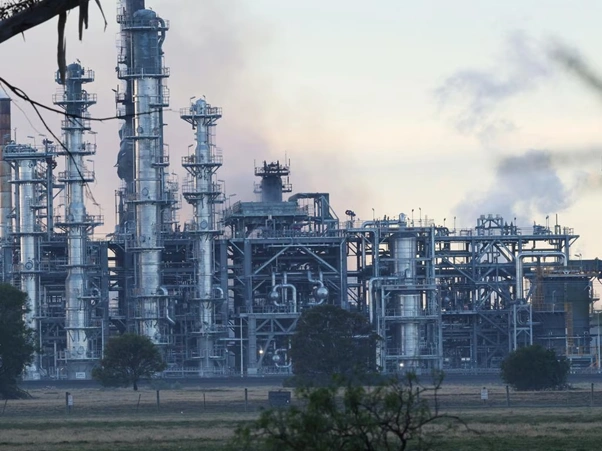
The Viva Energy Corio refinery in Geelong processes up to 120,000 barrels of oil per day and is a critical part of Australia’s fuel infrastructure. [The Australian]
The fire affected two petrol production units. Other sections of the refinery remained undamaged. Viva Energy chief executive Scott Wyatt confirmed the extent of the impact, stating:
“But naturally petrol will be one of the products that are potentially impacted. We’ll only start increasing production again once we’re confident we can do that safely.”
Geelong Mayor Stretch Kontelj described the fire as unprecedented. He confirmed he had spoken with refinery management and noted the significant shock the incident caused to the facility and its workforce.
Petrol and Diesel Output Slashed as Refinery Operates at Minimum Rates
Following the fire, the refinery moved to minimum production rates as a safety precaution. Petrol production sustained the most significant impact. Jet fuel and diesel production continued at reduced levels while engineers assessed the damage.
Energy Minister Chris Bowen acknowledged the seriousness of the situation. He stated production will face a measurable impact, though he noted the government remains in close contact with Viva Energy. Bowen described the incident as happening at “not great timing” for Australia’s fuel security.
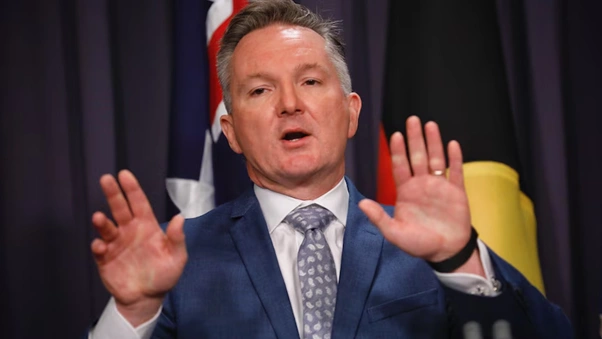
Energy Minister Chris Bowen [ABC]
Australia’s only other operational refinery, the Ampol Lytton facility in Brisbane, may need to increase output to offset the gap. The Brisbane refinery also accounts for approximately 10 per cent of national fuel supply. The remainder comes from overseas imports, primarily from Singapore, South Korea, and Malaysia.
Fuel Price Hike Expected as Domestic Supply Chain Tightens
Economists warn that a price increase at the pump is likely to follow. Dr Luke Hartigan, a Senior Lecturer in Economics at the University of Sydney, said the reduced supply will push prices upward. He noted that given current market conditions, the price effect could materialise quickly.
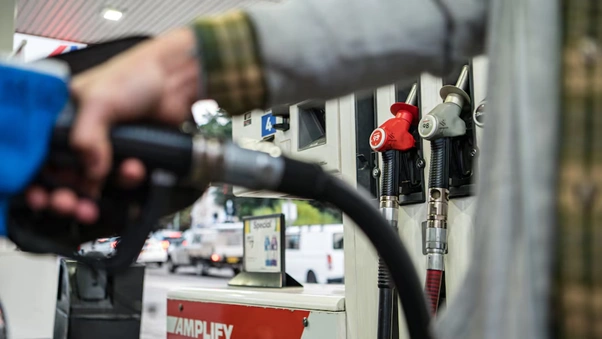
Fuel prices are expected to rise as reduced refinery output tightens domestic supply across Australia. [ABC News]
Associate Professor Xin Deng from Adelaide University said Victoria and diesel markets will face the most acute pressure. With half of Victoria’s fuel supply originating from the Geelong refinery, even a temporary production disruption can widen shortages and lift prices at service stations.
Deng added that unless the government acts quickly, including considering emergency fuel releases or rationing, the number of petrol stations running dry is likely to grow. Price hikes at the pump may follow shortly after.
Victoria’s Fuel Shortage Crisis Deepens Amid Existing Global Pressures
Australia entered this incident already managing a Stage 2 fuel supply crunch. Conflict in Iran has disrupted key global oil supply routes, including traffic through the Strait of Hormuz. The Geelong fire compounds an already fragile situation.
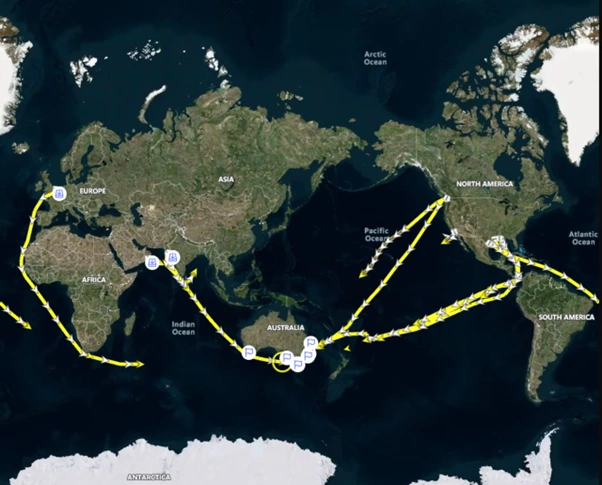
Australia relies heavily on fuel imports, with Geelong playing a key role in Victoria’s domestic supply network. [News.com.au]
Professor Hussein Dia of Swinburne University of Technology said the fire reduces the buffer the national fuel system has to absorb further shocks. He noted the incident does not necessarily mean people will run out of fuel immediately. However, it leaves less room to manage any additional disruption.
The fire also threatens to reverse progress made through government measures designed to ease fuel costs. These include a temporary federal excise reduction and free public transport across Victoria throughout April. Experts say the fire’s effects may offset or diminish the intended consumer benefits of both policies.
Diesel Supply Disruption Threatens Freight, Agriculture, and Supermarkets
Diesel underpins some of Australia’s most critical supply chains. Freight vehicles, farm machinery, and logistics networks all rely on it. Any sustained reduction in diesel availability risks broader economic disruption beyond the fuel sector.
Hartigan warned that if truck operators cannot access diesel, food deliveries to supermarkets may slow. This could reduce availability and increase prices for everyday goods. The effect would extend the fuel crisis into the broader cost-of-living pressure consumers already face.
Experts agree that diesel supply requires priority management during any extended period of reduced refinery output. Government agencies and fuel distributors will need to coordinate allocation across critical sectors to prevent wider disruption.
Risk of Panic Buying Could Amplify Petrol Shortages Across Australia
Experts caution that behavioural responses to the fire could worsen the physical supply situation. Dr Amanda Craft, a lecturer at Western Sydney University, said visible infrastructure incidents, especially those involving fire, trigger precautionary purchasing even when the actual supply remains largely functional.
Research on consumer behaviour during crises shows that people often act to avoid anticipated scarcity rather than responding to current need. This dynamic can generate the very shortages consumers fear. The approach of the ANZAC long weekend, a period of elevated travel demand, amplifies this risk further.
Craft stressed that transparent and specific government communication, including concrete data on stock levels and distribution plans, is the most effective tool to prevent demand spikes. Vague reassurances, she said, tend to increase public anxiety rather than reduce it.
Environmental and Public Health Risks Follow Geelong Refinery Blaze
The fire released significant smoke and combustion emissions over the Geelong region. Environmental scientists warned that the blaze may have introduced elevated levels of sulphur dioxide, volatile organic compounds, and fine particles into the air. These substances pose respiratory risks for residents near the site.
Professor Susan Wilson of the University of New England noted that soil and water contamination could occur if the site containment proves inadequate. She said ongoing monitoring of air, soil, and water quality remains essential as emergency responders complete their assessment.
Professor Kannan Govindan of Adelaide University also flagged the possibility of longer-term environmental effects, including contamination from persistent compounds such as polycyclic aromatic hydrocarbons. He noted that no confirmed health incidents had been reported as of Thursday but called for continued public health monitoring.
Also Read: Viva Energy Geelong Refinery Fire Sparks Fuel Supply Fears
Refinery Fire Exposes Australia’s Long-Term Fuel Security Vulnerabilities
Australia has significantly reduced its domestic refining capacity over the past two decades. The country now relies on just two operational refineries and depends heavily on imported refined fuels. Experts say this structural vulnerability becomes clear whenever a single local facility faces disruption.
Associate Professor Deng described the incident as a further wake-up call for Australia’s fuel security strategy. He called on the government to commit to policies that support the development of domestic renewable and alternative fuels, reducing dependence on ageing refinery infrastructure and long international supply chains.
Professor Dia echoed this position. He said Australia’s fuel resilience will only improve through a long-term shift away from liquid fuels altogether. In the short term, careful supply management, clear government communication, and coordination across import channels remain the most effective tools to limit the impact of the Geelong fire on Australian consumers.
FAQS
Q1: What caused the Geelong oil refinery fire?
A1: The fire was caused by an equipment failure, with authorities investigating the exact circumstances behind the incident.
Q2: How does the Geelong refinery affect Australia’s fuel supply?
A2: It supplies about 50% of Victoria’s fuel and roughly 10% of national demand, making any disruption significant.
Q3: Will fuel prices increase after the fire?
A3: Yes, reduced production is expected to tighten supply, which could lead to higher petrol and diesel prices.
Q4: Are there any risks of fuel shortages?
A4: While a nationwide shortage is unlikely, local disruptions and temporary shortages may occur, especially in Victoria.
Q5: What industries could be impacted by diesel disruptions?
A5: Freight transport, agriculture, and supermarket supply chains could face delays and increased costs if diesel supply is affected.
Disclaimer
This article is published by Colitco for informational purposes only and is based on publicly available information at the time of writing. It does not constitute financial, investment, or professional advice. While every effort has been made to ensure accuracy, Colitco makes no representations or warranties regarding the completeness or reliability of the information. Readers are advised to conduct their own research and consult qualified professionals before making any decisions based on this content. Colitco and its affiliates are not liable for any loss or damage arising from the use of this information.
Sources