
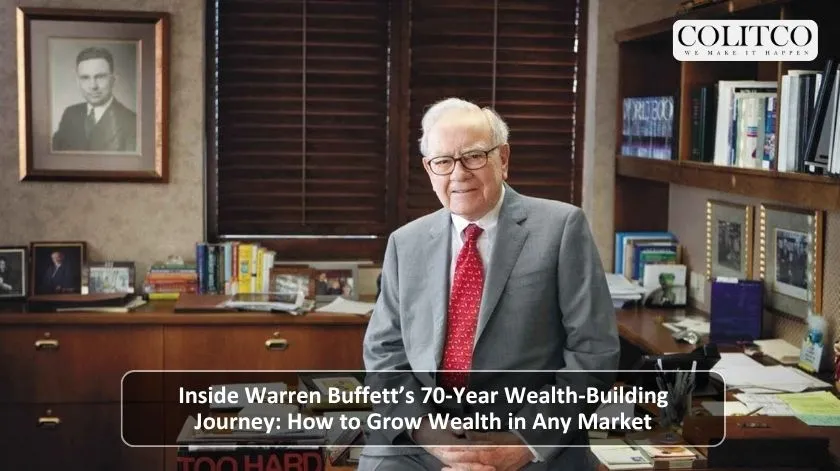
On November 10, 2025, one and a half months before Warren Buffett officially stepped down as the CEO of Berkshire Hathaway, the company issued a news release, in which Buffett said, “I will no longer be writing Berkshire’s annual report or talking endlessly at the annual meeting.”
Buffett understood that picking the right stocks was not enough; he also needed to attract long-term investors to Berkshire Hathaway. For this reason, communication with investors became one of his most powerful tools. He not only invested wisely but also inspired confidence among potential investors.
His company, Berkshire Hathaway, crossed the $1 trillion market valuation mark just two days before Warren Buffett’s 94th birthday in 2024. Since then, despite wars, global sell-offs, and sharp declines across stock markets worldwide, the company has managed to maintain a market capitalisation above $1 trillion. As of May 8, 2026, Berkshire Hathaway’s market cap stood at $1.035 trillion.
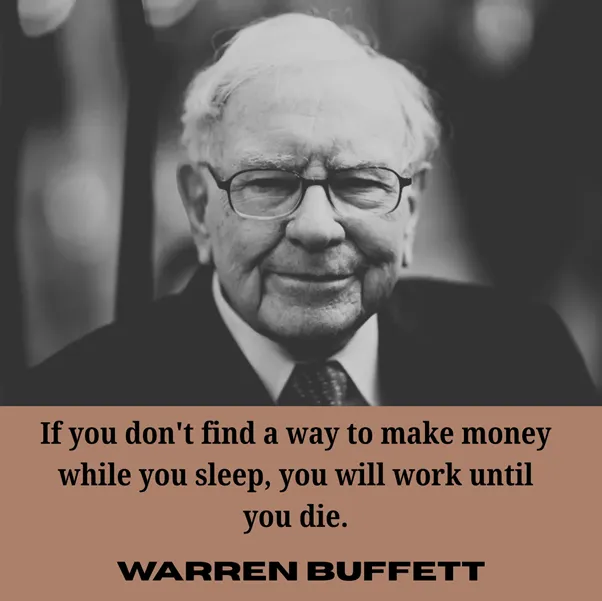
Figure 1: A famous quote from Mr Buffett: “If you don’t find a way to make money while you sleep, you will work until you die.” [Credit for the image of Warren Buffett: Johannes Eisele /AFP / Getty Images]
After Buffett announced that he would step down at the end of the year, the news quickly dominated headlines across the financial world. Many had already begun to miss his witty speeches and engaging letters to shareholders. Lee Munson, President and CIO of Portfolio Wealth Advisors and a longtime Buffett follower, said about Buffett’s annual letters to Berkshire Hathaway shareholders, “Uh, he used it for social engineering.”
In this article, we will break down the timeless investment strategies of Warren Buffett and examine how his disciplined approach helped build a trillion-dollar empire. It doesn’t matter if you are a beginner or an experienced investor; these lessons can provide valuable insights into long-term wealth creation.
The Making of an Investing Icon
The Genesis of a Great Investor
Warren Buffett was born a year after “The Great Depression” hit the U.S. financial market. The Great Depression is the widely used term for the economic crisis that began after the October 1929 U.S. stock market crash, which led to widespread bank failures, a collapse in international trade, and soaring unemployment, reaching 25% in the United States by 1933. To this day, it is regarded as the most severe and prolonged economic catastrophe in modern history, casting a long shadow over the global economy from 1929 to 1939.
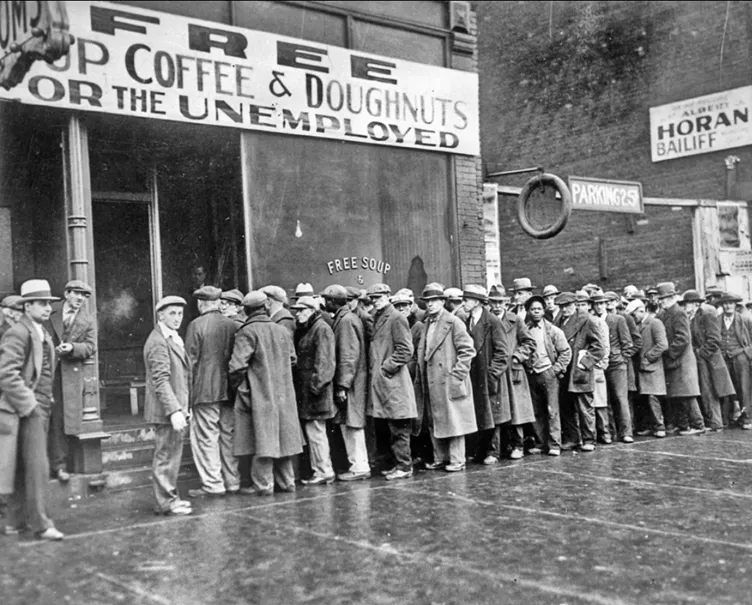
Figure 2: The Great Depression: Unemployed men queue outside a soup kitchen in Chicago during the height of the economic crisis. [Source: Everett Collection/Shutterstock]
Buffett’s father, Howard Buffett, also lost his job at the bank and opened a brokerage firm named Buffett-Falk & Co. in Omaha, Nebraska. Little Buffett often used to spend time in his father’s library reading about business, investments and finance.
It may sound like the story of a child prodigy, but Warren Buffett began his entrepreneurial journey at the age of six. Yes, just six!
One of his earliest ventures was selling chewing gum in his neighbourhood. He bought packs of Juicy Fruit, Spearmint, and Doublemint gum and sold them for a nickel each. Interestingly, Buffett refused to sell individual sticks, firmly sticking to his “principle” of selling only full packs.
Later, we see that one of Warren Buffett’s core investment strategies was sticking firmly to his own principles while making investment decisions. One of his famous remarks perfectly reflects this philosophy: “The important thing is not how big the circle is. The important thing is staying inside the circle.”
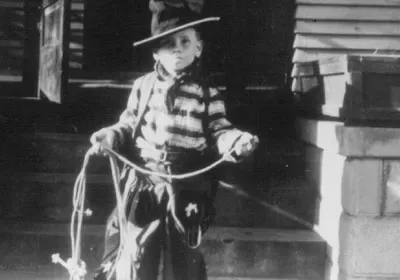
Figure 3: Buffett in his early childhood [Source: Forbes]
At the age of 11, he used all the profits and savings he earned from his ventures and made his first investment. The first stock market investment he made was by purchasing shares of Cities Service Preferred at $38 per share. By the time he reached his late teens, Warren Buffett had accumulated nearly $5,000 through a combination of small businesses and early investments, equivalent to around $76,000 in today’s money.
From $5k to $150 billion
However, this was only the beginning of one of the greatest wealth-building journeys in modern financial history.
After completing his education at the University of Nebraska–Lincoln and later at Columbia University under legendary value investor Benjamin Graham, Buffett refined his philosophy of value investing. In 1956, he launched Buffett Associates, an investment partnership that delivered extraordinary returns through disciplined stock selection and long-term investing.
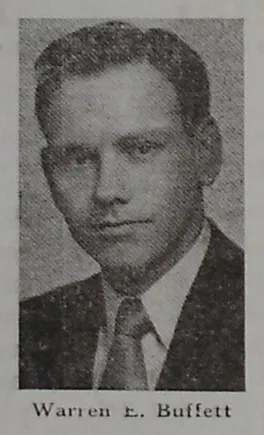
Figure 4: Warren Buffett at some point in middle age
A turning point came in the 1960s when Buffett acquired control of Berkshire Hathaway, then a struggling textile company. Instead of abandoning the company entirely, he transformed it into an investment powerhouse. Buffett used profits generated from Berkshire’s businesses and insurance “float”, money collected from insurance premiums before claims are paid, to purchase stakes in high-quality companies.
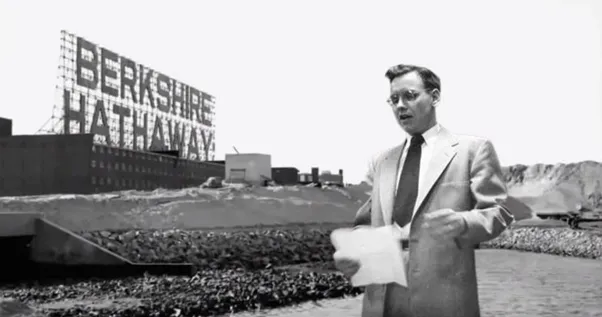
Figure 5: On February 15, 1955, Berkshire Fine Spinning Associates merged with Hathaway Manufacturing Company, officially creating Berkshire Hathaway. A decade later, in 1965, Warren Buffett acquired control of the company by purchasing shares at approximately $15 each. [Source: Microcap Newsletter]
Over the decades, Buffett invested heavily in companies such as Coca-Cola Company, American Express, Apple Inc., and GEICO. He kept his strategy focused on buying strong businesses with durable competitive advantages and holding them for the long term.
Through patience, discipline, and the power of compounding, Buffett eventually turned Berkshire Hathaway into a trillion-dollar conglomerate, making him one of the wealthiest and most respected investors in the world.
By May 2025, his wealth reached $157 billion, and at that time, he was the world’s seventh richest person.
Also Read: Warren Buffett’s Historic Google Bet Shakes Up Wall Street
10 Timeless Investment Strategies the “Oracle of Omaha” Has Preached Himself
Warren Buffett did not build a $150-billion fortune by accident. Across seven decades of investing, from buying his first stock at eleven years old to steering Berkshire Hathaway into a trillion dollar company, he has returned to the same handful of principles. And just when you think picking a stock like Coca-Cola Company is an easy-peasy task, you should remember what author Roger Lowenstein wrote in his book ‘Buffett: The Making of an American Capitalist’:
“A Berkshire stockholder once complained that there were no more franchises like Coca-Cola left. Munger tartly rebuked him. ‘Why should it be easy to do something that, if done well two or three times, will make your family rich for life?’”
(“Munger” refers to world-renowned investor Charlie Munger, Berkshire Hathaway’s longtime vice chairman.)
1. Stay Within Your Circle of Competence
Perhaps the most liberating idea in all of Buffett’s philosophy is also the most counterintuitive: you do not need to know everything. You only need to know your thing – deeply, honestly, with full conviction.
“You don’t have to be an expert on every company, or even many. You only have to be able to evaluate companies within your circle of competence. The size of that circle is not very important; knowing its boundaries, however, is vital.” — Warren Buffett
If you have spent twenty years in the pharmaceutical industry, you understand drug pipelines and regulatory cycles in ways that even the brightest Wall Street generalist cannot match. That edge, that earned, specific knowledge, is exactly where Buffett says your investments should live.
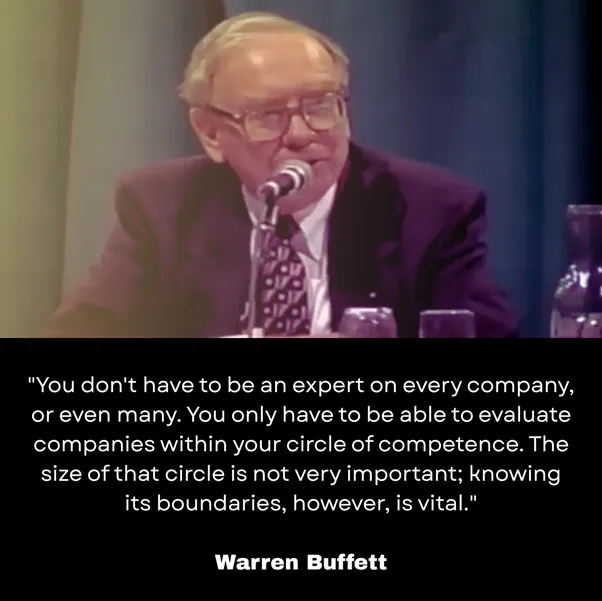
Figure 6: Warren Buffett’s advice regarding staying within your circle of competence
Charlie Munger, his long-time partner, has also mentioned a bit about this: “Knowing the edge of your own competency is very important. If you think you know a lot more than you do, well, you’re really asking for a lot of trouble.”
And from the broader Buffett school of thought, American hedge fund manager Joel Greenblatt echoed the same idea: “It makes sense that if you limit your investments to those situations where you are knowledgeable and confident.” He believed that the chances of success become significantly higher only in such situations.
2. Insist on a Margin of Safety
Before Buffett had a philosophy, he had a teacher. After studying under Benjamin Graham at Columbia Business School, Buffett went on to work for his company, Graham-Newman Corp.
Mr Graham, the father of value investing, drilled one concept into his students above all others: never pay full price for a business, and always leave yourself a cushion against being wrong. Buffett absorbed this lesson completely.
The margin of safety is the gap between what you pay for a company and what it is actually worth. If a business is intrinsically worth ₹100 per share and you buy it at ₹60, you have a 40% margin of safety. That buffer protects you from errors in your own analysis, unforeseen business setbacks, and the simple unpredictability of the future.
The concept is at the heart of Benjamin Graham’s The Intelligent Investor, which Buffett has called the best book on investing ever written and which emphasises buying shares at a meaningful discount to their intrinsic value.
Buffett, in the 1996 Berkshire Hathaway Annual Meeting, has illustrated the principle with characteristic wit: “Don’t try to drive a 9,800-pound truck over a bridge that says it’s, you know, capacity: 10,000 pounds. But go down the road a little bit and find one that says capacity: 15,000 pounds.”
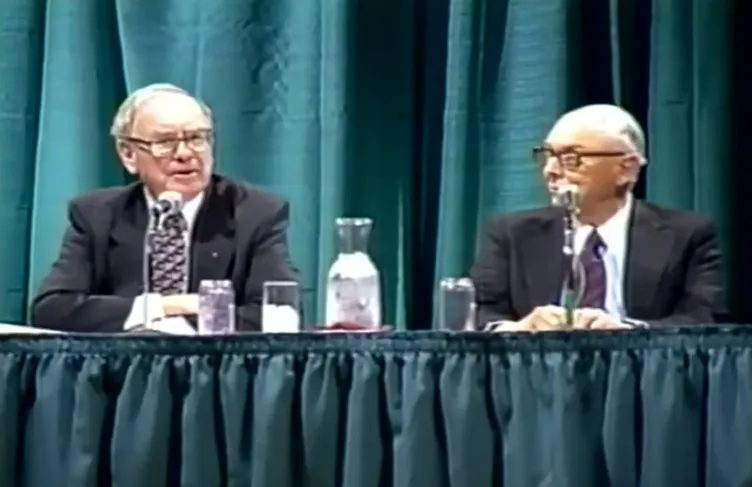
Figure 7: Warren Buffett and legendary investor Charlie Munger, Berkshire Hathaway’s then vice chairman who passed away in November 2023, during the 1996 Berkshire Hathaway Annual Meeting. [Source: YouTube]
3. Look for Economic Moats
Buffett popularised the term “economic moat,” the durable competitive advantage that protects a business from rivals, much like a water-filled moat around a medieval castle. A wide moat means a company can sustain its profits for decades without watching competitors chip away at its market share.
Regarding this, once Buffett has commented, “The key to investing is not assessing how much an industry is going to affect society, or how much it will grow, but rather determining the competitive advantage of any given company and, above all, the durability of that advantage.”
Moats come in many forms. Coca-Cola’s moat is brand recognition so deep it spans 200 countries. GEICO’s moat is a cost advantage; it can insure customers more cheaply than almost any rival. Apple’s moat is customer loyalty and ecosystem lock-in so powerful that switching to a competitor feels genuinely disruptive.
Buffett prefers to invest in businesses with strong economic moats, a term he uses to describe companies with a durable competitive advantage that allows them to stay ahead of their competitors and maintain profitability over time.
4. Think Long-Term; Ideally, Forever
In an era of algorithmic trading where positions are held for fractions of a second, Buffett’s investment horizon is almost philosophical in its patience.
“Our favourite holding period is forever.” — Warren Buffett
Buffett has held Coca-Cola since 1988. He has held American Express since the 1960s. He does not sell because the market dips. He does not sell because a quarter disappoints. He sells when the fundamental reason he bought a company has changed, and not before.
In a very recent interview of Warren Buffett on CNBC Television, he has explicitly mentioned, “If you are buying one-day options, or selling them, it’s not investing; it’s not speculating; it’s gambling.”
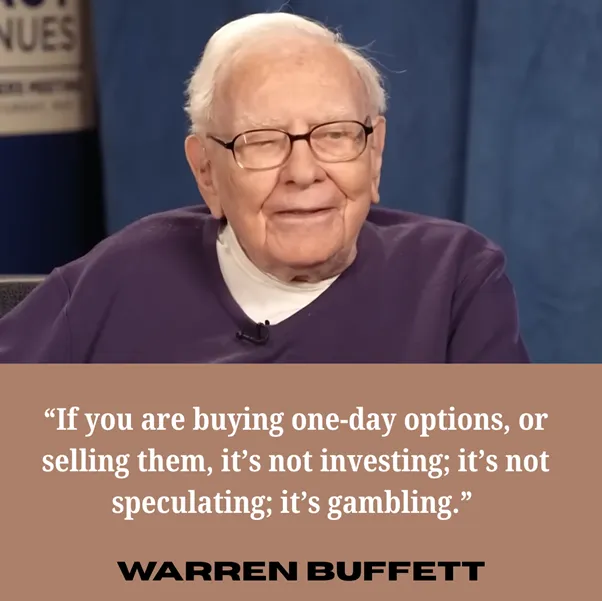
Figure 8: Warren Buffett, now in his mid-90s, during a recent interview on CNBC Television. [Credit: YouTube/CNBC Television]
Buffett’s 1988 investment in Coca-Cola, now one of Berkshire Hathaway’s most iconic holdings, exemplifies this mindset. When he bought it, he did not just see a beverage company; he saw a brand with global reach and pricing power that would only grow stronger with time.
The long-term view is inseparable from the mathematics of compounding. Berkshire Hathaway has delivered a compounded annual return of nearly 20% (more accurately, 19.8%) to its shareholders from 1965 to 2023, roughly double the S&P 500 index’s returns over that same period. That extraordinary differential is not the result of spectacular individual trades. It is the result of good businesses held long enough for compounding to work its quiet, inexorable magic.
Peter Lynch, the legendary Fidelity fund manager, agreed with the essential thrust of this principle:
“The real key to making money in stocks is not to get scared out of them.” — Peter Lynch.
Also Read: Berkshire Hathaway Opposes Workforce Oversight Proposal, Reports Buffett Pay
5. Be Greedy When Others Are Fearful & Vice-Versa
This is the strategy that separates Buffett from nearly every investor who has ever tried to imitate him. It is simple to say. It is extraordinarily hard to execute, because it requires acting in direct opposition to the crowd at the exact moment the crowd is most convinced it is right.
“Be fearful when others are greedy, and be greedy when others are fearful.” — Warren Buffett
In the depths of the 2008 financial crisis, when banks were failing, and panic was cascading through the markets, Buffett published an op-ed in The New York Times urging Americans to buy stocks. He was simultaneously deploying Berkshire’s capital into Goldman Sachs, General Electric, and other distressed institutions on terms extraordinarily favourable to himself.
The principle is rooted in a core insight: the market’s mood swings are not a reliable guide to value. Prices fall when fear dominates and rise when optimism runs away with itself. In neither case does the underlying business change overnight. The investor who can hold that thought steady while everyone around them is losing their heads has a profound edge.
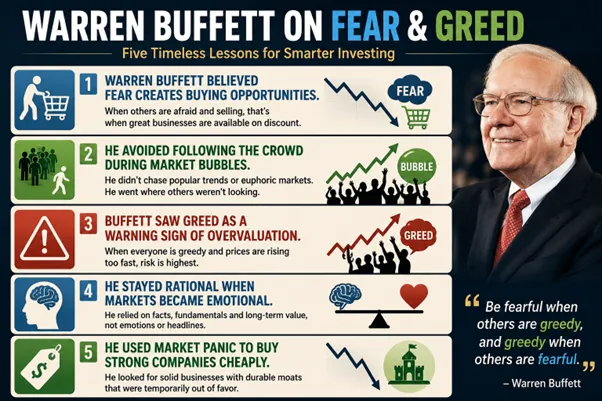
Figure 9: An image showing 5 lessons from Warren Buffett regarding Fear & Greed
6. Buy Wonderful Companies at Fair Prices; Not Fair Companies at Wonderful Prices
This principle marks Buffett’s evolution beyond Graham’s pure “cigar butt” approach, buying dirt-cheap companies with little life left in them for one last puff of value. Charlie Munger was largely responsible for this shift, pushing Buffett toward quality.
“It’s far better to buy a wonderful company at a fair price than a fair company at a wonderful price.” — Warren Buffett
Pay attention to the distinction. A mediocre business bought cheaply will eventually exhaust its temporary advantages. A great business bought at a reasonable price will keep growing, keep compounding, and keep rewarding its patient owner year after year. The purchase price matters enormously. But it matters less than the quality of what you are buying.
Buffett prefers companies with the highest profit margins in an industry, as long as they also match his other buying parameters, such as a strong brand, competitive advantage, and financial health.
Roger Lowenstein, the author of Buffett: The Making of an American Capitalist, once remarked that Warren Buffett’s brilliance stems largely from his exceptional rationality.
7. Understand the Business Before You Buy It
Buffett has a rule that looks almost embarrassingly simple: never invest in a business you cannot understand. He passed on the dot-com boom of the late 1990s because he could not see with confidence how the internet companies of that era would generate durable earnings. He was mocked for it. Then the bubble burst, and he was vindicated.
One of his famous quotes regarding risks in investment is “Risk comes from not knowing what you are doing.”
Understanding a business means more than reading its annual report. It means grasping the competitive dynamics of its industry, the strength of its customer relationships, the reliability of its revenue streams, and the integrity of the people running it. Buffett acts like a business owner rather than a stock market speculator. He studies everything possible about the business, becomes an expert in that field, and works with management rather than against them.
8. Trust the Float: The Genius of Permanent Capital
This is the structural insight that most casual Buffett admirers miss entirely. It is not about the stocks he picks. It is about the machine he built to fund them.
When Buffett acquired GEICO and built Berkshire’s insurance empire, he gained access to something extraordinarily valuable: the float. Insurance companies collect premiums from policyholders upfront and pay claims later. The money held in between, the float, can be invested. In effect, it is a loan that costs Buffett nothing, or close to nothing, as long as the insurance business is underwritten competently.
As Munson explained: “He got with the float from Geico — you take money in for insurance and then which you don’t pay out in claims, you can invest. Well, he was one of the greatest investors of all time. So he had a source of capital that had very low cost. It was liquidity that he didn’t have a liquidity problem with.”
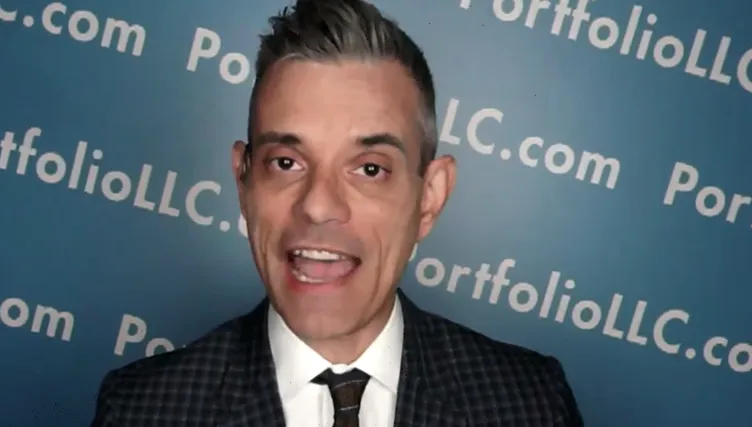
Figure 10: Lee Munson in Yahoo Finance’s interview [Source: YouTube/Yahoo Finance]
This structural advantage, the ability to be patient when others cannot, helps explain why Berkshire can afford to wait for the perfect opportunity while other investors are forced to act by redemption pressure or liquidity needs.
Buffett himself has described the float as better than free money, because in years when GEICO operates profitably, Berkshire is essentially paid to hold billions of dollars in investable capital. It is an engine with almost no equivalent in the investing world.
9. Watch the Management; Character Counts More Than Cleverness
Buffett spends as much time evaluating the people running a business as he does analysing its financials. He is looking not for brilliance, but for integrity.
“We look for three things when we hire people. We look for intelligence, we look for initiative or energy, and we look for integrity. And if they don’t have the latter, the first two will kill you.” — Warren Buffett
A clever manager without integrity will eventually destroy value. An honest manager of merely average ability will generally do fine with a good business behind them. Buffett’s preference has always been for businesses so good that even an ordinary manager cannot ruin them, but when he finds extraordinary managers, he gives them wide latitude and stays out of their way.
10. Let Compounding Work; Time Is the Greatest Investor’s Tool
The final strategy is less an action than a disposition. A willingness to do almost nothing, for a very long time, while the mathematics of compounding quietly builds wealth of staggering proportions.
“My wealth has come from a combination of living in America, some lucky genes, and compound interest.” — Warren Buffett
Buffett has elsewhere noted that over 99% of his net worth was accumulated after his fiftieth birthday. Not because he suddenly discovered a new strategy, but because compounding is exponential, its power is barely visible in the early decades and almost incomprehensible in the later ones. The man who understands compounding earns it; the man who does not, pays it.
Berkshire Hathaway has never paid a dividend. Every dollar of earnings has been reinvested, compounded, and deployed again. It is a structure that Buffett designed deliberately to let time do what no single trade ever could.
End Note
Albert Einstein is often, perhaps apocryphally, credited with calling compound interest the eighth wonder of the world. “He who understands it earns it… he who doesn’t… pays it.” Whether he said it or not, it captures something Buffett has demonstrated empirically for seven decades: the investor who starts early, stays patient, and lets earnings reinvest upon earnings will, in the long run, defeat almost every rival who ever tried to outthink the market.
Warren Buffett is now in his mid-90s. In his letter to shareholders dated November 10, 2025, he wrote, “As Thanksgiving approaches, I’m grateful and surprised by my luck in being alive at 95.” Needless to say, the world hopes to have more time with him and continue learning from his invaluable insights on finance and investing.
Sources
- https://www.cnbc.com/2018/05/05/warren-buffetts-three-best-investing-tips-explained.html
- https://www.investopedia.com/articles/01/071801.asp
- https://youtu.be/_KvInq1fUcY
- https://www.cmcmarkets.com/en-gb/investing-guides/warren-buffet-investment-strategies
- https://www.investing.com/academy/trading/warren-buffett-investment-strategy-rules-fortune/
- https://www.sfu.ca/~poitras/BUFFET.pdf
- https://www.ruleoneinvesting.com/blog/how-to-invest/warren-buffett-quotes-on-investing-success/
- http://mastersinvest.com/circleofconfidencequotes
- https://en.wikipedia.org/wiki/Circle_of_competence
- https://vocal.media/education/warren-buffett-s-investment-strategy
- https://duncangrp.com/quotes-from-warren-buffett-charles-munger/
- https://www.sarwa.co/blog/warren-buffett-quotes


