
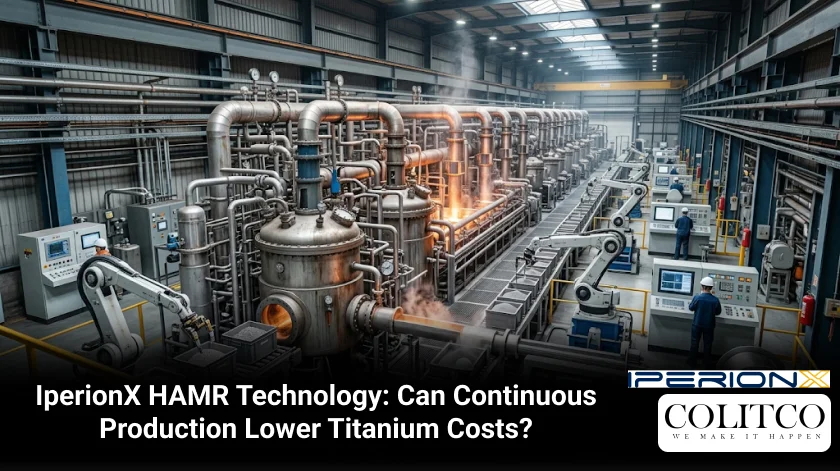
Titanium is tough, light and surprisingly hard to get. IperionX believes it has found a better way to make it. The Nasdaq- and ASX-listed company pitched its plan at a November 2026 investor webinar. Its centrepiece is IperionX HAMR technology. The company says it can deliver low-cost titanium production on American soil.
This article explains what HAMR is, why it matters, where it runs, when products arrive and how GenX trims costs.
Why Low-Cost Titanium Production Matters Now
Titanium goes into every fighter jet, missile, naval vessel and armoured vehicle. Yet the United States stopped making primary titanium in 2020. Its titanium sponge capacity now sits at 0, after the last plant closed that year.
So every American titanium part starts with imported metal. That is according to U.S. Geological Survey data the company cites. For defence planners, that reliance is a genuine concern.
Supply is getting tighter too. China and Russia control about 80% of it. Chinese sponge capacity now tops 500,000 tpa. Premium titanium takes about 20 months to arrive. Peer ATI reported a record US$4.3bn backlog on 29 October 2026. Forgings are booked out two years. Buyers are even paying extra to lock in capacity.
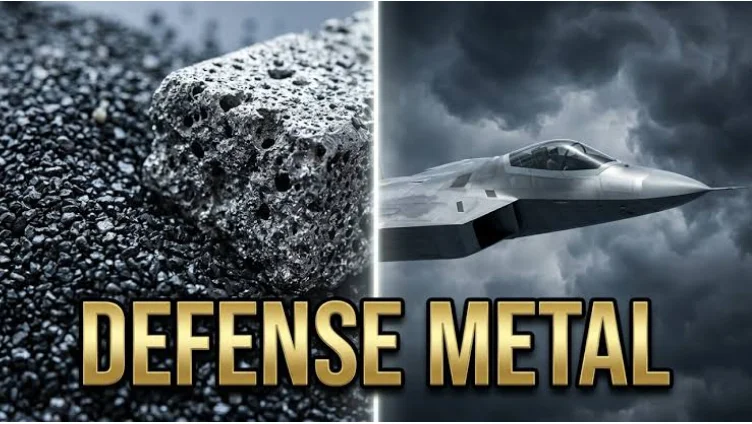
Titanium is used in fighter jets, missiles, naval vessels and armoured vehicles. [LinkedIn]
What Is IperionX HAMR Technology?
HAMR turns titanium scrap or minerals into titanium powders. IperionX bought HAMR and HSPT outright in 2024. HSPT then shapes that powder into blanks and finished parts. The traditional route is far longer. It runs through sponge, vacuum arc remelting, forging, rolling, drawing and machining. Management’s own analysis of a 0.50″ hex head bolt shows the gap.
The results look promising so far. The HAMR furnace is validated above 200 tpa. It produced 1.6 t in 63 hours of back-to-back runs, above nameplate. Grade 5 aerospace-grade quality was met consistently. Spherical powder stayed within Grade 23 oxygen limits. Full system rating is due by year-end.
Cost is the real test. Phase 1 capital is complete, so the platform is already paid for. Each extra ton carries less capital and less overhead. Management expects cost per ton to fall as output grows.
Where Titanium Powder Production Happens
Everything sits at the Titanium Manufacturing Campus in Halifax County, Virginia. Here is what stands on site today:
- HAMR furnace: Validated above 200 tpa, with 1.6 t made in 63 hours.
- Pressing: A 300-ton SACMI press gives 3x forming capacity, or ~11 million single-cavity parts a year.
- Sintering: 3 furnaces, including a new Elnik unit and a second due in the December quarter.
- Inventory: 19 t of finished powder and 207 t of scrap in hand.
- Output: 8.7 t of finished powder and 15.9 t of HAMR powder last quarter, up from 1.4 t and 5.1 t.
Management says powder capacity is no longer the constraint. Qualified products and funded orders now matter most.
How GenX Continuous Production Cuts Costs
GenX is the next-generation HAMR platform. It runs continuously. That means no heat-up, cool-down or reloading between batches. The validated gains are:
- Throughput: 6x higher on a like-for-like run time.
- Power: >75% less per kilogram of titanium powder.
- Magnesium: >45% less, and it is HAMR’s largest reagent cost.
- Hydrogen: >60% less per kilogram of titanium powder.
- Campaign: Over 500 kg of powder across four continuous runs totalling 41 hours.
That campaign ran at a rate equivalent to ~100 tpa. All valid samples, 100%, met ASTM oxygen specifications. All spherical powder fell within Grade 23.
When Will Revenue Products Arrive?
Management plans to sell parts first, then powder, then mill products. The timeline looks like this:
- Engineered products: US$200–1,000+ per kg, targeting 2026, with ~19 products in development.
- Titanium powders: US$60–120 per kg, targeting 2027, with ~5 products.
- Mill products: US$50–80 per kg, targeting 2028, with ~5 products.
Orders are already flowing. Four products are delivering to U.S. defence, including Army fasteners, ballistic plate and Navy pump components. A new US$18.5m Army Task Order 2 funds fastener and track-pin production. A US$47.1m IBAS award backs a 1,400 tpa expansion. Available liquidity is US$96.7m, made up of US$63.0m cash plus US$33.7m obligated U.S. Government funding.
Feedstock is covered too. The Atlas acquisition adds ultra-high-grade stockpiles, with grades up to 23% THM. The Titan DFS shows an after-tax NPV of US$813M and a 39.4% IRR. Risks remain, though. Scale-up, customer qualification and funded orders must still deliver. Lower costs stay a company claim until volumes prove them.
Also Read: Westpac Banking Strategy 2026: Can Business Lending Drive Future Returns?
FAQs
Q1: What is IperionX HAMR technology?
A1: It’s the company’s way of turning titanium scrap or minerals into powder. The furnace is validated at above 200 tpa, after 1.6 t in 63 hours.
Q2: How does GenX lower costs?
A2: By never stopping. GenX runs continuously, lifting throughput 6x. It also needs >75% less power and >45% less magnesium than batch HAMR.
Q3: Where does titanium powder production take place?
A3: In Halifax County, Virginia, at the Titanium Manufacturing Campus. Right now it holds 19 t of finished powder and 3 sintering furnaces.
Q4: When will titanium powder reach the market?
A4: Management is eyeing 2027, priced at US$60–120 per kg. Engineered products come first in 2026, with mill products in 2028.
Disclaimer:
Treat this piece as general information, not financial advice. It relies on IperionX’s November 2026 investor webinar and ASX announcements. Forward-looking statements on production, costs and timelines may not eventuate. Titanium projects carry technical, regulatory and commercial risks. The figures are company claims, not independently verified. Weigh your own circumstances, and speak to a licensed adviser before investing.

Luke Carlino is a seasoned Copywriter, Content Strategist, and Social Media Manager specialising in Mining, Finance, and Business journalism. With more than a decade of industry experience, he brings rigorous editorial standards and commercial acuity to every project.