
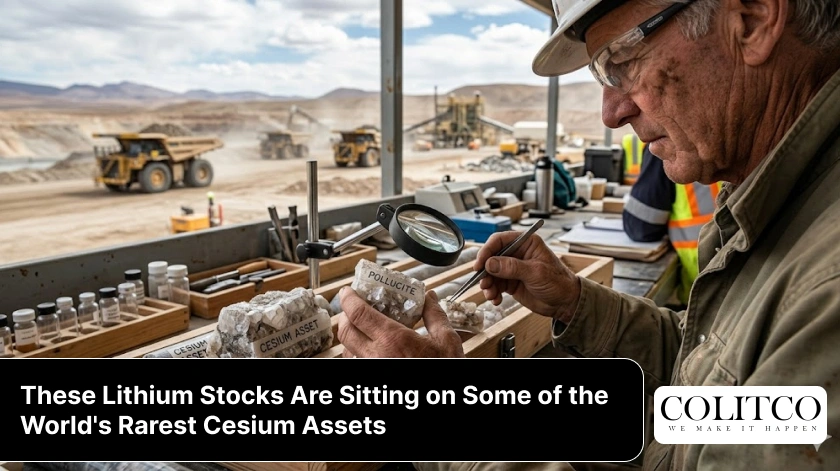
Most people have never heard of cesium. That’s partly what makes it so valuable.
It’s a soft, silvery-gold alkali metal. It sits on the critical minerals lists of the United States, Canada, Japan, and the province of Quebec.
China controls more than 70 per cent of global processing capacity. The US has no primary domestic production.
Supply is so tight that the market runs almost entirely on long-term contracts with no spot trading at all.
Key Applications Driving Cesium Demand
Cesium is not a single-use commodity. Its reach spans multiple high-stakes industries:
- Oil and gas drilling: Cesium formate brine is used in high-pressure, high-temperature wells. It’s difficult to replace in this application
- Atomic clocks: Powers GPS networks and global telecommunications synchronisation
- Quantum computing: Used in hardware components for next-generation computing systems
- Perovskite solar cells: Emerging application in renewable energy generation
- Defence and aerospace: Radar, radiation detection, missile guidance, and ion propulsion systems
- Medical: Cesium isotopes are used in cancer therapy and diagnostic imaging
The Cesium Market at a Glance
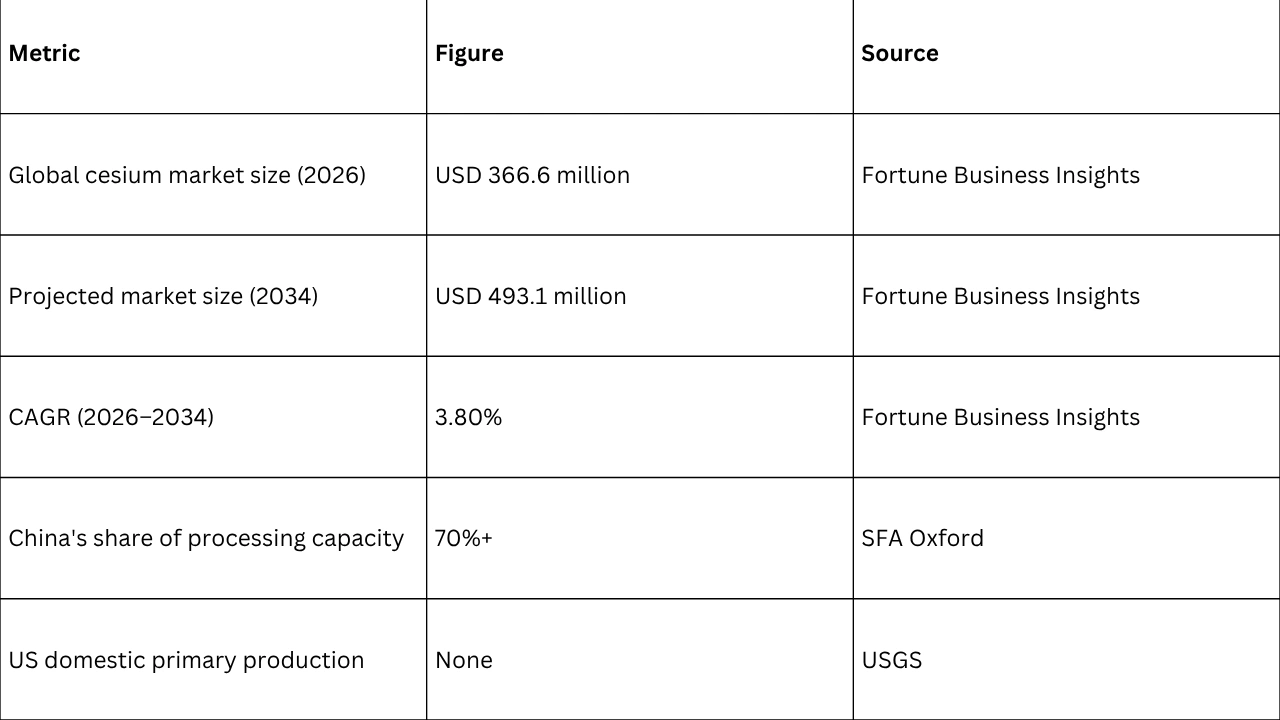
The US Department of the Interior added cesium to its list of critical minerals in May 2021, alongside 14 other metals essential to high-technology sectors and defence.
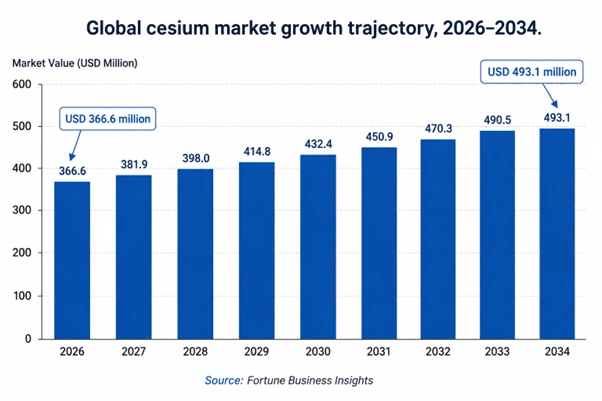
Global cesium market growth trajectory, 2026–2034.
Why Lithium Pegmatites Carry Cesium Potential
The connection between lithium and cesium is geological, not coincidental.
The rock systems that produce lithium — known as LCT (Lithium-Caesium-Tantalum) pegmatites — are among the most evolved magmatic systems on Earth. As a pegmatite body fractionates over time, rarer elements concentrate in the most evolved portions.
Cesium, in the mineral form known as pollucite, represents the final stage of that fractionation. It sits at the apex of the system.
That means the largest, most evolved lithium pegmatites are also the most prospective for meaningful cesium.
This has made a small number of lithium projects far more interesting than their core battery metal credentials alone would suggest.
How Rare Is Pollucite, Really?
- Only three deposits globally have historically produced commercial cesium from pollucite
- Those are Bernic Lake (Canada), Bikita (Zimbabwe), and Sinclair (Western Australia)
- Australia’s Sinclair Mine extracted its last cesium in 2019 — no equivalent domestic replacement has emerged
- Economic pollucite deposits typically range from less than 10,000 tonnes to 350,000 tonnes in size
PMET Resources Holds the World’s Biggest Cesium Find
The clear leader among lithium stocks with a cesium asset is PMET Resources (TSX: PMET, ASX: PMT), formerly Patriot Battery Metals.
The Company’s 100 percent-owned Shaakichiuwaanaan Property in Quebec, Canada, was confirmed in July 2025 as the host of the world’s largest pollucite-hosted caesium pegmatite Mineral Resource — by a significant margin.
The Caesium Zone MRE (Declared July 2025)
The maiden Caesium Zone MRE covers two zones — Rigel and Vega — within the CV13 Pegmatite:
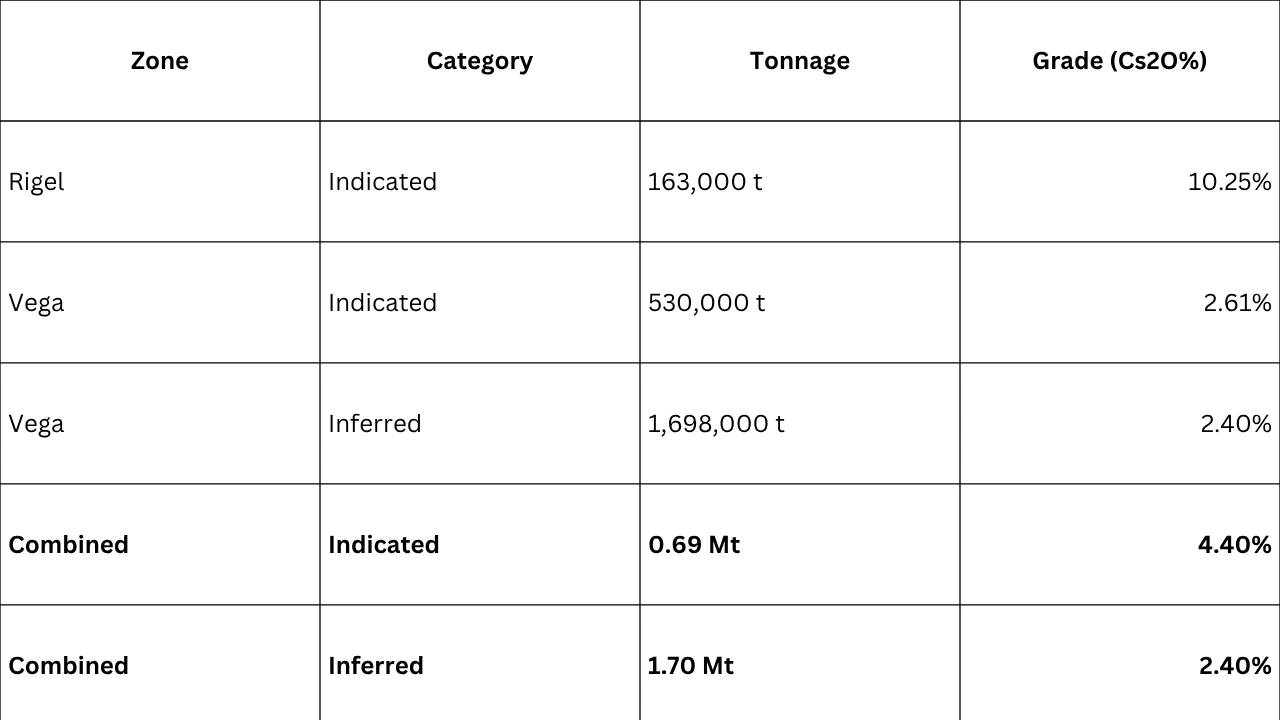
The Rigel Zone sits at shallow depth — approximately 50 metres from surface. It includes the highest cesium grades recorded globally in recent years, with drill intercepts reaching 22.69 percent Cs2O over 1 metre.
The Lithium Asset Beneath It
The cesium sits inside one of the largest lithium projects in the Americas.
The Consolidated Mineral Resource for Shaakichiuwaanaan (CV5 and CV13 combined) totals:
- Indicated:0 Mt at 1.40% Li2O
- Inferred:4 Mt at 1.33% Li2O
In October 2025, PMET Resources delivered a positive lithium-only Feasibility Study on the CV5 Pegmatite. It declared a maiden Mineral Reserve of 84.3 Mt at 1.26% Li2O (Probable) and outlined potential production of up to 800,000 tonnes per annum of spodumene concentrate.
The project ranks in the top ten lithium pegmatites globally by size.
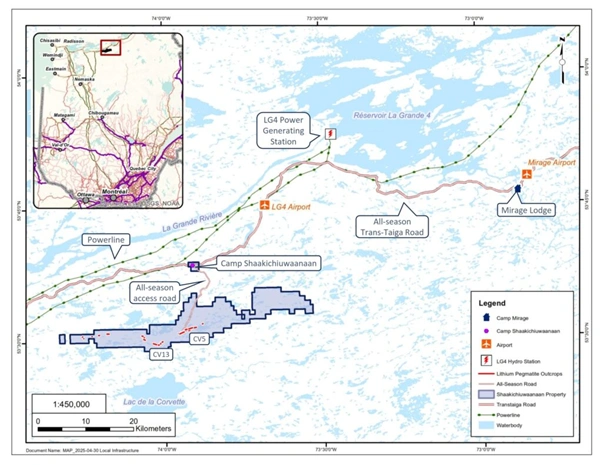
3D perspective of the Shaakichiuwaanaan Project showing TREO and lithium grade distribution at the CV5 and CV13 Pegmatites. [PMET Resources]
Key Cesium Milestones at Shaakichiuwaanaan
Here’s how the story developed through 2025 and into 2026:
- March 2025: Initial discovery of two distinct cesium enrichment zones at CV13 announced
- April 2025: High-grade drill intercepts confirmed, including samples exceeding 20% Cs2O
- July 2025: World’s largest pollucite-hosted caesium pegmatite MRE declared
- October 2025: Marketable commercial-grade pollucite concentrates successfully produced from bench-scale metallurgical testwork
- October 2025: Positive lithium-only Feasibility Study delivered; Koch Technology Solutions engaged for cesium processing evaluation
- Early 2026: New Helios Caesium Zone discovered — the widest cesium drill intercept to date across the property recorded
A broader Preliminary Economic Assessment covering lithium, caesium, and tantalum is now in planning.
Darren L. Smith, Executive Vice President Exploration, stated: “At Shaakichiuwaanaan, we have now defined the largest reported occurrence of pollucite in the world — by a significant margin.”
Noram Lithium Adds Cesium to a Multi-By-Product Story
A second name worth watching is Noram Lithium Corp. (TSXV: NRM, OTCQB: NRVTF). The Company is advancing the Zeus Lithium Project in Clayton Valley, Nevada.
In August 2025, a full review of assay data from 91 drill holes at Zeus identified cesium and rubidium alongside the lithium mineralisation.
Zeus Deposit: By-Product Concentrations
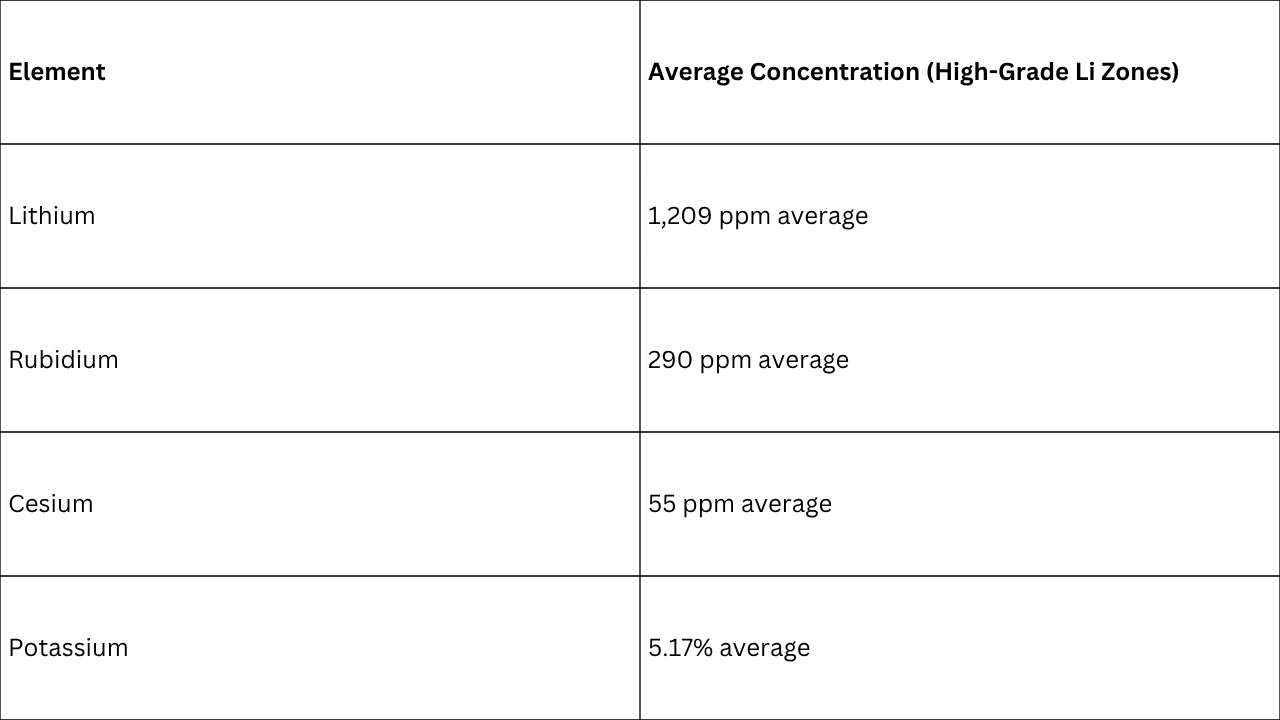
These are trace concentrations within lithium claystone — not primary pollucite. The commercial viability of recovery remains unproven pending further metallurgical testing.
However, at mid-2025 prices of approximately USD 2,873 per ounce for 99.5 percent pure cesium (Shanghai Metals Market, August 2025), even modest recovery rates could materially change the project’s economics.
Noram has engaged Global Resource Engineering to update its PEA and MRE incorporating cesium, rubidium, molybdenum, and potash credits.
Head-to-Head: PMET Resources vs Noram Lithium on Cesium
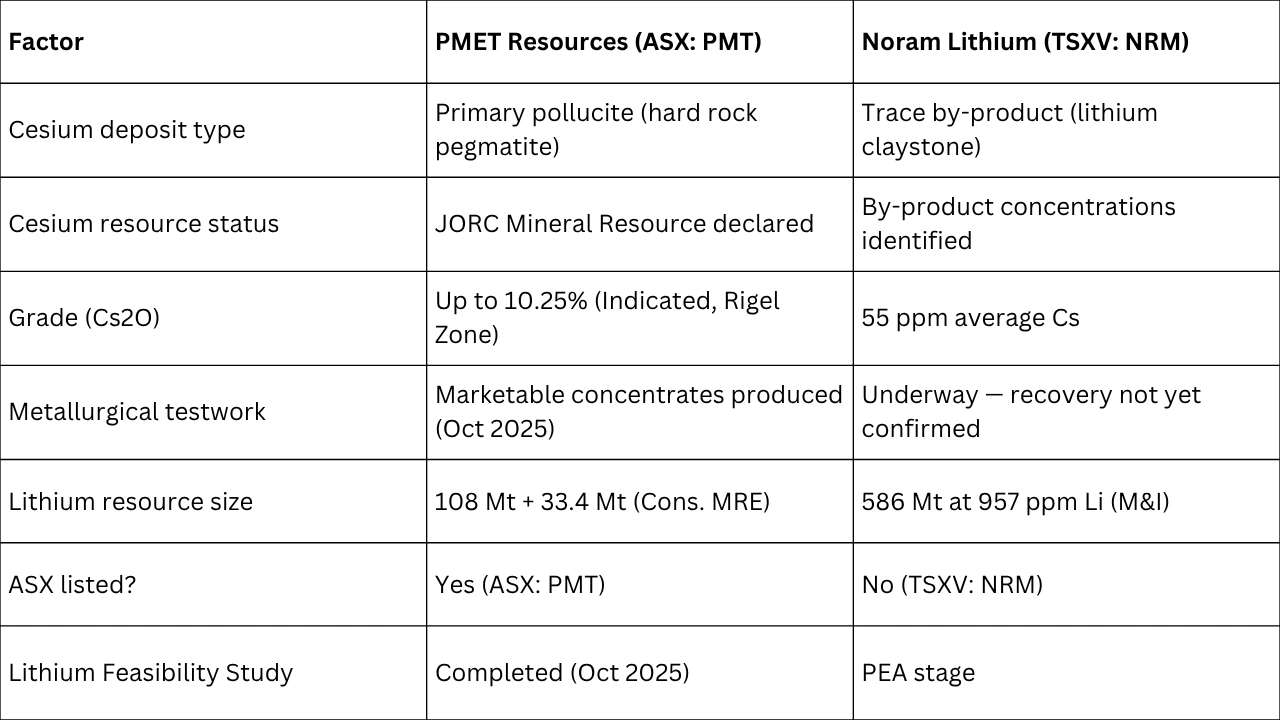
What This Means for Investors Watching Lithium Stocks
The case for monitoring cesium alongside lithium is now well established at PMET Resources. It’s less clear-cut at Noram, but the direction of travel is the same.
Both companies are approaching cesium not as the primary story but as a by-product that could reshape project economics. For PMET Resources, the scale of the cesium resource is now large enough to be assessed as a standalone asset in an upcoming PEA.
For investors following ASX critical minerals companies, the PMET Resources dual listing on the ASX provides direct access.
The broader context matters too. With China controlling the bulk of cesium processing capacity, and the US-Canada compact on critical minerals supply chains signed in late 2021, a large North American primary cesium resource at a project already advancing through permitting carries strategic value that goes well beyond mine-level economics.
Australia’s own top lithium producers are operating in Western Australia, a jurisdiction that once hosted a commercial cesium mine. The Sinclair cesium deposit has been inactive since 2019.
No current ASX-listed Australian lithium explorer has declared a comparable cesium resource. That gap, and the growing geopolitical significance of cesium supply, is a thread worth following as the Australian critical minerals strategy continues to evolve into 2025 and beyond.
Also Read: Elevra Lithium Cashes Out of Ewoyaa as Huayou Sweeps Up Ghana’s Lithium Future
Frequently Asked Questions
Q: What is pollucite and why does it matter for cesium production?
A: Pollucite is the primary mineral source for commercial cesium extraction. It’s extremely rare, found in only a handful of LCT pegmatite deposits globally. Before the Shaakichiuwaanaan discovery, the most notable deposits were at Bernic Lake in Canada and Bikita in Zimbabwe.
Q: Why is cesium classified as a critical mineral?
A: Cesium is listed as critical by the US, Canada, and Japan due to its role in atomic clocks, defence systems, quantum computing, oil and gas drilling fluids, and medical imaging. Its supply is concentrated, with China controlling over 70 percent of global processing, making supply security a national concern in Western markets.
Q: Which lithium stock has the largest confirmed cesium asset?
A: As of 2025, PMET Resources (TSX: PMET, ASX: PMT) holds the world’s largest pollucite-hosted caesium pegmatite Mineral Resource at Shaakichiuwaanaan in Quebec, Canada. The resource totals 0.69 Mt at 4.40% Cs2O (Indicated) and 1.70 Mt at 2.40% Cs2O (Inferred).
Q: Does cesium always occur alongside lithium?
A: Not always, but there’s a geological connection. Cesium-rich pollucite forms in the most evolved portions of LCT (Lithium-Caesium-Tantalum) pegmatites — the same rock types that produce spodumene lithium. Large, evolved lithium pegmatites are the most prospective environments for meaningful cesium mineralisation.
Q: What is cesium used for commercially?
A: The largest commercial application is cesium formate brine for high-pressure oil and gas drilling. Other major uses include atomic clocks (which underpin GPS), quantum computing hardware, perovskite solar cells, aerospace propulsion, radiation detectors, and cancer therapy.
Disclaimer: This article is general in nature and does not constitute financial advice. Colitco LLP accepts no responsibility for any claim, loss, or damage as a result of information provided or its accuracy. Readers should conduct independent research and consult a licensed financial adviser before making any investment decision.
Source:


