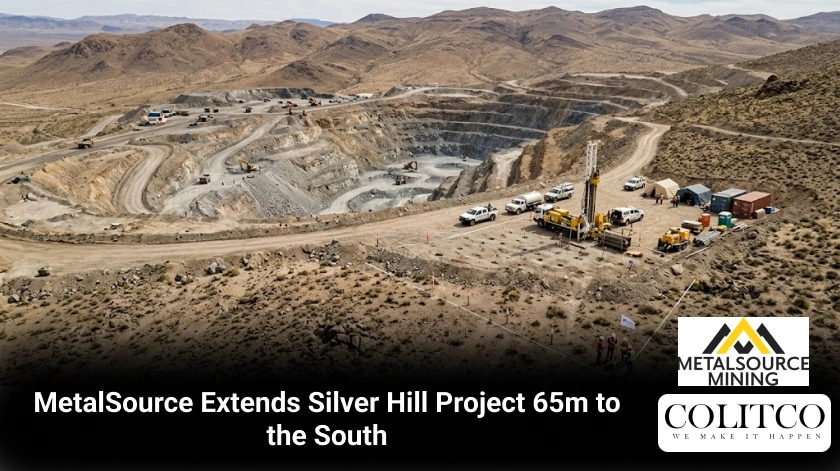
MetalSource Mining reported on 30 July 2026 that drill hole SH26-27 cut roughly 15 metres of polymetallic mineralisation at the Silver Hill Project in North Carolina. That is the furthest south the company has drilled so far, sitting about 65 metres beyond hole SH26-19.
Here is the part that matters. The lab has not seen it yet.
No grades. No silver number, no gold number, no lead or zinc. What the company has is core in a tray and a geologist’s eye. The release says the rock holds widespread sphalerite and galena, with about 3.5 metres of semi-massive to massive sulphides inside the wider zone.
Sphalerite is zinc. Galena is lead. Both have shown up in nearly every good hole at Silver Hill so far, and both usually travel with silver in this kind of system. So the visual call is a reasonable one. It is still a call, not a result.
What a visual update actually tells an investor
Junior explorers put out two kinds of news. One kind moves the model. The other kind keeps the story warm while the lab does its job.
This one is the second kind, and there is nothing wrong with that. Assay queues in North America have been slow all year. MetalSource even flagged that some samples blew past the lab’s upper limits and had to be re-run under overlimit procedures. That is a good problem. It is also a slow one.
The honest read: SH26-27 tells us the mineralised corridor probably keeps going south. It does not tell us whether it is worth anything down there.
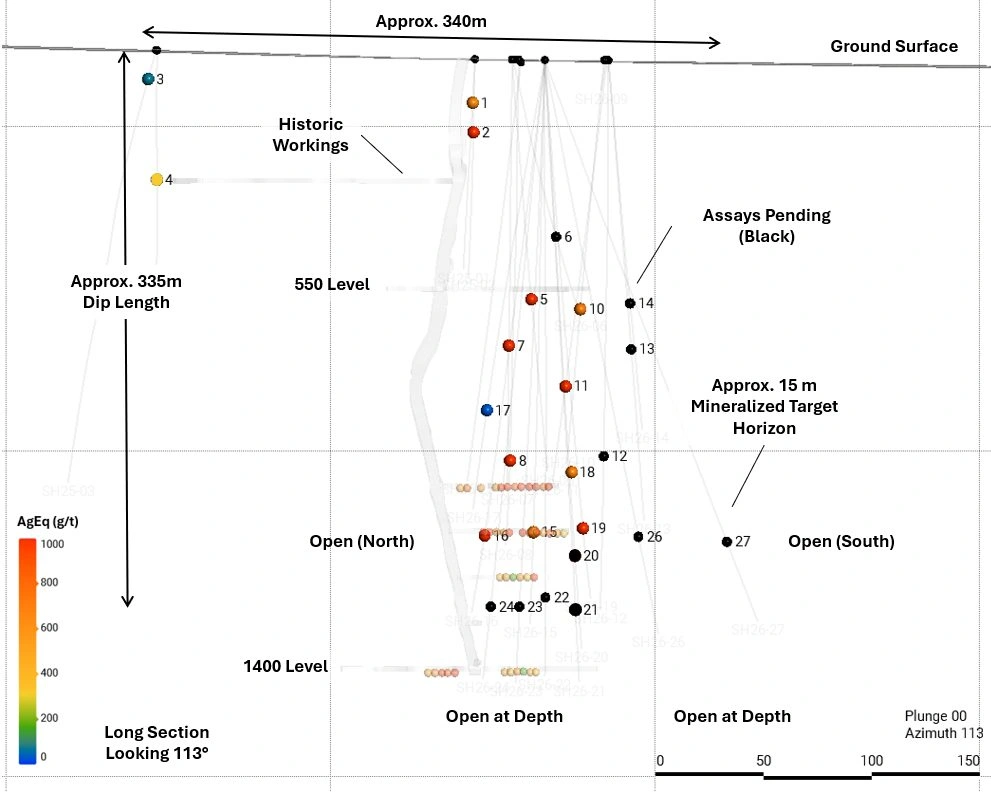 Long section of the Silver Hill system showing reported intercepts by silver equivalent value. Black dots mark holes with assays pending. [MetalSource Mining]
One drill pad is doing most of the work at Silver Hill
Dig into the collar table and something jumps out.
Holes SH26-15 through SH26-27 all share the same collar coordinates. Same easting, same northing, same elevation. Thirteen holes, one pad, fanned out at different angles and dips. SH26-27 was pushed out at an azimuth of 173 degrees and a dip of minus 67 over 283 metres.
That is a cheap way to drill. No pad clearing, no rig moves, no fresh permitting each time. For a company at this stage it stretches the budget a long way.
It also means the 65-metre “step out” is a change in angle, not a change in address. The drill is reaching further south from the same spot rather than testing the ground from a new one. Not a criticism. Just worth knowing when the words “step out” appear in a headline.
The grade that set the bar, and the number nobody mentions
Silver Hill got serious attention in April, when SH26-07 returned 12.62 metres at 48.04 g/t gold equivalent, including 2.74 metres at 210.72 g/t. Chief executive Joe Cullen called that hole a confirmation that the system “strengthens dramatically with depth.”
Then in June, SH26-19 returned 6.28 metres at 1,156 g/t silver equivalent, including 3.6 metres at 1,789 g/t. Those are the numbers holding the share register together.
Now for the caveat buried in the fine print of every one of those releases. The metal recovery figures used in the silver equivalent maths come from batch metallurgical test work completed in 1988. Recoveries of 95.5% for gold, 92.9% for silver, 89.2% for lead, 93.8% for zinc, 90.8% for copper. All from a nearly four-decade-old bench test.
Equivalent grades are marketing arithmetic at the best of times. Built on 1988 recoveries, they need fresh metallurgy before anyone treats them as economics. MetalSource says as much in its own disclaimer: the results are preliminary and cannot define a resource.
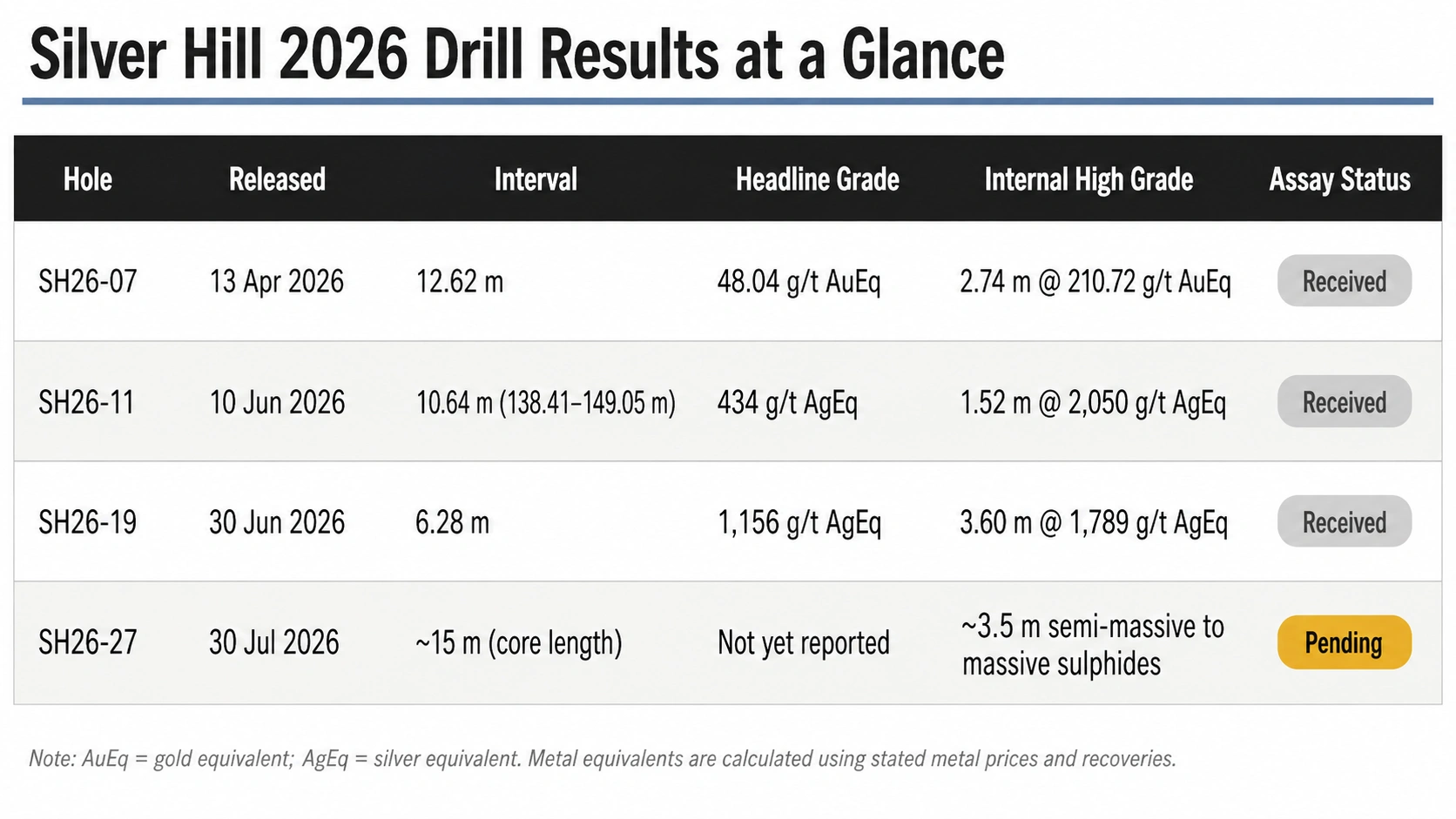
Reported Silver Hill drill intercepts in 2026, with the July hole still awaiting laboratory results.
Two rigs, an IP survey and a 2027 deadline
The next phase goes back around SH26-07, drilling along strike, down plunge and deeper. A second rig is being mobilised to test district-scale targets thrown up by a recent induced polarisation survey.
The date to circle is early 2027. That is when MetalSource is targeting its first mineral resource estimate.
Everything between now and then is a countdown to that number. Step-outs widen the footprint. Infill firms up the middle. The maiden resource is where the market finally stops trading on core photos and starts trading on tonnes and grade.
Silver above US$50 an ounce for much of the past year has made this an easier program to fund than it would have been in 2023. It has also made the bar higher, because plenty of juniors are drilling silver right now.
For Australian investors, this one sits outside the ASX entirely. Getting exposure means going through CSE or OTCQB channels, with the currency and liquidity headaches that brings. Anyone wanting the same theme closer to home has ASX-listed silver and base metals coverage available, and Colitco’s earlier look at Silver Tiger Metals share price entry points covers a comparable pre-production silver story on a North American exchange. South32’s Cannington silver-lead-zinc operation in northwest Queensland shows what the same metal mix looks like at production scale. More background sits across Colitco’s mining and investment news sections.
The next MetalSource release worth reading closely is the assay batch. Not the core photos.
FAQs
Q: Where is the Silver Hill Project?
A: Davidson County, North Carolina, roughly 15 km south of Lexington.
Q: Is MetalSource listed on the ASX?
A: No. It trades as MSM on the CSE, MSMMF on OTCQB and E9Z in Frankfurt.
Q: What did hole SH26-27 return?
A: About 15 metres of visible polymetallic mineralisation. Assays are pending.
Q: Why does it matter that assays are pending?
A: Visible sulphides confirm the rock type, not the metal content or value.
Q: When is a resource estimate due?
A: MetalSource is targeting early 2027.
Q: What metals does Silver Hill host?
A: Silver, gold, lead, zinc and some copper.
Disclaimer:
This article is general information only and does not constitute financial or investment advice. It does not take into account any individual’s objectives, financial situation or needs. Exploration results referenced are preliminary and insufficient to define a mineral resource. Investing in early-stage exploration companies carries a high risk of capital loss. Readers should seek advice from a licensed financial adviser before making any investment decision.
Source:

Elizabeth Jones is a finance and mining content specialist with over 10 years of experience creating clear, SEO-driven content across fintech, investing, banking, insurance, cryptocurrency, and resource markets. She transforms complex financial data and industry trends into engaging, reader-focused articles that improve understanding and audience engagement.