
Australia leads the world in AI adoption for mining. The numbers are striking, and the stakes are high. Industry data and government reports confirm the sector stands at a turning point, balancing major productivity gains against growing operational risks.
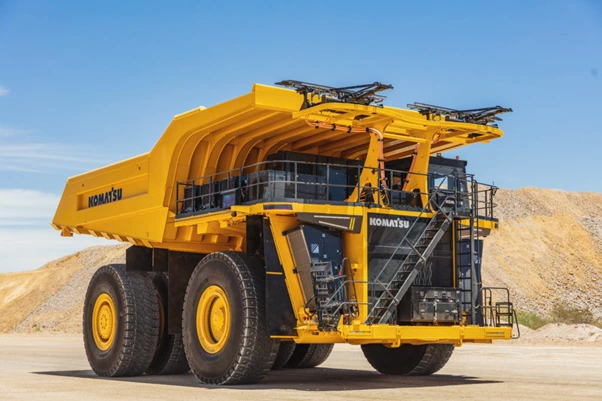
Autonomous haul trucks operating at a large-scale mining site in Western Australia, highlighting the country’s leadership in AI-driven mining operations. [International Mining]
Australia Commands 74% of Global AI Mining Investment
Nearly 70 per cent of global mining companies now integrate AI-driven technologies into their operations. Investment in AI for mining reached US$900 million, with Australia commanding 74 per cent of total global capital in this fast-evolving field. China follows at 12 per cent and the United States at 9 per cent.
AI investment in the mining sector soared from less than US$200 million in 2020 to US$900 million in 2025. Median deal sizes in mining tech startups nearly tripled to US$8.7 million. The pace of growth shows the sector has moved past experimentation into full-scale deployment.
“Mining is no longer testing proofs-of-concept; it’s investing in proven technologies that deliver measurable impact,” said Marco Marinucci, CEO of Mind the Bridge. “This is the moment when data, AI, and automation converge to redefine operational excellence.”
Autonomous Trucks and Predictive Systems Drive Productivity
Autonomous haul trucks, predictive maintenance systems, and AI-assisted geological modelling now operate across every phase of the mining lifecycle. AI enables mines to make faster decisions, extract more value from data, and optimise increasingly complex operations.
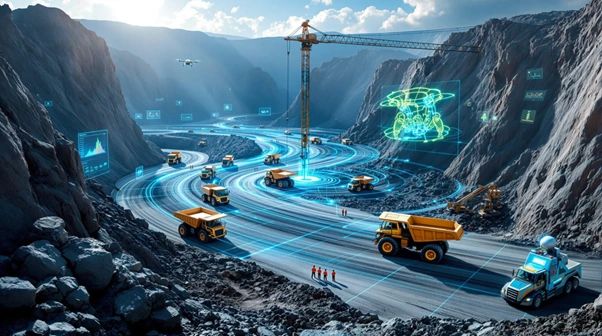
AI-powered autonomous vehicles and predictive maintenance systems are transforming efficiency and reducing downtime across Australian mining operations. [Discovery alert]
The Roy Hill iron mine in the Pilbara stands as a prime example. Epiroc and Hancock Iron Ore launched a landmark project converting 78 haul trucks, with 60 operating autonomously, creating the world’s largest fully agnostic autonomous mine.
Over 450 autonomous vehicles currently operate across Western Australian mining sites. Expansion plans target an additional 200-plus units by 2027. These systems run continuously across three shifts, with no need for human drivers.
AI Transforms Mineral Exploration Across the Country
Australian mines are projected to hit 60 per cent AI solution implementation in 2026, marking the transition from optional technology to essential infrastructure. This shift touches exploration, not just operations.
The Gawler Challenge provided a clear example of AI’s exploration potential. Winning entries used machine learning to systematically test geological factors on known deposits and generate predictions about lesser-known areas. That capability matters more now than ever.
New discoveries are deeper, more remote, and technically complex. They require greater capital, advanced technology, and longer development timelines. AI helps operators narrow the search and reduce costly drilling failures before they happen.
Mining Output Grows, But Productivity Lags Behind
Mining was the fastest-growing industry in Australia’s December quarter. Gross value added grew 3.7 per cent over the year to December 2025, well above GDP growth of 2.6 per cent, marking the first time in nearly two years that the sector outpaced the broader economy.
Despite this growth, a troubling pattern persists. Mining multifactor productivity fell 3.3 per cent in 2024-25, the fifth consecutive annual decline. AI adoption alone does not fix the problem. Governance, skills, and engineering discipline must also improve.
Australia’s export revenues are expected to hold above $370 billion over the next two years, with volumes near historic peaks. Sustaining these output levels will depend on growing investment and translating technology into sustained productivity gains.
Cybersecurity Risks Grow as IT and OT Systems Merge
The most significant and least visible risk from AI adoption in mining is the erosion of the boundary between information technology and operational technology.
Thousands of IoT devices monitoring temperatures, vibrations, and acoustics feed data into software systems. Centralised data lakes, cloud-based AI models, and remote operations centres extend IT infrastructure deep into operational environments, often in ways organisations have not fully mapped.

As mining operations digitise, cybersecurity risks increase with the convergence of IT and operational technology systems. [Freepik]
Ransomware groups increasingly target OT environments not to steal data, but to cause operational disruption. The financial exposure from a sustained production outage can significantly exceed the cost of the initial incident.
When compromised OT control logic disables protections or alters operating parameters, mechanical damage in processing plants or mobile equipment can result, with long repair timelines.
Australia’s Security of Critical Infrastructure Act now covers 11 sectors. It imposes mandatory incident reporting to the Australian Signals Directorate within 12 hours for significant breaches. Mining operators fall within this regulatory scope.
Governance Gaps Put AI Mining Deployments at Risk
The pace of AI adoption is outrunning the frameworks designed to govern it. In an industry where operational failures carry physical, financial, and safety consequences, that gap matters.
Organisations managing these risks most effectively treat resilience as a design requirement, not an afterthought. Embedding cyber risk assessments, engineering validation processes, and clearly defined fallback modes for automated systems from the outset helps prevent vulnerabilities from becoming embedded in long-life assets.
A key implication for mine operators is the need to treat training data governance as a formal safety-critical function. Without it, AI models can produce unreliable outputs in conditions they were not trained to handle.
Critical Minerals Demand Adds Strategic Pressure
BDO’s Annual Mining Report 2026 identifies three primary forces reshaping the landscape: the push for decarbonisation, the electrification of transport, and the rapid expansion of data centres to support AI. In net-zero scenarios, demand intensity is set to jump 48 per cent for lithium and 60 per cent for cobalt over the next decade.
China currently controls approximately 60 per cent of global rare earth processing capacity and 70 per cent of lithium battery manufacturing. This creates vulnerabilities for nations dependent on these supply chains. Australia sees an opportunity to fill that gap.
Defence spending has emerged as a significant secondary market. Critical minerals are vital for technologies such as radar, guidance electronics, and advanced communications. This adds a national security dimension to what was previously a purely commercial sector.
Microsoft and Government Back Australia’s AI Infrastructure Push
Australia’s AI mining boom sits within a broader national investment story.
“Australia has an enormous opportunity to translate AI into real economic growth and societal benefit,” said Satya Nadella, Chairman and CEO of Microsoft.
“That is why we are making our largest investment in Australia to date, committing A$25 billion to expand AI and cloud capacity, strengthen cybersecurity, and expand access to digital skills across the country.”

Satya Nadella, Chairman and CEO of Microsoft. [CNBC]
The Minerals Council of Australia has also proposed a $13 million, three-year pilot program to embed AI into environmental regulatory decision-making. MCA CEO Tania Constable said the approach would help the government deliver modern, efficient environmental regulation while meeting environmental objectives.
“In mining alone, a 12-month delay across the new project pipeline is estimated to cost the Australian economy $51 billion in cumulative GDP, and bottlenecks are worsening,” Constable said. AI-assisted approvals, proponents argue, could cut those delays significantly.
Also Read: Flynn Gold Completes WA Asset Sale to Redirect Focus to Tasmania
FAQS
Q1. What is driving Australia’s AI mining boom in 2026?
A1. Australia’s AI mining boom is driven by large-scale investment, advanced automation technologies, and strong demand for critical minerals. The sector has moved from experimentation to full deployment, supported by government policy and private capital.
Q2. How much of the global AI mining investment does Australia control?
A2. Australia accounts for approximately 74% of global AI mining investment, making it the dominant player ahead of China and the United States.
Q3. What technologies are transforming mining operations in Australia?
A3. Key technologies include autonomous haul trucks, predictive maintenance systems, AI-driven geological modelling, and IoT-enabled monitoring systems that optimise efficiency and reduce downtime.
Q4. Why is productivity still declining despite AI adoption?
A4. Productivity challenges persist due to gaps in governance, workforce skills, and engineering processes. AI alone cannot resolve inefficiencies without proper implementation and operational discipline.
Q5. What cybersecurity risks are associated with AI in mining?
A5. The integration of IT and operational technology (OT) systems increases exposure to cyberattacks. Ransomware incidents can disrupt operations, damage equipment, and cause significant financial losses.
Q6. How is AI improving mineral exploration in Australia?
A6. AI enhances exploration by analysing geological data, identifying potential deposits, and reducing costly drilling failures, especially in deeper and more complex environments.
Q7. Why are critical minerals important in the AI mining boom?
A7. Critical minerals like lithium and cobalt are essential for clean energy, electric vehicles, and data centres. Rising global demand is increasing Australia’s strategic importance in supply chains.
Q8. What role is the government playing in AI mining development?
A8. The government supports AI adoption through regulation, infrastructure investment, and initiatives like AI-assisted environmental approvals, while enforcing cybersecurity compliance under critical infrastructure laws.
Q9. How does AI impact mining workforce requirements?
A9. AI reduces reliance on manual labour while increasing demand for skilled workers in data analysis, cybersecurity, and system management, shifting the workforce toward technical roles.
Q10. What are the biggest risks facing AI mining in Australia?
A10. Key risks include cybersecurity threats, governance gaps, unreliable AI outputs due to poor data management, and failure to convert technological investment into sustained productivity gains.
Disclaimer:
This article by Colitco is for informational purposes only and does not constitute financial, investment, or professional advice regarding the AI mining sector in Australia. While the information presented reflects current industry data and trends, no guarantee is made as to its accuracy or completeness. Readers should conduct independent research or seek professional advice before making decisions related to AI mining technologies or investments. Colitco accepts no liability for any losses resulting from the use of this information.
Sources
https://news.microsoft.com/source/asia/features/investing-in-australias-ai-future/
https://discoveryalert.com.au/strategic-technology-integration-australian-mining-2026/
https://miningmagazine.com.au/critical-minerals-boom-marks-definitive-turning-point-for-mining-bdo



