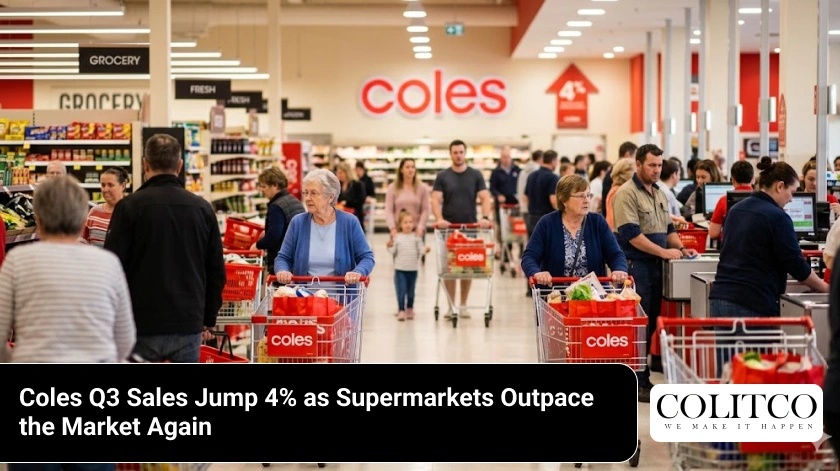
Coles Group Limited (ASX: COL) has posted another solid quarter, with supermarket sales climbing 4.0% to $9.78 billion in the 12 weeks to 29 March 2026.
The result puts the Company ahead of the broader market for the third quarter running, with CEO Leah Weckert crediting disciplined execution and a clear focus on everyday value.
Total group sales revenue for the period came in at $10.70 billion, up 3.1% on the same quarter last year.
What the Coles Q3 Sales Numbers Actually Tell You
Strip out tobacco and the supermarket growth story gets stronger. Sales excluding tobacco rose 5.7%, highlighting the depth of volume-led demand across the grocery offer.
Comparable sales growth, a figure closely watched by analysts as it strips out the impact of new store openings, came in at 3.6%.
The quarterly figures cover:
- Supermarkets: $9,781 million, up 4.0% (comparable: +3.6%)
- Liquor: $781 million, down 3.9% (comparable: -4.3%)
- Other: $141 million, down 14.5%
The “Other” segment relates to the Product Supply Agreement with Viva Energy Group Ltd, which is due to expire by the end of November 2026.

Coles Group Q3 FY26 group sales revenue by segment. [Coles Group]
eCommerce Is the Standout in This Quarter’s Result
Online grocery is now a meaningful part of how Australians shop, and Coles is capturing that shift faster than expected.
eCommerce sales revenue jumped 24.8% to $1.33 billion. Penetration lifted to 13.6%, up from 11.3% in the same period last year. In March alone, penetration reached 14.2%.
The result came across all fulfilment channels, suggesting the growth is structural rather than driven by a single campaign or event.
Coles Plus and Coles Plus Saver subscriptions rose 75% over the quarter. Flybuys active members grew 5% to 10.3 million.
These loyalty indicators matter. They signal repeat engagement, which supports volume growth across both in-store and online channels.
What’s Driving Volumes on the Shop Floor
Volume growth in Coles’ supermarkets during Q3 came from several directions at once.
Promotional activity played a part, particularly the Summer value campaign and the “Shop. Scan. WIN!” promotion. KitchenAid cookware also drove foot traffic during the period.
But there was also a more macro factor. In March, elevated demand for pantry staples emerged as geopolitical uncertainty in the Middle East affected consumer sentiment across Australia.
Exclusive to Coles sales grew 7.3%, supported by 142 new product launches. The new Coles Kitchen salad range and a refresh of the Coles Simply range both performed well.
The Coles Finest tier was the strongest across the portfolio, with revenue up 8.2%.
Supermarket price inflation excluding tobacco eased to 0.8%, down from 1.7% in the previous quarter. That moderation came from fresh produce deflation and softer packaged grocery inflation.
The Company renewed 17 supermarkets during the quarter and opened two new locations, including an integrated food and liquor store in Glen Iris, Victoria.
Liquor Remains the Weak Spot
Coles Liquor continued to struggle. Sales fell 3.9% to $781 million, with comparable sales down 4.3%.
The Company noted that its convenience liquor portfolio, which accounts for around 90% of the store network, held up reasonably well. The sharper declines came from warehouse-style stores.
March was particularly difficult. Consumer sentiment weakened as geopolitical tensions and higher petrol prices weighed on discretionary spending.
Coles cited improved Flybuys swipe rates in Liquor, up 7.2%, and expanded Uber Eats partnership as early signs of stabilisation. But earnings pressure in the segment is expected to continue through the second half.
During the quarter, 14 Liquor stores were closed and one new store opened.
Leah Weckert on the Result
Leah Weckert, Coles Group CEO, said the Company delivered a strong result that reflects consistent execution across its strategic priorities.
“Achieving consistent sales momentum for the period over multiple years demonstrates our commitment to remaining focused on long-term outcomes whilst successfully navigating short-term volatility in market conditions and supply chains,” she said.
Outlook: Cost Pressures Are Building
Looking ahead into Q4, Coles expects supermarket sales growth to remain broadly in line with the third quarter pace, adjusted for Easter and Anzac Day timing effects.
The picture isn’t entirely straightforward. Coles flagged it is seeing higher supplier cost price increase requests and rising costs in fuel, freight, and packaging. The Company said it is actively managing these and will work to offset the impact where possible.
In Liquor, reduced consumer confidence is expected to dampen fixed cost fractionalisation across the rest of the half, with an earnings impact flagged.
Weckert put the value proposition front and centre: “We know value and availability will be important to our customers over the months ahead and we are well placed to respond to this with our extensive own brand portfolio, our leading eCommerce platforms and the strength of the infrastructure and capability that sits within our supply chain.”
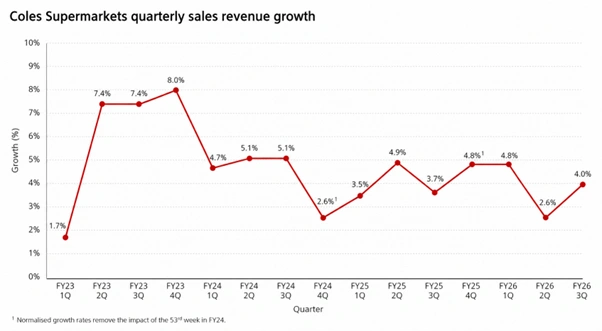
Coles Group quarterly supermarket headline sales revenue growth, FY23 to Q3 FY26.
Investors tracking the Coles Group ASX investment thesis will note the continued divergence between supermarkets and liquor performance, a theme that has shaped sector positioning throughout FY26.
The Coles Q3 sales result also arrives in the context of ongoing scrutiny around supermarket pricing practices, with regulatory and legal pressures remaining a background risk for the Company.
Also Read: Regis Healthcare CEO Search Ends: The Bupa Executive Taking the Wheel at Australia’s Aged Care Giant
Frequently Asked Questions
Q: What were Coles’ Q3 2026 sales results?
A: Coles Group reported total group sales of $10.70 billion for the 12 weeks to 29 March 2026, up 3.1% on the prior year. Supermarkets led the result with 4.0% growth to $9.78 billion.
Q: How did Coles supermarket sales perform in Q3 FY26?
A: Supermarket sales rose 4.0% to $9.78 billion, with comparable sales up 3.6%. Excluding tobacco, sales grew 5.7%, driven by volume-led demand and value-focused promotions.
Q: How is Coles eCommerce performing?
A: Coles eCommerce sales jumped 24.8% to $1.33 billion in Q3 FY26, with online penetration rising to 13.6% from 11.3% a year earlier.
Q: Why did Coles Liquor sales fall in Q3?
A: Liquor sales dropped 3.9% to $781 million as soft consumer sentiment, particularly in March, weighed on warehouse store performance. Geopolitical uncertainty and higher fuel prices dampened discretionary spending.
Q: What is Coles’ outlook for Q4 FY26?
A: Coles expects supermarket sales growth to remain broadly in line with Q3. The Company flagged rising costs in fuel, freight, and packaging as near-term pressures, while Liquor earnings are expected to remain soft through the second half.
Disclaimer: This article is for informational purposes only and does not constitute financial advice. Readers should seek independent financial advice before making any investment decisions.
Source: https://www.colesgroup.com.au/DownloadFile.axd?file=/Report/ComNews/20260501/03085352.pdf


