
Most Australians have been told they should invest. Most don’t.
Research from 2026 suggests that six in ten Australians hold no investments outside their superannuation. That’s a lot of people sitting out one of the more accessible wealth-building tools available to them.
The ASX processed over 61 million equity trades in February 2026 alone, with close to 1,900 companies listed on the exchange. It’s well-regulated, beginner-friendly, and does not require a finance degree to navigate.
This guide walks beginner investors through the Australian stock market in 2026, step by step, from clearing your financial decks to placing your first trade.
Step 1: Sort Your Finances Before You Buy a Single Share
Investing is not the first step. Getting your financial foundations right is.
Before you open a brokerage account, make sure you have:
- An emergency fund covering three to six months of expenses
- No high-interest debt – credit cards running at 15% or more will wipe out any returns
- A budget that lets you invest without needing that money back soon
Only invest money you won’t need for at least five years. The Australian share market is volatile in the short term, and selling during a downturn locks in losses.
If you’re carrying significant credit card debt, pay that off first. No share on the ASX consistently beats the cost of high-interest liabilities.
Step 2: Decide What You’re Actually Investing For
Your goal shapes everything – what you buy, how long you hold it, and how much risk you take on.
Ask yourself:
- Am I building long-term wealth for retirement?
- Am I growing a deposit for a home in the next five to seven years?
- Do I want passive income from dividends now?
- Am I comfortable riding out short-term market drops for larger long-term gains?
A 28-year-old investing for retirement in 35 years can absorb far more volatility than a 55-year-old who needs income in five. Clarity on your goals is not just useful – it stops you from making panicked decisions when markets fall.
Step 3: Understand What You Can Buy on the Australian Stock Market in 2026
The Australian stock market in 2026 offers beginner investors several accessible entry points.
Shares
Buying shares makes you a part-owner of a listed company. If the company grows its profits, your shares typically rise in value. Many ASX companies also pay dividends — cash distributions paid out of profits, usually twice a year.
Exchange-Traded Funds (ETFs)
An ETF holds a basket of companies in a single trade. Rather than picking individual stocks, you buy exposure to an index – like the ASX 200 or the S&P 500 – in one go.
ETFs are a logical starting point for beginners because they spread your risk across hundreds of companies at once. A simple two-ETF starter portfolio could pair the iShares Core S&P/ASX 200 ETF (IOZ) with a broad international fund for local and global exposure.
The Vanguard Australian Shares Index ETF (VAS) tracks Australia’s top 300 companies. Management fees on these types of funds typically sit well under 0.2% per year.
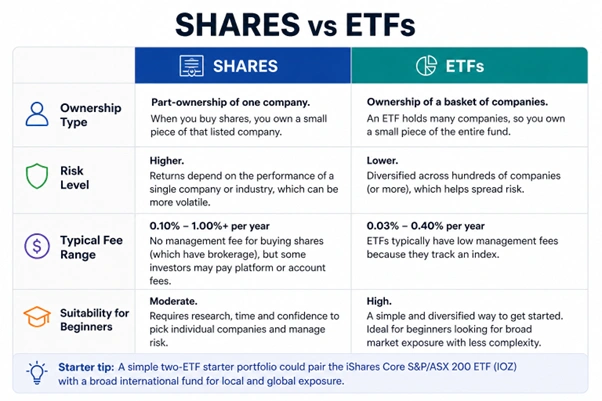
A comparison table of shares vs ETFs
Step 4: Choose a Brokerage Platform
To buy shares on the ASX, you need a brokerage account. Think of it as a bank account for buying and selling securities.
In 2026, the number of brokerage options available to Australian investors has grown significantly, and the differences between them – in fees, market access, and how your shares are held – vary considerably.
The main options for beginner investors in 2026:
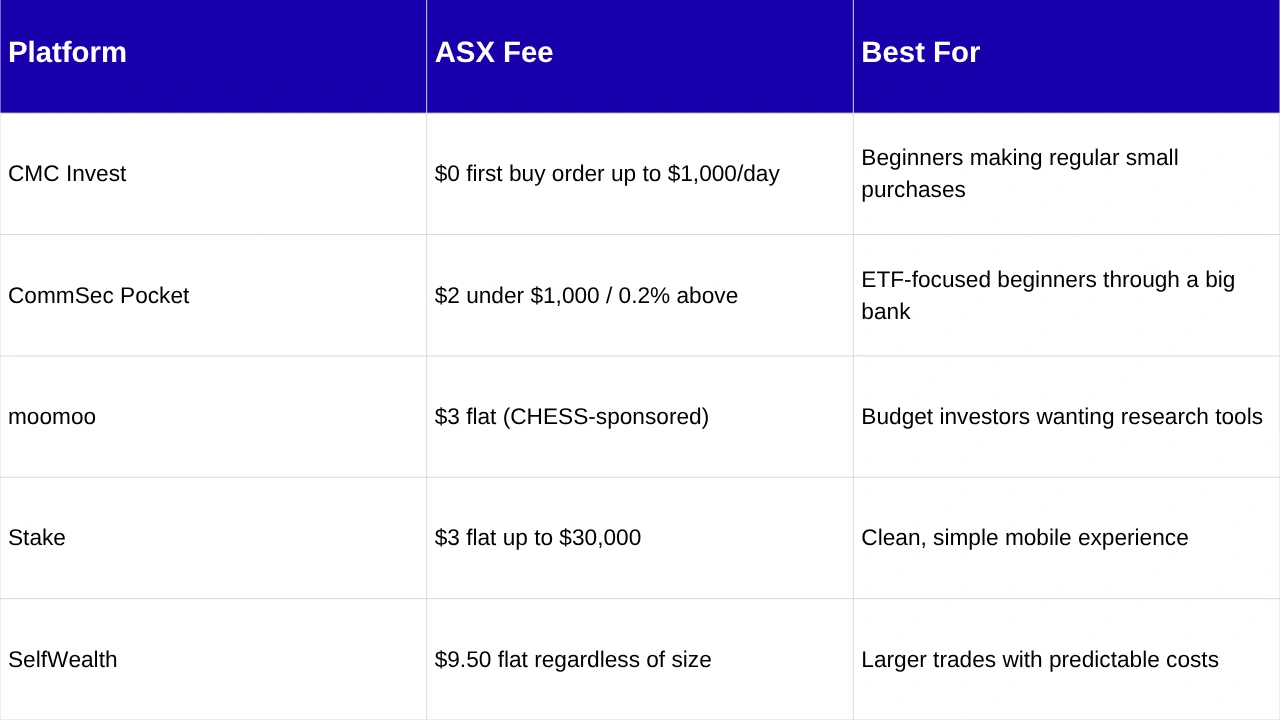
What is CHESS sponsorship?
When you buy shares through a CHESS-sponsored account, your ownership is recorded electronically with a unique Holder Identification Number (HIN) – the shares are in your name.
Custodian accounts hold shares on your behalf, which adds a layer of counterparty risk. For most beginners, CHESS sponsorship is the safer structure.
All legitimate platforms in Australia must hold an Australian Financial Services Licence (AFSL) issued by ASIC. This means client funds are kept separate from the broker’s own money. Always verify this before signing up.
Key Takeaway: For most beginner investors starting with small, regular amounts, CMC Invest’s zero-brokerage offer on sub-$1,000 daily ASX trades or CommSec Pocket’s $2 flat fee are the most cost-effective entry points. Prioritise ASIC regulation and CHESS sponsorship above everything else.
Step 5: Open Your Account
Most brokerage accounts can be opened online in under 15 minutes. Here’s what to expect:
- Go to the platform’s website and select “Open Account”
- Enter your full name, residential address, date of birth, and tax file number (TFN)
- Upload a copy of your driver’s licence or passport for identity verification
- Link your bank account for deposits and withdrawals
- Wait for approval – usually same day or the next business day
- Transfer your initial funds into the account
Do not skip providing your TFN. Without it, the platform is legally required to withhold tax from your dividend income at the highest marginal rate.
Step 6: Place Your First Trade
Once your account is funded, placing a trade is straightforward.
- Search for the company or ETF by its ASX ticker code (e.g. VAS, IOZ, CBA)
- Choose between a market order – executes immediately at the current price – or a limit order – only fills if the price reaches your nominated level
- Enter the dollar amount or number of units you want to buy
- Review the trade summary, including the brokerage fee
- Confirm
Settlement takes two business days after the trade executes – referred to as T+2. You are charged brokerage at the time of the trade, not settlement.
For a first trade, a market order is the simpler choice. Limit orders give you price control but can go unfilled if the stock never reaches your target.
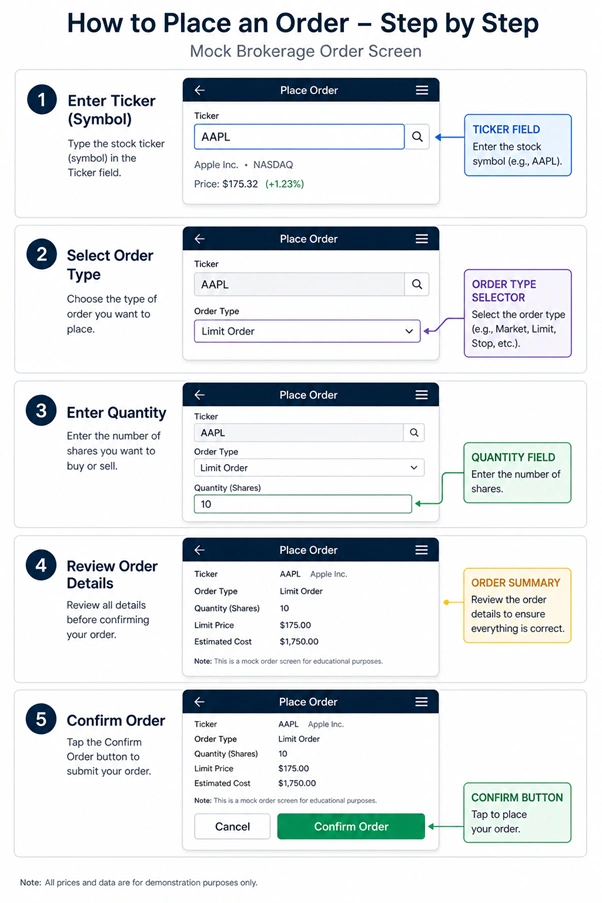
A step-by-step screenshot diagram of a mock brokerage order screen.
Step 7: Build a Simple Starting Portfolio for the Australian Stock Market
You do not need to pick individual stocks to invest on the ASX. For most beginners, a two-ETF structure is both sufficient and sensible.
A common approach pairs Australian market exposure with global diversification:
- VAS or IOZ – Australia’s top 200 to 300 companies across banking, mining, healthcare, and retail
- VGS or IQLT – broad international exposure to high-quality companies outside Australia
The ASX 200 returned 6.26% in 2025, while historically the index has averaged roughly 9 to 10% annually over the long term. An ETF tracking that index captures those returns without requiring you to select individual stocks.
Once your confidence grows and your portfolio size increases, you can consider adding ASX dividend shares for passive income – or read up on how experienced investors structure portfolios for long-term retirement goals.
Step 8: Know the Australian Tax Basics for Investors
Tax is part of investing. The rules in Australia are not complicated, but they do favour investors who hold for the long term.
Capital Gains Tax (CGT)
When you sell shares for a profit, that gain is added to your taxable income. Hold a share for more than 12 months before selling and only 50% of the capital gain is taxable. This CGT discount is one of the strongest incentives the Australian tax system provides for patient, long-term investing.
Dividends and Franking Credits
Many ASX companies pay fully or partially franked dividends. Franking credits represent company tax already paid at 30% on those profits. You can use those credits to offset your personal tax bill – and if your marginal rate is below 30%, you may receive a refund.
Super First
Before investing outside of superannuation, check whether you are making the most of contributions inside it. Super investment earnings are taxed at 15%, compared to your personal marginal rate outside. Salary sacrifice contributions remain one of the most tax-efficient ways to build wealth in Australia.
If you are unsure how your investments will be treated at tax time, speak with a registered tax adviser.
Step 9: Stay Invested – and Stay Consistent
The most common beginner mistake is not staying in the market long enough for compounding to work.
Markets will fall. They always do. In 2022, the ASX 200 lost more than 5%, yet investors who held through that period participated fully in the recovery that followed. Building a portfolio around diversified ETFs gives you a better chance of weathering those periods without bailing out at the wrong time.
Habits that tend to separate long-term winners from short-term reactors:
- Invest a fixed dollar amount monthly, regardless of what the market is doing (dollar-cost averaging)
- Reinvest dividends rather than spending them
- Review your portfolio once or twice a year, not every week
- Ignore short-term headlines
What Success Looks Like and What to Do If Something Goes Wrong
After six months, a beginner investor on the right track should have:
- A funded brokerage account with CHESS sponsorship
- A portfolio in one or two diversified ETFs
- Automatic monthly contributions set up
- A basic understanding of their CGT and dividend tax obligations
- The discipline to leave the portfolio alone
If something has gone wrong, it usually comes down to one of three things: using an unregulated platform, investing money that was needed short term, or selling in a panic during a market drop.
None of these are unrecoverable. But all three are avoidable with a clear plan before you start.
Final Thoughts
The Australian share market in 2026 is accessible, regulated, and built for ordinary investors. For beginner investors willing to treat the ASX as a long-term wealth engine rather than a short-term bet, the approach has not changed: start with what you can afford to leave alone, buy broadly diversified funds, contribute consistently, and let time do most of the work.
The platform matters less than the habit. Start simple.
FAQs
Q: How much money do I need to start investing on the ASX?
A: An investment can start with as little as $500, plus brokerage costs. Several platforms now allow you to start with less – CommSec Pocket accepts deposits from around $50, and CMC Invest has no minimum deposit requirement at all. The more relevant question is how much you can afford to invest consistently, without needing that money back in the short term.
Q: What is the best ETF for beginners on the ASX in 2026?
A: There is no single best ETF, but a few stand out for their simplicity and low cost. The Vanguard Australian Shares ETF (VAS) is often considered a cornerstone fund for local investors, providing exposure to the 300 largest companies on the ASX – including BHP, Commonwealth Bank, CSL, and Wesfarmers. Pairing VAS with a broad international fund like the iShares S&P 500 ETF (IVV) gives beginners meaningful diversification in just two trades.
Q: Do I need a financial adviser to start investing on the ASX?
A: No, you can open a brokerage account and buy ETFs entirely on your own. That said, working with a licensed financial adviser can help with superannuation structure, tax-efficient strategies, and building a personalised plan aligned to your risk profile. For most beginners starting with broad index ETFs and regular contributions, a good foundation does not require paid advice. Seek it when your situation becomes more complex – multiple income streams, large lump sums, or approaching retirement.
Q: Is now a good time to invest on the ASX in 2026?
A: Timing the market consistently is something professional fund managers fail to do reliably. Dollar-cost averaging – investing a fixed amount at regular intervals regardless of market conditions – means you automatically buy more units when prices fall and fewer when they rise, smoothing your average purchase price over time. For beginner investors with a long-time horizon, a market dip is often a better entry point than a market high. The worst time to start is usually the time you keep waiting for.
Q: What is the difference between a market order and a limit order on the ASX?
A: A market order executes immediately at whatever price is available when you place the trade. A limit order only executes if the share price reaches the level you set – giving you price control, but no guarantee the trade fills. For beginners buying well-traded ETFs like VAS or IOZ, a market order is the simpler and more reliable option. Limit orders are more useful when buying less liquid stocks where the spread between buy and sell prices is wider.
Q: How are my ASX investments taxed in Australia?
A: Two main taxes apply. Capital gains tax (CGT) is triggered when you sell shares at a profit – that gain is added to your taxable income for that financial year. If you hold a share for more than 12 months before selling, only 50% of the capital gain is assessable, thanks to the CGT discount. Dividends are taxed as income, though franking credits from Australian companies can offset part or all of the tax owed, depending on your marginal rate.
Q: What is dollar-cost averaging and should beginners use it?
A: Dollar-cost averaging means investing a fixed dollar amount at regular intervals — say, $300 every month – rather than trying to invest a lump sum at exactly the right time. This strategy reduces the temptation to time the market and supports long-term compounding through automatic contributions into ASX-listed ETFs or index funds. For most beginner investors on the Australian stock market in 2026, it is the most practical and psychologically manageable way to build a portfolio over time.
Disclaimer: This article is for informational purposes only and does not constitute financial advice. Before making any investment decisions, consider speaking with a licensed financial adviser.
Sources:


