
The UK government has moved to formalise its grip on British Steel, announcing new legislation via the King’s Speech that gives ministers the legal power to bring the steelmaker into full public ownership.
The announcement, made by Prime Minister Sir Keir Starmer on 11 May 2025, sets the stage for a potential nationalisation of the Scunthorpe plant, the last site in Britain capable of producing virgin steel from raw materials.
Why the Government Is Pushing the British Steel Bill Now
The new legislation follows the government’s intervention in April 2025 under the Steel Industry (Special Measures) Act, which kept British Steel’s blast furnaces running after its Chinese owner, Jingye Group, moved to shut them down.
That emergency law passed in a single day on a Saturday – a rare recall of Parliament from Easter recess – and was the most dramatic act of industrial intervention the UK had seen since the 2008 financial crisis.
Since the April intervention, the government has been in discussions with Jingye to find what it calls a “pragmatic and realistic solution” for the business. Those talks have not yet produced an outcome.
The new Bill, to be formally introduced this week, takes things further. It creates a legal mechanism for full public ownership – something the April legislation did not do.
What the King’s Speech Bill Actually Does
The new powers would be subject to public interest tests. If used to nationalise British Steel, they would boost national security while giving stability to workers at Scunthorpe, and British Steel’s suppliers and customers.
Critically, this Bill does not automatically nationalise the company. It gives the government the option to act – and only if specific conditions are met.
Any decision to bring British Steel into public ownership would only be taken after the Bill receives Royal Assent, and if the public interest test set out in the legislation is met.
That framing gives ministers flexibility. They can proceed with nationalisation, continue looking for a private co-investor, or hold the option in reserve while negotiations continue.
The Scunthorpe Plant: What Is at Stake
British Steel’s Scunthorpe plant is the last remaining site in the UK producing virgin steel.
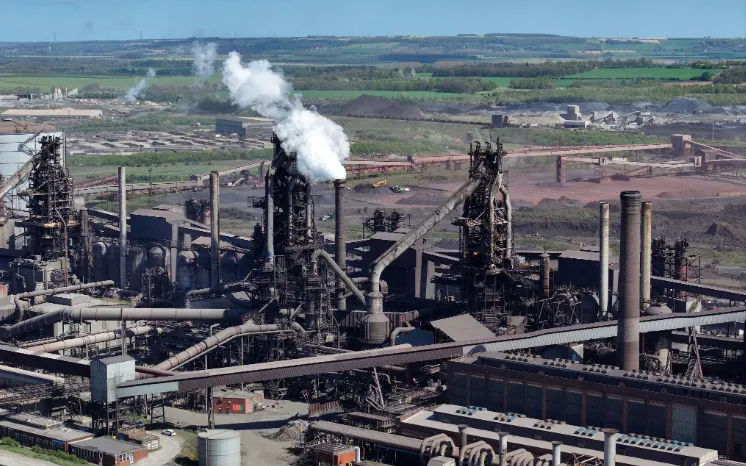
British Steel’s Scunthorpe plant [Wikipedia]
Letting it close would have made the UK the only G7 nation without primary steelmaking capability – a situation the government has repeatedly described as unacceptable on both economic and national security grounds.
Steel is vital for both the UK’s national security and manufacturing, and crucial for the Government’s mission to build 1.5 million new homes, with construction projects requiring millions of tonnes of steel.
As of 26 March 2026, the amount of working capital the government has provided to British Steel since the emergency legislation was passed stood at approximately £419 million.
That figure alone illustrates how deep the government is already in – and why formalising a path to ownership makes political and financial sense.
The Road That Led Here
Jingye Group, the Chinese steelmaker that bought British Steel in 2020 for £70 million, announced in March 2025 that the Scunthorpe works were losing £700,000 a day and would be closed.
The company had earlier sought a £1 billion bailout from the UK government without committing to firm guarantees on jobs or the plant’s future.
Negotiations collapsed, and Parliament was recalled in extraordinary circumstances.
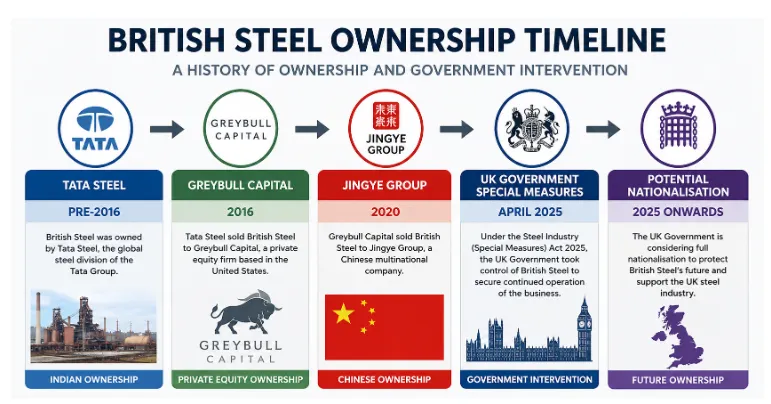
British Steel’s ownership history, from privatisation to potential public ownership.
You can read more about the background and the government’s initial calculus in our earlier coverage,UK Weighs Saving British Steel.
Political Reactions: Divided, as Expected
The announcement has drawn a predictable response from across the political spectrum.
Conservatives have questioned whether the government is handing taxpayers an open-ended financial commitment. Shadow business secretary Andrew Griffith previously warned the legislation would mean the chancellor “standing behind the payroll” of British Steel.
Labour backbenchers, on the other hand, have pushed for faster action. Some members have argued temporary measures are not enough and that full public ownership is the only path that protects long-term job security for Scunthorpe’s thousands of workers.
The government has been careful to frame its position around economics and national resilience rather than ideology.
Revitalising the steel sector is described as a top priority, and the government has recognised that securing the long-term future of the UK’s steel sector relies on both public and private investment for modernisation.
What Happens Next
The Bill moves through Parliament this week. Once it receives Royal Assent, the government will hold a formal legal power to nationalise British Steel if it determines the public interest test is satisfied.
Talks with Jingye are expected to continue in parallel. The government has not ruled out a private co-investment deal, but the window is narrowing.
The launch of the Government’s landmark Steel Strategy in March set out its long-term plan to revitalise the UK steel sector and meet up to 50 per cent of UK steel demand domestically.
Whether that plan ends with a nationalised British Steel or a new private partnership, the King’s Speech bill locks in one thing: the government is not walking away from Scunthorpe.
Also Read: These Lithium Stocks Are Sitting on Some of the World’s Rarest Cesium Assets
FAQs
Q: What did the King’s Speech announce about British Steel?
The King’s Speech included a new Bill giving the UK government the legal power to bring British Steel into public ownership. The move follows months of crisis at the Scunthorpe plant after its Chinese owner, Jingye Group, moved to shut down operations in early 2025.
Q: Is British Steel being nationalised?
Not yet. The new legislation creates the option for nationalisation, subject to a public interest test. No final decision has been made. The government is still in discussions with Jingye Group and has not ruled out a private co-investment deal.
Q: What is the Steel Industry (Special Measures) Act 2025?
It is the emergency legislation Parliament passed on 12 April 2025 — in a rare Saturday sitting — giving the Secretary of State the power to direct British Steel’s operations and keep its blast furnaces running. It was a short-term intervention, not a transfer of ownership.
Q: Why does the UK want to keep British Steel open?
Scunthorpe is the only site in the UK capable of producing virgin steel from raw materials. Closing it would make Britain the only G7 nation without that capability, raising serious concerns about national security, housing construction supply chains, and thousands of jobs in the local community.
Q: How much has the government spent on British Steel so far?
As of 26 March 2026, the UK government had provided approximately £419 million in working capital to British Steel since the emergency legislation passed in April 2025.
Q: What is Jingye Group’s role in all of this?
Jingye Group is the Chinese steelmaker that bought British Steel in 2020 for £70 million. In March 2025, it announced the Scunthorpe works were losing £700,000 a day and planned to close the blast furnaces. Negotiations with the UK government over a co-investment deal collapsed, triggering the emergency legislation.
Q: What happens after the Bill receives Royal Assent?
Once the Bill becomes law, the government will have the formal legal power to proceed with nationalisation if the public interest test is satisfied. Talks with Jingye are expected to continue alongside the legislative process.
Disclaimer: This article is for informational purposes only and does not constitute financial or investment advice.
Source: https://www.gov.uk/government/news/new-legislation-gives-government-power-to-bring-british-steel-into-public-ownership


