
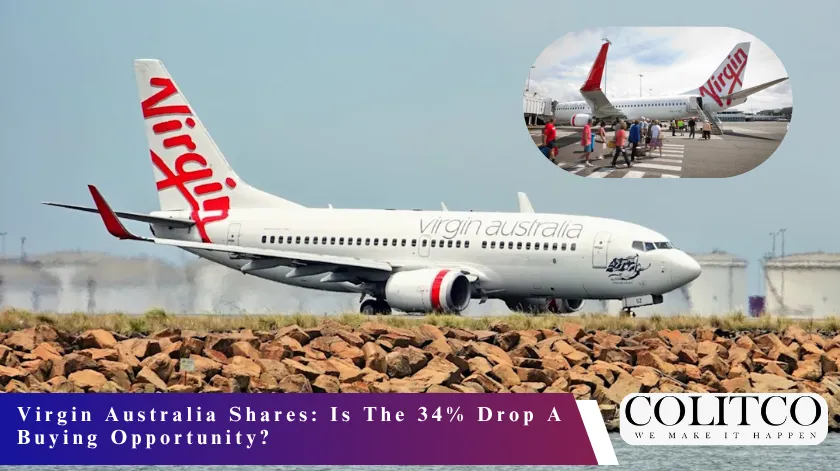
Virgin Australia’s stock has been plunging in 2026, down 34% so far, and performing poorly compared to the market overall.
The stock of the airline is currently trading below its IPO price of 2.90 and its previous high of about 3.23 at a price of 2.30. The increased fuel prices associated with the Iran war have had a significant effect on the operating costs and investor confidence.
The stock has fallen 23.6 in March alone, as there is increasing concern about the stability of aviation demand. The pressure on performance by geopolitical risks and cost is still present, which makes airline stocks more susceptible to changes than any other industry.

Passengers using laptops mid-flight as the airline industry faces volatility. [Courtesy: Forbes]
How Did The IPO And Market Performance Compare?
Virgin Australia re-traded on the ASX on 24 June 2025 with high investor support and recovery hope. Nonetheless, the present performance of the share prices is portraying a different story to the early entrants.
The stocks are currently below the IPO price, resulting in a loss for those who initially invested. The 34% fall in the stock in 2026 is significantly worse than the 18% fall in the stock in Qantas and the 1.55% fall in the stock in ASX 200.
This analogy underscores the sensitivity of the airline industry to macroeconomic conditions and increases in the cost of operation, which have disproportionately impacted aviation stocks.
What Do Financial Results Reveal About Virgin Australia Shares?
Irrespective of the drop in share price, Virgin Australia registered good operational performance during the first half of FY2026. The revenue grew by 9.3% to reach 3.32 billion, as the travel demand and better capacity utilisation boosted the revenue.
Underlying EBIT increased by 11.7 per cent to $490 million based on efficiency enhancement and cost control activities. The price power is also high as revenue per available seat kilometre increased by 6.4%.
Nonetheless, statutory net profit after tax decreased by 27.9% to $341 million because the previous tax benefits were not repeated. These ambivalent outcomes indicate competence in operations and strain on overall profitability.

Aircraft on runway reflecting strong revenue growth but rising cost pressures. [Courtesy: IATA]
Is Rising Cost Pressure A Long-Term Concern?
The increase in costs continues to be one of the largest issues that concern Virgin Australia shares and other aviation industries.
The cost of fuel has increased drastically owing to geopolitical tensions in the Middle East, which have caused a great rise in airline costs. There are also increased maintenance expenses due to supply chain interruptions and the increased prices of parts.
Also, there are increased airport fees that have further strained the operating margins. These price rises can compel the airlines to increase the costs of tickets, which can affect demand in the long run.
Although the demand in the travel sector is high, the profitability may be constrained by the persistence of cost inflation, thus making it difficult to grow in the long term.
What Are Analysts Saying About Virgin Australia Shares?
Analysts are not confident, even though the airline has good operational measures and revenue growth in FY2026.
According to Blake Halligan of Catapult Wealth, the increase in earnings and the benefits of transformation were mentioned as positive factors in the company.
He, however, retained a hold rating with the increasing cost pressures and the uncertainty regarding future costs. The demand and yields are favourable, but there is a balanced risk situation due to the rising operational costs.
This defensive attitude can be seen as an indication of the general market sentiment, with investors balancing good fundamentals with macroeconomic risks and volatility in the aviation sector.

Analyst reviewing airline stocks amid mixed signals in the aviation sector. [Courtesy: Scan X]
Should Investors Buy Virgin Australia Shares Now?
The fall in Virgin Australia stocks offers an opportunity and a risk to the stock analysts of airlines. The long-term investment potential is supported by strong growth in revenue, increasing demand, and operational efficiencies.
There is uncertainty in the near term, though, due to geopolitical tensions, volatility of fuel prices, and an increase in operating costs. The shares that are trading below the IPO can appeal to the value-oriented investor to gain entry.
Nevertheless, one should be wary based on the prevailing conditions. Before making decisions, investors in the global aviation markets should watch the cost trends and macroeconomic trends keenly because the situation is unpredictable.
Also Read: Flight Centre AGM 2025: Strong Trading Update & Outlook
FAQs
Q1. Why are Virgin Australia shares down in 2026?
A1: Virgin Australia shares have declined due to rising fuel costs, geopolitical tensions, and increased operating expenses, impacting profitability.
Q2. Is Virgin Australia financially strong despite the decline?
A2: Yes, the company shows strong revenue and EBIT growth, though net profit has been impacted by cost pressures.
Q3. Should investors buy Virgin Australia shares now?
A3: Analysts suggest a cautious “hold” approach due to uncertainty around costs and broader market risks.
Q4. How does Virgin compare to Qantas in 2026?
A4: Virgin Australia shares dropped 34%, while Qantas shares declined 18%, showing relative underperformance.
Disclaimer
This article is for informational purposes only and does not constitute financial advice. Virgin Australia’s performance depends on market conditions, geopolitical risks, and operational challenges. Investors should conduct independent research or consult a licensed financial advisor before making investment decisions. Information is based on publicly available sources and may change without notice.
Sources
- https://www.fool.com.au/2026/04/04/down-34-in-2026-are-virgin-australia-shares-a-good-buy-today/
- https://www.fool.com.au/2026/02/27/virgin-australia-posts-1hfy26-earnings/
- https://www.reuters.com/world/asia-pacific/virgin-australia-half-year-profit-rises-21-strong-demand-2026-02-26/
- https://www.theaustralian.com.au/business/aviation/virgin-australia-posts-strong-profit-but-warns-rising-costs-threaten-airfare-prices/news-story/ccfa846014b68bbc675725feead02653


