
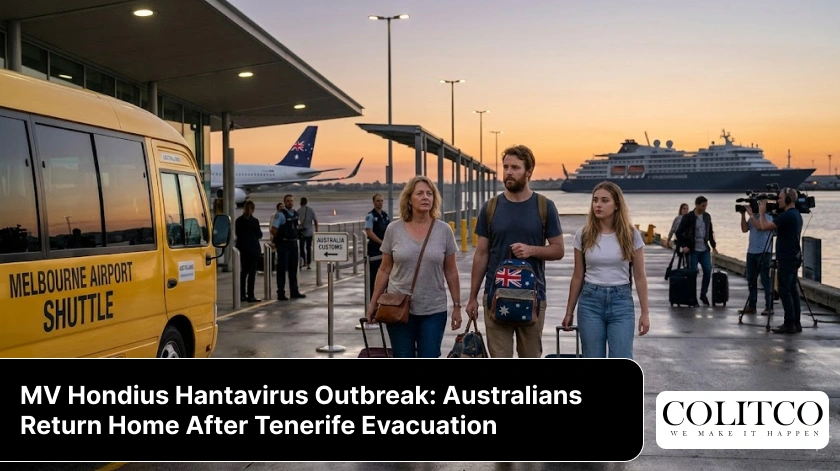
Four Australian nationals and one New Zealand citizen are preparing to fly home to Perth after the hantavirus-stricken Dutch expedition ship MV Hondius docked in Tenerife, Spain, early Sunday morning. The ship carried passengers from 23 countries, three of whom have died since the vessel departed Argentina in April.
MV Hondius Cruise Ship Docks in Tenerife Amid Hantavirus Crisis
The MV Hondius dropped anchor at the industrial port of Granadilla de Abona in Tenerife at approximately 5:30 a.m. local time on Sunday, May 10, 2026. Health officials from Spain and the World Health Organization (WHO) coordinated the arrival after weeks of tense negotiations between the ship’s operator, Oceanwide Expeditions, and port authorities.
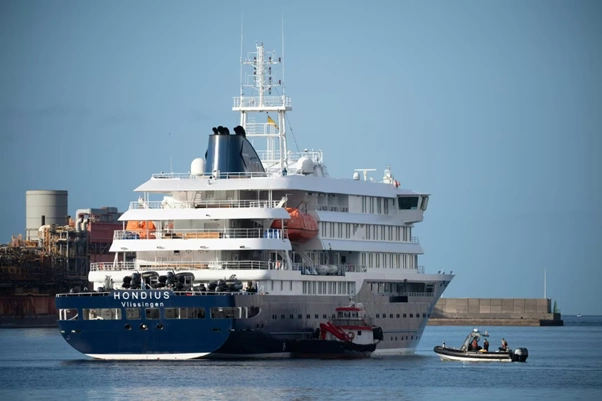
The MV Hondius arrives at Tenerife’s Granadilla de Abona port during an international health evacuation operation on May 10, 2026. [The Australian]
Spain coordinated the docking operation with 22 countries and the WHO. Spanish authorities insisted no foreign nationals would remain in the Canary Islands after disembarkation, even those showing symptoms. Each passenger transferred directly from the ship to the airport via speedboat and secured vehicles, with no contact with the local population.
Spain’s Health Minister Mónica García described the disembarkation procedures as “unprecedented.” A Norwegian air ambulance aircraft arrived on standby at Tenerife Airport to respond to any medical emergencies during the evacuation process.
Four Australians on Board, All Reported Asymptomatic
Australia’s Department of Foreign Affairs and Trade (DFAT) confirmed that four Australian nationals remained aboard the MV Hondius as it sailed toward Tenerife. All four passengers tested negative for hantavirus and showed no symptoms, according to DFAT.
Spanish health officials required passengers to test negative before repatriation flights could be arranged. The four Australians cleared that requirement and are expected to board a repatriation flight to Perth via connecting hubs.
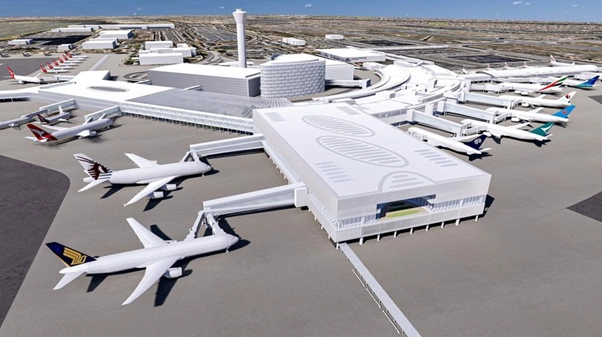
Australian authorities prepared monitoring procedures for returning passengers arriving in Perth. [The West Australian]
A separate Australian passenger had already left the ship earlier. That individual was among 23 people who disembarked at the remote island of Saint Helena on April 23 and reportedly returned home before the outbreak became widely known.
New Zealand Passenger Among Those Awaiting Repatriation
Oceanwide Expeditions confirmed one New Zealand national was on board the MV Hondius. New Zealand’s Ministry of Health stated there was no evidence to suggest the passenger contracted the virus.
New Zealand Deputy Director of Public Health Dr. Richard Jaine confirmed the repatriation process would include a full health assessment. He added that quarantine measures remained a possibility depending on risk levels identified upon return.
New Zealand’s Ministry of Foreign Affairs and Trade said consular officials in Wellington, The Hague, and Madrid maintained contact with local authorities throughout the incident. The ministry did not release further personal details about the passenger.
Perth Receives Returning Passengers Under Health Monitoring Protocol
Perth serves as the likely arrival point for the Australian passengers due to its proximity to European transit routes through the Middle East. Australia’s Department of Health alerted state-level health authorities, including those in Western Australia, to prepare for the passengers’ return.
Under Australia’s Biosecurity Act, returning passengers from the MV Hondius may receive a human health order requiring up to 45 days of self-monitoring. Western Australian health authorities confirmed they stood ready to assess each passenger on arrival.
The Australian Centre for Disease Control noted that hantavirus has never been recorded in a human case in Australia. The department rated the risk to the Australian public as “very low” but stressed that monitoring protocols would remain in place.
Three Deaths Recorded, Hantavirus Confirmed as Andes Virus Strain
Three passengers died since the MV Hondius left Ushuaia, Argentina, on April 1, 2026. The WHO confirmed six laboratory-confirmed cases of hantavirus as of May 8, with a total of eight suspected or confirmed cases across the ship.
Health officials identified the outbreak strain as the Andes virus, the only known hantavirus variant capable of limited human-to-human transmission. The case fatality ratio stood at approximately 38 percent based on confirmed data.
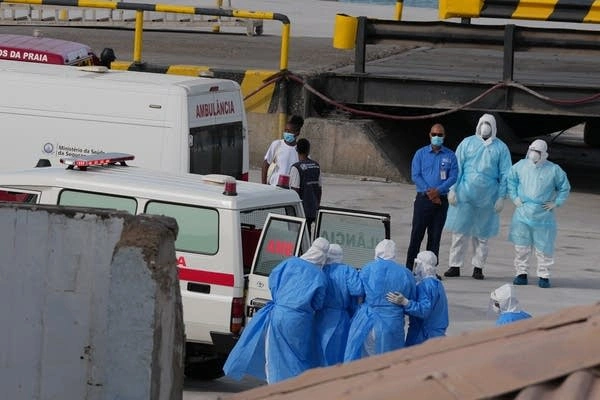
Health officials coordinated international monitoring efforts following confirmed hantavirus cases aboard the MV Hondius. [MPR News]
The first death occurred on April 11. The deceased passenger’s wife disembarked at Saint Helena on April 24 and later died at a hospital in Johannesburg, South Africa. A third passenger died on board. One British national was evacuated to South Africa for treatment and remained in critical but stable condition.
How Passengers Likely Contracted the Virus Before Boarding
Health experts believe the initial cases originated on land, not on the ship. No rodent activity was reported on board the MV Hondius at any stage of the voyage.
Argentine health authorities published a report on May 6 tracing the movements of the index case, a Dutch national, who completed a four-month road trip through Chile, Uruguay, and Argentina before boarding on April 1. Investigators speculated the individual may have contracted the virus during a bird-watching excursion near a landfill in Ushuaia, where exposure to infected rodent droppings was possible.
Researchers at the University of Colorado Anschutz Medical Campus explained that hantavirus has an incubation period of one to eight weeks. This means passengers may have felt healthy at embarkation before falling ill during the voyage.
Global Response: 22 Countries Coordinate Repatriation Flights
Repatriation flights from Tenerife covered passengers from numerous countries including the United States, United Kingdom, France, Germany, Belgium, Ireland, Canada, Turkey, and the Netherlands. The European Union made two aircraft available to cover nationals from countries without dedicated transport.
Nebraska Medicine CEO Dr. Michael Ash addressed the U.S. response, saying: “We are prepared for situations exactly like this. Our teams have trained for decades.” The statement came as 17 American passengers prepared to fly to Offutt Air Force Base in Nebraska for medical evaluation at the National Quarantine Unit.
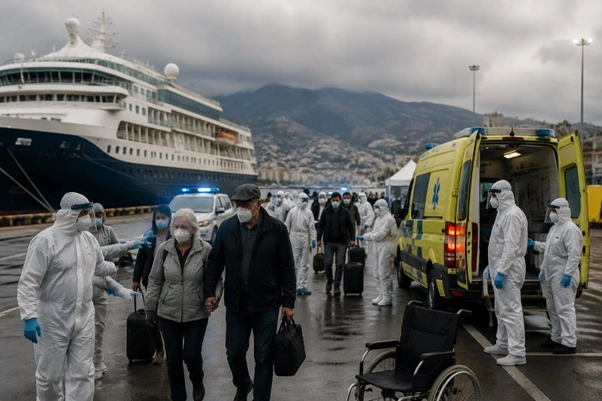
Multiple countries coordinated emergency repatriation flights after the cruise ship outbreak. [Travelandtourworld]
France evacuated five nationals to Paris on May 10. Those passengers faced 72 hours of hospitalization followed by 45 days of home quarantine. Other countries adopted varying quarantine approaches based on their own public health guidelines.
WHO Assesses Global Risk as Low but Monitoring Continues
WHO Director-General Dr. Tedros Adhanom Ghebreyesus traveled to Tenerife on Sunday to personally oversee the evacuation and reassure local residents. He stated that the global public health risk from the outbreak remained low, based on scientific assessment and available evidence.
Health officials across multiple countries continued tracing passengers who disembarked before the outbreak was publicly confirmed, particularly those who left at Saint Helena on April 23. The WHO notified health authorities in New Zealand, Turkey, Sweden, Saint Kitts and Nevis, and several other nations about potential exposure among their citizens.
Australia’s health department confirmed it was working closely with the WHO and international partners. The department reaffirmed that no human cases of hantavirus had been detected in Australia and that the country’s health services remained well-positioned to respond if needed.
Also Read: Inside Warren Buffett’s 70-Year Wealth-Building Journey: How to Grow Wealth in Any Market
FAQS
Q1. What happened on the MV Hondius cruise ship?
A1. The Dutch expedition cruise ship MV Hondius experienced a hantavirus outbreak during its voyage after departing Argentina in April 2026. Three passengers died, while several others tested positive or showed suspected symptoms.
Q2. How many Australians were on board the MV Hondius?
A2. Australia’s Department of Foreign Affairs and Trade confirmed that four Australian nationals remained on board the ship before its arrival in Tenerife, Spain.
Q3. Did the Australian passengers test positive for hantavirus?
A3. No. Australian authorities stated that all four Australians tested negative for hantavirus and showed no symptoms before repatriation flights were arranged.
Q4. Why did the ship dock in Tenerife?
A4. Spanish authorities coordinated the docking in Tenerife to safely evacuate and repatriate passengers under strict health protocols alongside the World Health Organization and multiple countries.
Q5. What is hantavirus?
A5. Hantavirus is a rare viral disease usually spread through exposure to infected rodent droppings, urine, or saliva. Some strains can cause severe respiratory illness.
Q6. What is the Andes virus strain?
A6. The outbreak aboard the MV Hondius involved the Andes virus strain, which is the only known hantavirus capable of limited human-to-human transmission.
Q7. Will the returning passengers face quarantine in Australia?
A7. Australian health authorities may require returning passengers to follow health monitoring or self-monitoring protocols for up to 45 days under biosecurity regulations.
Q8. Has hantavirus ever been recorded in Australia?
A8. Australia’s health authorities stated that no human hantavirus cases have ever been recorded in the country.
Q9. How did passengers likely contract the virus?
A9. Health experts believe the original exposure happened on land in South America before passengers boarded the ship, possibly during travel in Argentina or nearby regions.
Q10. What is the WHO saying about the outbreak?
A10. The World Health Organization assessed the global public health risk as low but said international monitoring and passenger tracing efforts would continue.
Disclaimer
This article is based on publicly available information and international health authority reports at the time of publication. It is intended for informational and news reporting purposes only and does not constitute medical advice. While every effort has been made to ensure accuracy, details of evolving health situations may change as new updates emerge. Readers are advised to refer to official statements from health agencies and government authorities for the most current information.
Sources
https://www.cnn.com/2026/05/10/health/live-news/hantavirus-cruise-outbreak