The numbers came out in the 14 October operations review. Diesel had already added US$0.9 a tonne year to date. At the then spot price near US$175 a barrel the full-year hit looks like US$1.1 a tonne. The Australian dollar sitting around US70 cents against the guidance assumption of US67 cents adds another US$1.0 a tonne for the year.
Guidance stays US$23.5 to US$25.0 a wet metric tonne free on board. That range is now under real pressure from two things management does not fully control.
Pilbara iron ore still carries the bulk of the cash flow. When unit costs rise the margin on every tonne shrinks. Iron ore prices have not been kind either. Realised prices have drifted and the cost curve is moving up at the same time. The combination bites harder than either factor alone.
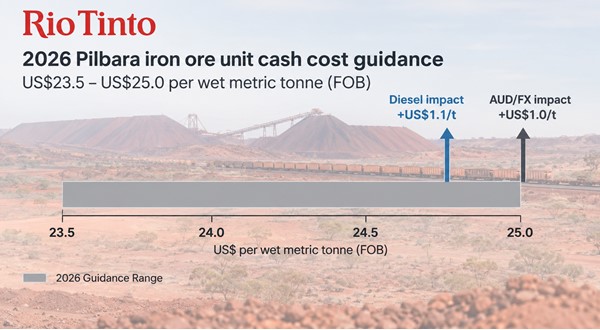
Estimated full-year diesel and currency hits relative to guidance.
Diesel cost impact on Rio Tinto unit costs
Middle East tension has kept diesel elevated through most of 2026. Rio Tinto burns a lot of it. Trucks, trains, generators. Roughly two-thirds of the group’s diesel goes into the Pilbara system. Every US$10 a barrel move adds about US15 cents a tonne for the full year. That sensitivity is now showing up in the year-to-date numbers.
The company has long-term contracts that lag the spot market, so the pain arrives with a delay. It still arrives. The October update made the lag clear. Higher diesel is not a one-off. It is structural while the energy market stays tight.
Productivity work is the offset. Management is chasing a US$1.8 billion annualised run-rate by year end. Some of that is already visible in higher plant utilisation and better volumes. It is not enough to cancel the diesel bill. It just slows the damage.
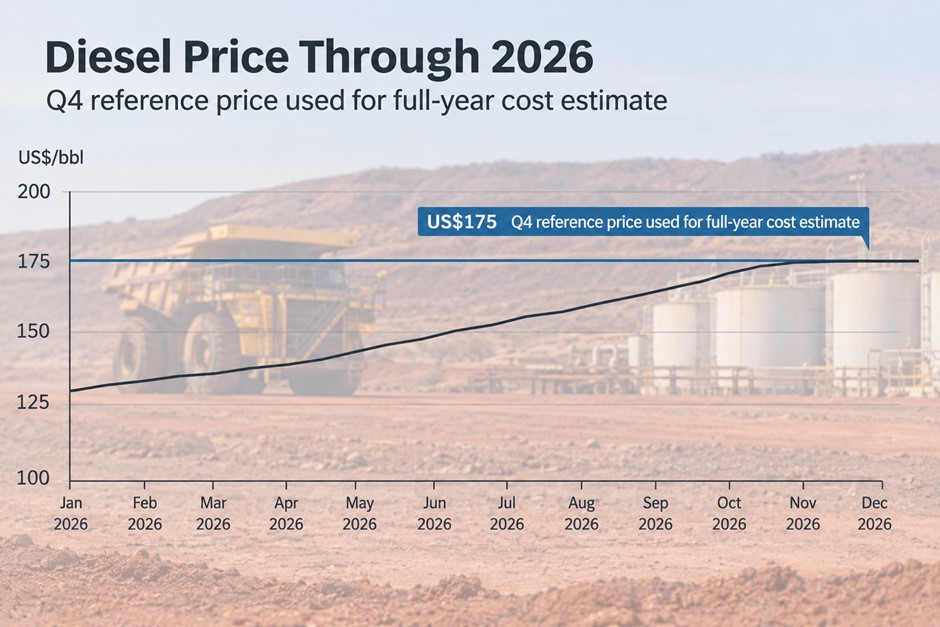
Diesel price used for the Q4 cost estimate.
Australian dollar pressure on Pilbara margins
Most Pilbara costs land in Australian dollars. Wages, contractors, power, most supplies. Revenue lands in US dollars. When the Aussie strengthens the same local costs translate into more US dollars per tonne. That is the FX hit sitting at roughly US$1.0 a tonne for the full year at current rates.
The Reserve Bank has left rates higher for longer. The currency has stayed firm. Rio Tinto’s guidance assumed a weaker Aussie. The gap is now material. Iron ore margins feel it first because the business is so large and so local-cost heavy.
Copper is the contrast. Oyu Tolgoi is ramping and copper C1 costs have been cut to the 30-50 cents a pound range on better gold credits and higher volumes. That part of the portfolio is moving the other way. The Pilbara is not.
What the numbers actually mean for margins
In the first half unit costs already sat at US$25.0 a tonne, the top of the full-year band. The second half has to absorb the remaining diesel and FX pressure. Volumes help. Pilbara sales ran 85.7 million tonnes in the September quarter, up 2 percent year on year. Nine-month sales sat at 243.3 million tonnes, up 4 percent. More tonnes spread the fixed costs but the variable cost hits from diesel and currency still land.
Independent analysis has put the combined diesel and FX effect near US$700 million on a 100 percent basis for the year. That is real money even for a company the size of Rio Tinto. It shows up in lower free cash flow and tighter headroom for the capital release program that is still running.
The company is still releasing capital. More than US$2 billion has already been flagged year to date inside the broader US$5-10 billion target. That work continues. It does not erase the cost pressure on the core iron ore business.
The practical takeaway
Rio Tinto can live with costs at the top of guidance if iron ore prices hold and volumes stay solid. The risk is a further diesel spike or another leg higher in the Aussie. Both remain live. The productivity program is the only internal lever that can still move the needle this year. Everything else is external.
The October update left the guidance range intact. That was deliberate. It also left a clear warning that the range is now dependent on factors outside the mine gate. Diesel and the Australian dollar are the two that matter most right now. Investors watching iron ore margins need to watch both.
FAQs
Q: Does the guidance still hold?
A: Yes. US$23.5-25.0 remains the official band. External factors can push the outcome to the top end.
Q: How big is the diesel sensitivity?
A: About US15 cents a tonne for every US$10 move in the diesel price.
Q: Is the Aussie dollar still a problem?
A: At current levels it adds roughly US$1.0 a tonne versus the original guidance assumption.
Disclaimer: This article is for general information only and does not constitute financial advice. Share prices and commodity costs can move quickly. Readers should do their own research or speak to a licensed adviser before making investment decisions.

Luke Carlino is a seasoned Copywriter, Content Strategist, and Social Media Manager specialising in Mining, Finance, and Business journalism. With more than a decade of industry experience, he brings rigorous editorial standards and commercial acuity to every project.