

The Flight Centre data breach investigation hinges on one word in the company’s ASX notice: unknown. Unknown people, unknown record counts and a supplier left unnamed.
On Thursday 26 November 2026, Flight Centre Travel Group (ASX: FLT) said it is probing unusual activity in a third-party accommodation booking system. The cybersecurity incident reaches the Flight Centre brand, Travel Associates, Cruiseabout and some independent agents.
What the Flight Centre notice says, and what it skips
Strip out the careful wording and the ASX statement makes four claims. Flight bookings are fine. Corporate travel runs on other systems. No card, payment or bank details have turned up. A significant number of customer records may have been accessed.
That last one has a catch. The company says it is not yet clear how many records were actually pulled out of the supplier’s system. Seen and stolen are different things, and the filing does not say which applies.
Most records hold names, some with basic travel details. A very small share carry limited passport details, email addresses, phone numbers, birth dates or, rarely, health or mobility information.
The market shrugged. Reuters reported shares fell as much as 2.1% to A$10.64 in early trade, the lowest since 19 October.
Fair reaction. Nothing in the notice threatens bookings or cash flow today.
The fix list is short. Flight Centre and the vendor changed authentication keys and credentials, then lifted monitoring. That is standard first aid after any suspected break-in, so it proves little. The vendor’s side of the story is still the missing chapter.
Why a hotel booking system holds passport details
Passport details in an accommodation system look odd until Cruiseabout enters the picture. Cruise lines and some international stays ask for passport information at booking.
Health and mobility notes probably arrive the same way, through requests for an accessible room or cabin. The filing does not spell that out, so treat it as an educated read, not a finding.
Those rare entries are the ones to watch. A stolen name is a nuisance. A name tied to a mobility need and a travel date is something else.
Scammers also do not need card numbers. A name, a hotel and a check-in date make a very believable “your booking has changed” email. Flight Centre’s own warning is to ignore unexpected links, attachments and requests for passwords or payment details.
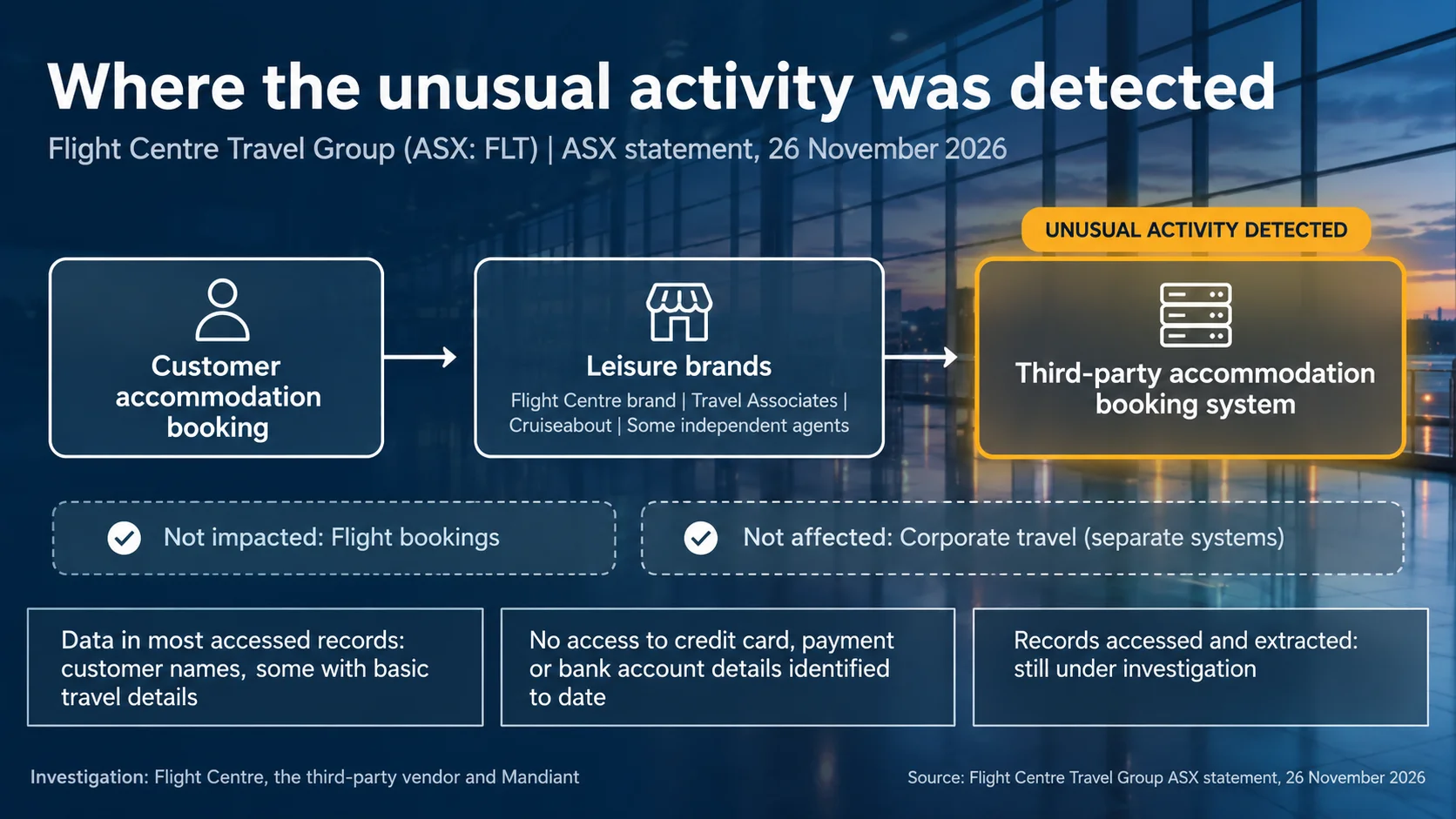
The activity was detected in a supplier’s accommodation system, not in flight or corporate booking platforms.
There is history here too. In 2017, a three-day “design jam” handed 16 teams a customer dataset. A free-text field inside it held 4,011 credit card numbers and 5,092 passport numbers for 6,918 people, according to the privacy commissioner’s 2020 determination.
That was an internal slip, and nothing links it to this week. Flight Centre paid A$68,500 in passport replacement costs back then. Sensitive details have a habit of piling up in odd corners of systems.
Travel sector cyber risk keeps landing on suppliers
This is not a one-off. Qantas said in July 2025 that six million customer records sat on a third-party platform. Booking.com warned customers in April 2026 that reservation details had been accessed.
Earlier this month, a booking platform behind campground systems in several states was hit, the ABC reported. Flight Centre now joins that run.
Recent Australian travel-booking data incidents
| Incident | Date | What was reported |
|---|---|---|
| Qantas | Jul 2025 | Six million customer records on a third-party service platform |
| Booking.com | Apr 2026 | Reservation details accessed by unauthorised parties |
| Bookeasy (park bookings) | Nov 2026 | Camper data breached across several state systems |
| Flight Centre | 26 Nov 2026 | Third-party accommodation system under investigation |
Boštjan Koželj, quoted by PhocusWire, put the trend bluntly: “Nobody attacks the fortress anymore.” Each booking hops through several vendors’ systems, and each hop holds a copy of the customer.
Here is the view from this desk. Travel sector cyber risk is baked into how the trade works. An agent sits on top of dozens of suppliers, and a retailer can lock down its own servers and still lose names through a partner it does not control.
Boards call that vendor risk. Customers call it Flight Centre’s problem, and they have a point. Their details went to Flight Centre, not to a booking platform they have never heard of.
The next update matters more than the share price
Three things will decide how this plays out:
- The record count, and how many records were actually taken
- The vendor’s name, and whether other travel sellers use the same platform (independent agents already do, which hints it is shared)
- When customer emails land, and what they say
On the count, law firm Clayton Utz reads ASX Guidance Note 8 as expecting a number once the facts are known. Flight Centre cannot give one yet. A follow-up without one would raise eyebrows.
Australian law also gives a company 30 days to assess a suspected eligible data breach. If serious harm is likely, it must then notify the privacy regulator and affected people. Flight Centre says it is notifying the relevant authorities.
Shareholders should watch legal exposure more than the 2% dip. Class actions followed the Optus and Medibank breaches in 2022. Nothing in this filing points to one yet.
A travel agent’s pitch is that the fiddly details are handled. The next few weeks will test whether that includes the customer’s own.
Also Read: Xi Jinping Australia Minerals Cooperation: Who Benefits?
FAQs
Q: Were payment details taken?
A: None have been identified so far, per the ASX statement.
Q: Which brands are affected?
A: Flight Centre, Travel Associates, Cruiseabout and some independent agents.
Q: Are flights affected?
A: No. Corporate travel also runs on other systems.
Q: What should customers do?
A: Ignore unexpected links and attachments, and share nothing in reply.
Q: Who is investigating?
A: Flight Centre, the vendor and cyber firm Mandiant.
Disclaimer: This article is general information only and is not financial advice. Colitco does not hold a view on whether to buy, hold or sell any security. Readers should do their own research and speak to a licensed adviser before making investment decisions.

Luke Carlino is a seasoned Copywriter, Content Strategist, and Social Media Manager specialising in Mining, Finance, and Business journalism. With more than a decade of industry experience, he brings rigorous editorial standards and commercial acuity to every project.