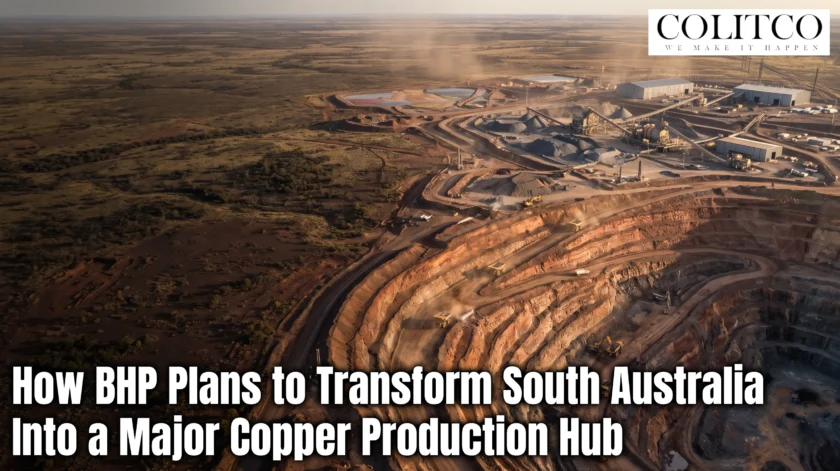
The BHP copper projects South Australia programme brings several operations into one development plan. Olympic Dam provides the processing base, while Carrapateena and Prominent Hill offer room to grow underground production. Some work is nearly ready; other projects remain under study. In this article, Colitco examines how the pieces fit together and which decisions stand between the plan and higher output.
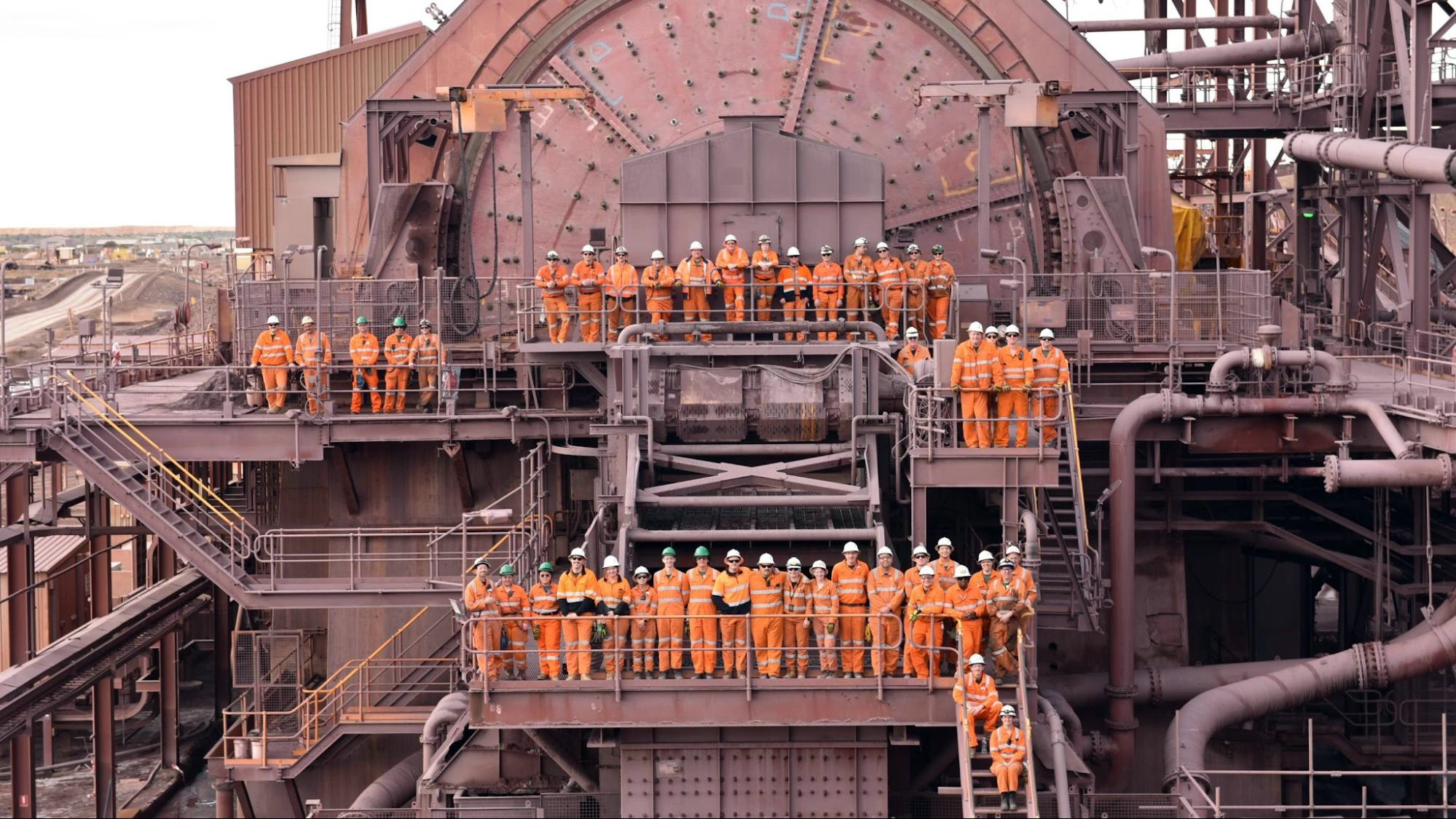
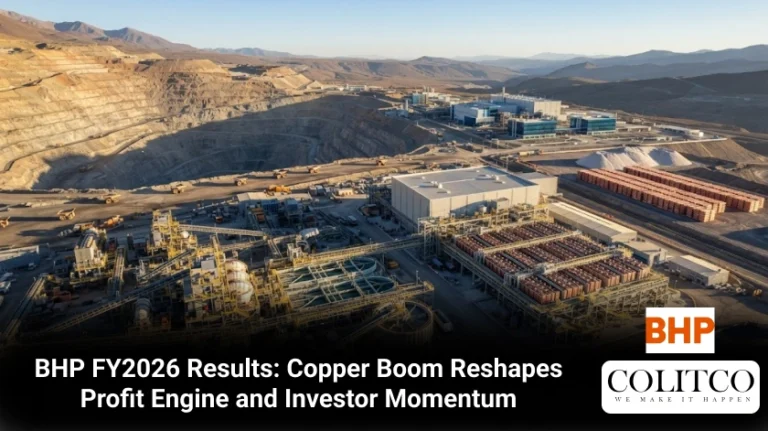
Figure 1: Workers at Olympic Dam in the cover photograph of BHP’s November 2026 Copper South Australia presentation. Credit: BHP.
Connecting Existing Mines Gives BHP a Base to Build From
BHP laid out its plans at an investor site tour on 23 November. Copper South Australia produced 321,000 tonnes of copper in FY2026. Its longer-term ambition is roughly double that volume by 2040.
That comparison needs care. The future figures describe a development pathway subject to studies, approvals and investment decisions. They are not a promise that every proposed project will proceed.
Olympic Dam already combines mining, concentrating, smelting and refining. Carrapateena and Prominent Hill produce concentrates. Owning those operations together gives BHP choices about where material goes and which facilities it expands first.
The practical benefit is flexibility. A mine can grow without requiring every tonne of its concentrate to pass through a newly enlarged local smelter immediately.
Shaft Hoisting at Prominent Hill Brings the First Change
Prominent Hill is the nearest milestone. BHP says execution of its expansion is complete, with commissioning scheduled for December 2026.
The project replaces truck haulage with an electrical hoisting shaft, supported by an underground crusher and materials-handling system. After ramp-up, planned mine production rises from FY2026’s 4.4 million tonnes to 7.5 million tonnes a year.
This addresses a specific constraint: getting ore out of the ground. The concentrator already has more capacity than the mine currently supplies. Better underground delivery allows more of that installed plant to be used.
Commissioning starts the next test. Equipment must work reliably together before its designed capacity becomes routine production.
Block Caving Opens a Route to Larger Mining Volumes
How is BHP increasing copper production in South Australia? A substantial part of the answer lies below the existing workings.
At Carrapateena, BHP plans a block cave beneath the current sub-level cave. It has approved USD 366 million of early funding for development and supporting infrastructure, ahead of a final investment decision expected in the first half of 2028.
The plan pairs a larger mine with another concentrator. Expanding only one would leave the other as a bottleneck.
Olympic Dam has a similar need to match mining with processing. BHP is comparing block-cave options, including a larger alternative that could bring forward concentrator production. Its preferred design is still being studied.
| Project | Next Planned Decision or Milestone | Role in the Expansion |
| Prominent Hill | Commissioning in December 2026 | Shaft hoisting increases underground ore delivery. |
| Smelter and refinery | Investment decision in H2 2027 | Two-stage smelting supports changing ore and higher volumes. |
| Carrapateena | Investment decision in H1 2028 | Block cave and extra concentrator capacity. |
| Olympic Dam mine and concentrator | Investment decision in 2029 | Additional bulk mining and processing capacity. |
Dates reflect the November presentation and may change. Commissioning, first production and full operating capacity are separate milestones.
Two-Stage Smelting Makes More of Olympic Dam’s Ore Usable
The smelter proposal does more than add capacity. As mining moves through Olympic Dam, the relationship between copper and sulphur in the feed changes. BHP says a two-stage process is needed to unlock its existing reserves.
The design adds a primary furnace and converts the current furnace to a secondary role. Refining capacity would also expand.
This explains why South Australia copper production cannot be assessed from underground tonnes alone. The processing route has to suit the material being mined.
Colitco’s examination of BHP’s longer-term copper opportunities puts this regional programme alongside the company’s wider portfolio. Here, the immediate issue is whether the mine and processing schedules can be delivered together.
Water and Power Upgrades Support the Extra Throughput
A larger concentrator needs a dependable water supply. More electrically driven equipment needs enough transmission capacity.
BHP identifies Northern Water as a key supporting project, with first water targeted for FY2032. It is a proposed government-led, multi-user facility, with BHP as a major customer.
Electricity is another constraint. The presentation says existing transmission capacity is nearing its limit. BHP is studying staged upgrades against a larger single build.
These choices affect the construction sequence. Finishing a processing plant early offers little benefit if the services needed to run it arrive later.
Staged Spending Leaves Room to Reassess the Returns
BHP expects Copper South Australia to fund Phase 1 from its own cash generation. Its indicative return calculation uses assumed long-term commodity prices; actual receipts will depend on the market and operating performance.
Gold, uranium and silver help the economics. Revenue from these metals contributes to the business and reduces reported copper unit costs through by-product credits. A low net cost therefore does not mean the underlying mining and processing bills have disappeared.
The useful checks over the next few years are concrete:
- Does Prominent Hill move from commissioning to dependable shaft operation?
- Do final designs and approved budgets support the proposed expansion returns?
- Can water, electricity and smelter work meet the mines’ schedules?
BHP has set out how a much larger copper business could operate. Investors can now judge progress against individual decisions and completed facilities, rather than treating the 2040 ambition as a single event.
ALSO READ: BHP Q1 Production Results 2026: The Copper Catch-Up Test
FAQs
Has BHP Approved the Entire Expansion?
No. The projects are at different stages, with several final investment decisions still ahead.
Does 650,000 Tonnes Mean Refined Copper Only?
No. The pathway includes copper sold as cathode and copper contained in concentrates.
What Is Copper Equivalent Production?
It expresses other metals’ value in copper terms using assumed prices. It is not additional physical copper output.
Why Does Ankata Matter?
Formerly Oak Dam, Ankata offers a possible later source of ore. Its development remains subject to further work and decisions.
Disclaimer: This article provides general information, not financial advice. Project dates, costs and growth pathways reflect BHP’s November 2026 presentation and may change. Aspirational production and indicative returns should not be treated as guidance or guaranteed outcomes.

Luke Carlino is a seasoned Copywriter, Content Strategist, and Social Media Manager specialising in Mining, Finance, and Business journalism. With more than a decade of industry experience, he brings rigorous editorial standards and commercial acuity to every project.