Xi Jinping asked Australia for closer minerals cooperation on Friday 20 November, with energy and agriculture on the same list.
The venue was Kylin Villa in Shenzhen, the complex that hosted Donald Trump and Vladimir Putin a day earlier. Anthony Albanese was in town for APEC, and it was his fifth bilateral meeting with Xi.
Friendly words are easy. The harder question is who sets the price once the cameras leave.
Xi Albanese APEC minerals talks carried a short wish list
Xinhua’s readout filed agriculture, energy and minerals under “traditional” cooperation. Green economy, new energy, digital industry, AI and climate response went into a separate “emerging” bucket.
The order matters. Old-economy trade comes first because it still pays the bills.
Xi also said the two sides had jointly delivered a “full turnaround” in relations.
Albanese leaned on the numbers. China takes about a quarter of Australian exports and roughly three-quarters of its iron ore.
The readout names areas, not tonnes or prices. That gap is where the real story sits.
The iron ore buyer in Beijing does not follow the toast
Days earlier, Resources Minister Madeleine King said any manipulation of iron ore trade would break international rules and threaten government revenue. “The manipulation of trade is not good for our country,” she told the ABC.
She meant China Mineral Resources Group, or CMRG, which Beijing set up in 2022 to buy ore for its steel mills. Wood Mackenzie estimates it now negotiates for more than half of China’s yearly iron ore imports.
This year it told mills not to buy certain products from BHP, Rio Tinto and Fortescue. One target was Fortescue’s lower-grade Super Special Fines, and the instruction was reportedly passed on verbally.
BHP and Rio have since signed supply deals. Fortescue is still talking. Rio’s deal reportedly runs for 1.5 years, longer than the usual one.
Fortescue has set its own deadline. If talks run past year-end, “operations may be affected.” Its September quarter sales of 42.9 million tonnes trailed shipments of 46.8 million.
Goldman Sachs reckons CMRG’s growing influence could cut the operating earnings of listed Australian miners by up to US9billionoveradecade,atUS85 to US$90 a tonne.
A leaders’ meeting cannot fix that. King has called it “unwise” for government to step into the contract talks.
So two tracks run side by side. One has handshakes. The other has an order book that the buyer controls.
Where each miner stands with CMRG
| Miner | Status | Detail |
| BHP | Deal reached in April | Included some yuan-denominated sales |
| Rio Tinto | Deal reached in October | Reportedly about 1.5 years |
| Fortescue | Still negotiating | Warned operations may be affected if no deal by year-end |
Two of the three big Pilbara producers have signed with China’s state iron ore buyer. Fortescue has not.
Coal shows China buys what it needs, not what it likes
October looked like a thaw dividend. Australia shipped 9.92 million tonnes of coal to China, up 40% on a year earlier and the most since April 2020.
The cause was less romantic. A fatal mine accident in Shanxi in May triggered safety checks and idled capacity, which pushed up domestic coking coal prices. Coking coal made up 70% of Australia’s year-on-year gain.
The strongest trade data of the year owes more to Shanxi than to Shenzhen.
Orders follow need. Goodwill just keeps the door unlocked.
Coal is a live issue at home too. NSW Parliament has passed a law to protect 400 jobs at Mount Pleasant.
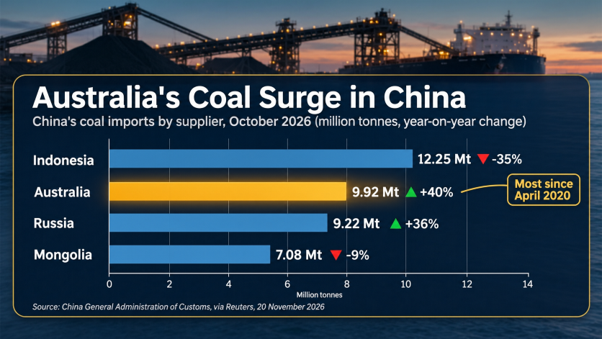
Australia’s coal shipments to China jumped 40% in October, but a Chinese mine accident did much of the work.
Fortescue and critical minerals show where the line sits
Fortescue is the odd case. It priced US$1.5 billion of notes at a 7% coupon this month, then swapped them into an offshore renminbi liability of about CNH9.95 billion at roughly 3.9%. Colitco’s breakdown of the Fortescue renminbi financing covers the mechanics.
Chief executive Dino Otranto has said CMRG told him from the start that it wanted better terms and more investment.
Chinese money is welcome. Chinese pricing power is the fight.
Critical minerals are harder again. Canberra and Washington signed a framework in October 2025, with US$1 billion each over six months and a price floor. China controls roughly 70% of rare earth mining and 90% of processing.
Officials expected Xi to raise concerns about that US deal in Shenzhen. Tension also remains over Australia’s screening of foreign investment in the sector.
Colitco’s read is that the “minerals” in Xi’s sentence mean bulk cargoes. Iron ore and coal are easy to trade. A Chinese partnership on critical minerals sits awkwardly beside a US price floor.
Three dates and decisions are worth tracking:
- Fortescue’s update on CMRG talks before 31 December
- Whether any CMRG contract terms leak
- Foreign investment screening calls on critical minerals deals
Cooperation is on the agenda. Pricing power is on the table, and Beijing holds more of it.
More on the sector sits in Colitco’s mining coverage, the daily mining news feed and the politics section.
FAQs
What did Xi ask Australia for?
Closer work on agriculture, energy and minerals, plus AI and green sectors.
Was a minerals deal announced?
No deal appeared in the readouts.
Why does CMRG matter?
It buys iron ore for Chinese mills and now drives the pace of contract talks.
Which ASX miner is most exposed?
Fortescue, which is still negotiating.
Disclaimer: This article provides general information, not personal financial advice. Speak to a licensed adviser before making investment decisions.

Luke Carlino is a seasoned Copywriter, Content Strategist, and Social Media Manager specialising in Mining, Finance, and Business journalism. With more than a decade of industry experience, he brings rigorous editorial standards and commercial acuity to every project.