
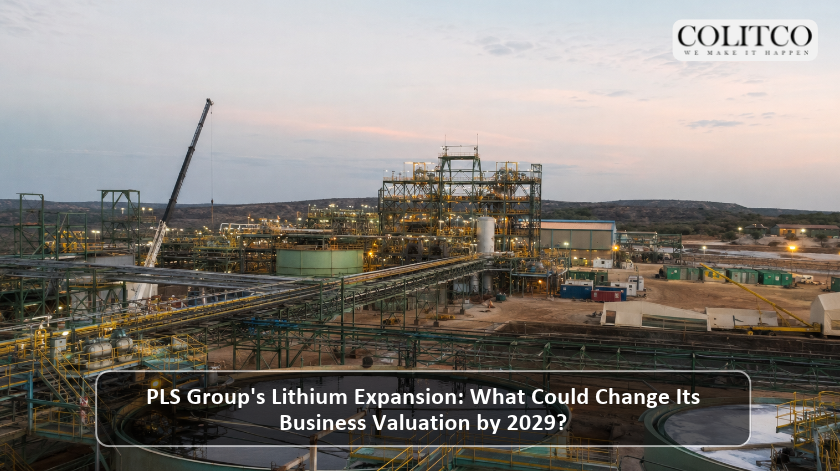
PLS Group Ltd (ASX: PLS) has lost favour with investors over the past six months. Investors have cooled on the lithium miner. Its shares traded around $2.61 on Thursday, just above their 52-week low of $2.44. The 52-week high of $6.81 now looks some distance away.
Behind the weak share price, however, the company is building for something far bigger. The question is whether more lithium will also mean a more valuable business. Grace Alvino of The Motley Fool Australia thinks the shares could double by late 2029. There is a major condition: the lithium market needs to cooperate.
At the heart of the PLS Group lithium expansion is Pilgangoora in Western Australia. In October, management said it had approved the $1.9 billion P2000 project there. The goal is to produce much more spodumene concentrate, a key source of lithium.
Pilgangoora in Western Australia sits at the heart of PLS Group’s expansion plans. [PLS]
How Is Current Production Supporting the Growth Case?
The growth story has already started. PLS has restarted its Ngungaju processing plant, which is now adding to output. The September quarter offered plenty to like:
- Record output: Production reached 267,600 tonnes for the quarter.
- Strong increase: That was up 25% on the previous quarter.
- Lower costs: Unit operating costs fell 12% to $539 per tonne.
- Room to respond: A large, low-cost operation could adapt as market conditions change.
Why does this matter for valuation? Size is only part of the story. Investors also want to know how much money each tonne can make. Lower costs give a miner more breathing room when prices slide. Still, one good quarter is no promise of another.
Why Do Lithium Demand and Prices Matter?
Much of the investment case comes down to the price of lithium. Electric vehicles remain a big source of demand. Large batteries that store energy are opening another door. Power grids are taking in more renewable energy. That power must be saved for when the sun sets, or the wind drops.
The outlook has bright spots, but also warning signs:
- Demand growth: The Australian government expects global lithium demand to grow over 11% yearly through 2031.
- Supply pressure: Its September Resources and Energy Quarterly also expects near-term oversupply.
- Price risk: Fresh supply could hold prices back, even as demand climbs.
- Possible upside: A stronger market could reward large producers that keep costs competitive.
In short, strong demand alone may not be enough. What counts is how quickly buyers absorb the new supply.
What Could Drive PLS Group’s Valuation by 2029 Towards $16.8 Billion?
To double its share price, PLS would need a market value of approximately $16.8 billion. That assumes the number of shares stays broadly the same until late 2029. In share price terms, it means moving from $2.61 to $5.22.
Alvino has sketched out how the numbers might work at full capacity:
- Sales volume: Pilgangoora sells 2 million tonnes of spodumene concentrate a year.
- Realised price: The company receives an average of A$2,000 per tonne.
- Revenue: Pilgangoora alone brings in approximately $4 billion annually.
- Operating costs: Management is targeting unit costs of around $600 per tonne.
- Earnings potential: Annual EBITDA could reach around $2.4 billion.
EBITDA measures earnings before interest, tax, depreciation and amortisation. Alvino’s estimate also allows for costs such as freight, royalties and head office expenses. The result would be more than double what PLS earned in FY26. Underlying EBITDA that year was $1,137 million.
Can PLS Group Deliver the Growth Investors Need?
It pays to read these figures with care. They are not the company’s earnings forecast for 2029. They show what could happen if the assumed prices and sales eventuate. Production is only due to begin in the September quarter of 2029. A full year at capacity would therefore come later. Investors would need to see those earnings coming and value them early.
That puts the spotlight on delivery. Building progress, spending and day-to-day performance will all be under watch. Prices matter just as much. A weaker market could take a large bite from projected revenue and earnings.
Alvino still sees doubling as realistic if conditions are favourable. She would be happy to buy at $2.61 as part of a diversified portfolio. However, she warns the road to $5.22 could be bumpy. The expansion gives PLS greater scale, but a higher valuation still has to be earned.
Also Read: Why Global Steelmakers May Face a New Manganese Supply Challenge
FAQs About PLS Group’s 2029 Outlook
Q1: How much will the P2000 project cost?
A1: The approved project carries a $1.9 billion price tag. It aims to lift annual capacity to approximately 2 million tonnes.
Q2: When will the new production begin?
A2: First output is expected in the September quarter of 2029. Ramping up will reportedly take about 6 months.
Q3: How did PLS perform in the September quarter?
A3: It produced a record 267,600 tonnes. Output rose 25%, while unit operating costs fell 12%.
Q4: What would it take for the shares to double?
A4: The company would need a market value of approximately $16.8 billion. That means $5.22 per share, if the share count stays broadly unchanged.
Disclaimer:
This article explores what might shape PLS Group’s valuation, using published information and one contributor’s assumptions. It is general information only, not financial advice or a recommendation to trade shares. Lithium prices, construction timelines, costs, and share numbers can change. A $5.22 share price is not guaranteed. Check company announcements and speak with a licensed financial adviser before investing money.

Luke Carlino is a seasoned Copywriter, Content Strategist, and Social Media Manager specialising in Mining, Finance, and Business journalism. With more than a decade of industry experience, he brings rigorous editorial standards and commercial acuity to every project.