OpenAI said it on its own terms. “We recently submitted a confidential S-1. We expect it to leak so we’re just announcing it,” the company posted on its website Monday. That sentence alone tells you a lot about how Sam Altman runs things. Don’t wait to be caught out. Say it first.
The filing marks the first formal step toward an initial public offering for the maker of ChatGPT, a company that did not exist as a commercial entity five years ago and is now being valued at close to nine figures.
The question hanging over all of it is whether public markets will pay what private investors already have.
What OpenAI’s Confidential S-1 Actually Means
A confidential S-1 is not an IPO. OpenAI can get private feedback from regulators first, before it sends its public documents to the Securities and Exchange Commission.
The public version, which will show its official income, profit, debts, and risks, will be released later. Usually, 15 to 21 days before a roadshow, if one happens.
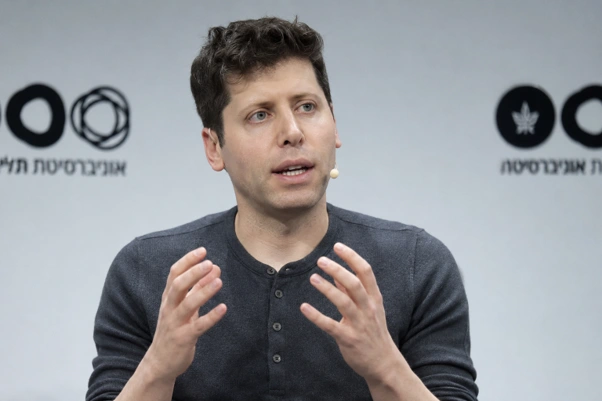
Sam Altman, CEO of OpenAI, has described a public listing as the “most likely path” for the company given its capital requirements.
Goldman Sachs, Morgan Stanley, and JPMorgan are leading the offering. Citigroup has also been in discussions about joining the underwriting syndicate, which at four bulge-bracket banks signals that this deal is being assembled for maximum institutional absorption. A trillion-dollar order book does not fill itself.
OpenAI indicated that no final decision has been made on whether or when shares would begin trading publicly. That is standard language for a confidential filing, but Altman went further.
The company said “it may be a while because there are things we want to do that are likely easier as a private company.” Read that as: there are restructuring moves, partnership negotiations, or compute commitments still in progress that are cleaner without quarterly earnings scrutiny.
The Numbers That Will Define the OpenAI IPO
OpenAI closed a $122 billion financing round at the end of March, received an $852 billion valuation, and reported more than $20 billion in annual recurring revenue for 2025, a tripling of its figures each year since 2023.
That revenue trajectory is genuinely extraordinary. Getting to $20 billion in ARR faster than Google or Facebook managed it in their early years is not a small thing.
The problem is the other side of the ledger. Internal documents suggest management is projecting a $14 billion loss in 2026, and the company does not expect to be profitable until 2029.
Q1 2026 alone reportedly produced roughly $6.95 billion in losses against $6 billion in revenue, a negative 122 per cent non-GAAP margin, meaning OpenAI lost $1.22 for every $1 of revenue.
That is a number that will require serious explanation on any roadshow. Burning more cash than you generate is not unusual for a growth-stage tech company.
Doing it at this scale, while asking public investors to price the business at $1 trillion, is a different proposition entirely.
Microsoft owns roughly 27 per cent of OpenAI’s new public benefit corporation structure, worth approximately $270 billion at the $1 trillion valuation. That relationship is both an asset and a complication.
The “Microsoft cap,” the dollar value defining OpenAI’s net revenue capture across enterprise distribution channels and bounding Microsoft’s economic upside outside its equity stake, is the single most important commercial disclosure in the filing for the period between 2026 and 2030.
How that revenue split is structured will shape what earnings actually look like post-listing.
The Race OpenAI Did Not Expect to Run
OpenAI’s move follows rival Anthropic’s June 1st disclosure that it is also moving toward an initial public offering of shares. Both are now following Elon Musk’s SpaceX, which has started an IPO roadshow pitching itself as an AI-focused space company.
That sequence matters. OpenAI kicked off the big AI boom in late 2022 with ChatGPT. But less than four years later, it’s only third in line to go public. It’s behind a company started by its own former staff and a rocket company that bought another AI startup.
Anthropic’s own S-1, filed shortly after closing a $65 billion Series H funding round, values the Claude maker at $965 billion, surpassing OpenAI’s $852 billion valuation.
The filing comes at a “precarious moment” for OpenAI as it appears to be losing ChatGPT’s early leads with consumers and businesses to Google and Anthropic, according to Emarketer analyst Nate Elliott. “But OpenAI doesn’t have a lot of other places to look for the enormous capital required to support its costs,” Elliott said.
That is the honest framing. The IPO is partly a capital necessity, not just a strategic choice. At a projected $600 billion in five-year compute commitments, the company is burning roughly $14 billion to generate roughly $25 billion in a single year.
The public markets provide a fundraising channel that private rounds, however large, eventually hit a ceiling on.
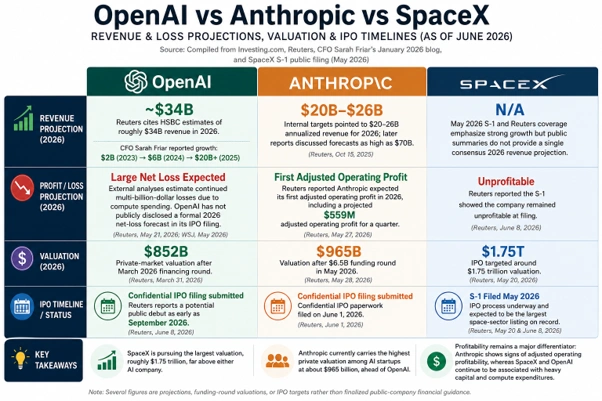
OpenAI, Anthropic, and SpaceX are all racing toward public listings in 2026. Their financials tell very different stories.
One Legal Obstacle That Is Now Gone
OpenAI cleared an obstacle last month with its victory against Musk in a federal jury trial.
That outcome removed a genuine structural risk from the IPO timeline. An active lawsuit challenging OpenAI’s conversion to a for-profit public benefit corporation would have created complications for SEC review of the S-1. With that cleared, the regulatory path is cleaner.
Musk has said he will appeal. But an appeal does not stop the filing process, and courts move on their own schedule.
What a $1 Trillion Listing Actually Assumes
At $1 trillion, OpenAI would be priced above Visa, TSMC, and Eli Lilly. It would be inside the top ten most valuable companies on earth.
The bull case for getting there rests almost entirely on the revenue trajectory holding through 2029 and compute costs falling as AI infrastructure matures. Internal projections call for $100 billion in annual revenue by 2030, driven partly by advertising, enterprise licensing, and agentic AI services.
The bear case is simpler. Google has better distribution. Open-source models are narrowing the capability gap. Microsoft holds a revenue-sharing arrangement that limits how much of OpenAI’s top line flows to the bottom.
And the nonprofit governance overlay, now recast as the OpenAI Foundation holding a 26 percent stake in OpenAI Group PBC, will draw scrutiny from institutional investors who expect cleaner corporate structures.
Public Citizen, a consumer advocacy group, has argued that “subordinating the nonprofit to the for-profit is impermissible,” and while no active legal challenge remains, the governance structure will get attention from SEC reviewers and public market investors who care about corporate structure risk.
The public S-1, whenever it drops, will settle some of these arguments. Until then, the number is aspirational.
Also Read: SpaceX IPO Opens to Australian Investors; ASIC Prospectus Highlights Major Risks
Frequently Asked Questions
Q: Has OpenAI gone public yet?
A: No, it has only filed confidential paperwork with the SEC.
Q: When might OpenAI actually have its IPO?
A: September 2026 is the current target, but nothing is confirmed.
Q: What is OpenAI worth right now?
A: Its last private valuation was $852 billion, set in March 2026.
Q: Is OpenAI profitable?
A: No. It lost more than it earned in Q1 2026 and does not expect to turn a profit until around 2029.
Q: Did Elon Musk’s lawsuit affect the IPO plans?
A: It could have, but a jury dismissed the case in May 2026, clearing that hurdle.
Disclaimer:
This article is for informational purposes only and does not constitute financial advice, investment advice, or a recommendation to buy or sell any securities. Colitco does not hold any position in OpenAI, Anthropic, SpaceX, or any entity mentioned in this article. All figures cited are sourced from publicly available reports, analyst commentary, and company statements as of the date of publication. Readers should conduct their own research and consult a licensed financial adviser before making any investment decisions.
Source:
https://openai.com/index/openai-submits-confidential-s-1/

Luke Carlino is a seasoned Copywriter, Content Strategist, and Social Media Manager specialising in Mining, Finance, and Business journalism. With more than a decade of industry experience, he brings rigorous editorial standards and commercial acuity to every project.