
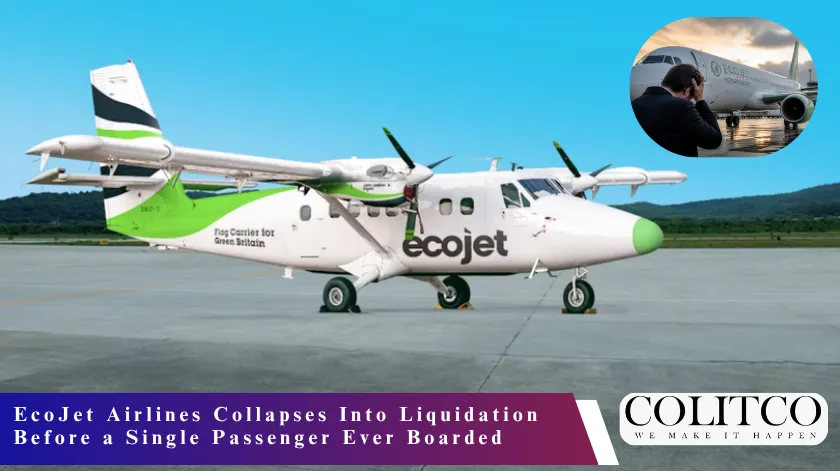
EcoJet Airlines, the Edinburgh-based carrier that aimed to become the world’s first fully electric airline, collapsed into voluntary liquidation after failing to secure £20 million in funding. The Scottish start-up never boarded a paying passenger.
The carrier held an ATOL licence but made no sales, and the Civil Aviation Authority recorded no outstanding bookings or consumer claims because the airline never launched service.
No stranded passengers. No refund queues. Just a quiet, rather extraordinary end.
The Dream Behind the EcoJet Airlines Story
On 17 July 2023, reports emerged that Dale Vince, the founder of Ecotricity and a prominent climate change activist, had formed a new company by the name of Ecojet, which planned to become the world’s first electric airline using a fleet of aircraft powered by renewable energy.

Dale Vince OBE, founder of Ecotricity and the principal backer behind EcoJet Airlines[Ecojet]
The ambition was real. At the launch of the airline, Vince said: “This is a vital frontier in the move to net zero, green living, whatever you choose to call it – and it’s absolutely doable. It’s a matter of when, not if.”
The plan was straightforward in concept. EcoJet would launch with conventional turboprop aircraft, then retrofit them with hydrogen-electric powertrains developed by ZeroAvia, eliminating carbon dioxide output entirely.
Environmental claims formed a central part of the Company’s strategy, with EcoJet stating retrofitting existing aircraft rather than building new planes could prevent around 90,000 tonnes of carbon emissions each year.
It wanted to be the flag carrier for green Britain. Instead, it became one of aviation’s most public cautionary tales.
Why EcoJet Airlines Liquidation Was Years in the Making
The Company’s problems began almost immediately after its 2023 launch.
The Ecojet concept was to launch with conventional fuels, initially operating with conventional turboprop engines, and then retrofit these to hydrogen-electric powertrains as soon as the CAA approved the engines for service. That approval never came.
Launch dates kept shifting. The original target of early 2024 slipped to late 2024, then to mid-2025, and eventually to 2026.
Due to difficulties in raising £20 million and delays in obtaining an Air Operator’s Certificate (AOC) from the UK Civil Aviation Authority, the launch was postponed repeatedly.
By January 2025, the situation had deteriorated badly. Ecojet had laid off 11 out of its 13 employees, leaving just two staff on the books.
A spokesperson told The Daily Telegraph that the airline had further delayed its launch owing to a “tough investment market,” with the redundancies made in order to “reduce overheads to a minimum.”
Funding Gap That Proved Unbridgeable
To progress its AOC application, EcoJet needed to demonstrate sufficient financial reserves. The numbers simply did not add up.
Ecotricity’s investment of just over £1 million in exchange for a 17,000-share stake in October 2024 underscored the relatively modest capital committed relative to the ambition, particularly given that CAA AOC applications typically require demonstrated financial reserves sufficient to operate for several months.
The Company had engaged Wyvern Partners to lead a £20 million fundraising campaign. That effort failed to close.
Ecojet’s accounts for the 12 months to 31 August 2024 stated that “operational funding support” from its shareholders “is expected to continue for a period of at least one year after the date of signing the financial statements.” That commitment did not hold.
In November 2024, the airline announced that it had acquired “its first two ATR 72-600 aircraft.” When the airline entered liquidation in January 2026, these aircraft had still not been delivered.
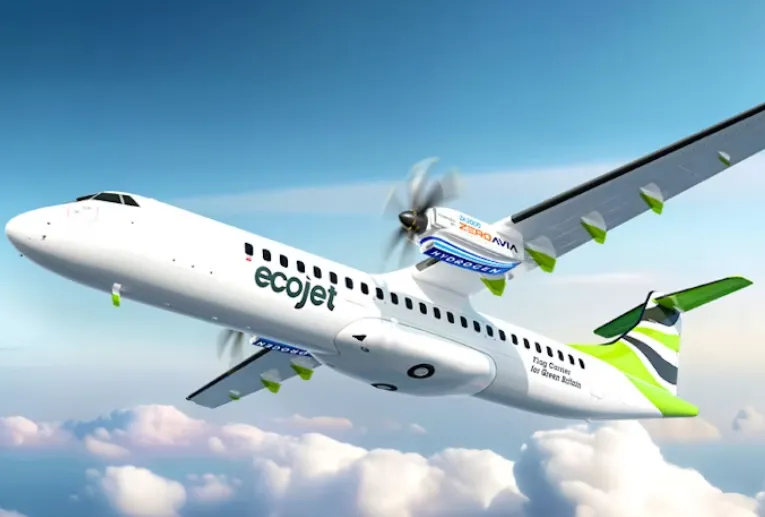
The ATR 72-600 was the aircraft type EcoJet planned to operate. [Ecojet]
The Final Days: Edinburgh Sheriff Court and Opus Restructuring
On 14 January 2026, Paul Dounis and Mark Harper from Opus Restructuring & Insolvency were appointed as provisional liquidators of Ecojet Airlines Limited.
Court documents filed in late January show a petition was submitted to Edinburgh Sheriff Court seeking to wind up the company and appoint interim liquidators.
Opus Restructuring confirmed: “Ecojet was a start-up business and has no material assets. The members have elected to fund the liquidation process to ensure that the company’s employees receive their full statutory entitlements.”
Vince, for his part, framed it as a pause rather than a full stop. He said: “It’s taking longer than we hoped to get the technology and regulatory pieces of the puzzle in alignment, and so we’re pausing work at this time.”
But the legal outcome was final. The collapse marks a swift end for the aviation venture, which existed for just under three years and never carried a paying passenger.
What the EcoJet Collapse Reveals About Electric Airlines
EcoJet’s failure is not just a story about one start-up running out of road. It is a story about the structural gap between clean aviation ambitions and commercial reality.
The gap between a compelling environmental proposition and the financial fitness required to satisfy CAA Air Operator Certificate requirements proved unbridgeable.
Green aviation faces a specific problem. The technology timelines are long, certification processes are demanding, and the capital requirements for even a modest regional operation are substantial. Investors willing to back a concept are harder to find than investors willing to back a running business.
EcoJet was not alone in struggling. US start-up Universal Hydrogen, which was developing similar hydrogen-electric retrofit technology for regional aircraft, also shut down in 2023 after burning through USD 100 million. Even Airbus quietly pushed back its ZEROe hydrogen aircraft programme by up to a decade.
The UK’s post-Brexit exclusion from the EU Emissions Trading System compounds the challenge for small carriers operating on thin margins on regional routes. Until policy is recalibrated to offer the kind of direct grant or loan guarantee support available to green technology developers in other sectors, the prospect of the next zero-emission airline start-up meeting a similar fate remains real.
The broader net-zero aviation industry faces a difficult reality. Battery density limitations constrain full electric aircraft to very short ranges, while hydrogen infrastructure at commercial airports remains almost non-existent. The technology is advancing, but not yet at the pace airline business models require.
This does not make the mission wrong. It makes the execution harder.
Also Read: Delta Airlines Quietly Kills the Snack Run on Hundreds of Short-Haul Flights
FAQ
Q: What happened to EcoJet Airlines?
A: EcoJet Airlines entered voluntary liquidation in January 2026 after failing to raise £20 million in funding and secure an Air Operator’s Certificate from the UK Civil Aviation Authority. The airline never launched commercial operations.
Q: Who founded EcoJet Airlines?
A: EcoJet Airlines was founded by Brent Smith, a former airline pilot, and backed by Dale Vince OBE, the founder of green energy company Ecotricity.
Q: Did EcoJet Airlines ever fly passengers?
A: No. EcoJet Airlines never carried a single paying passenger. The airline existed from 2023 to 2026 without completing its regulatory approvals or launching scheduled services.
Q: What was EcoJet’s plan for electric flights?
A: EcoJet planned to operate conventional ATR 72 turboprop aircraft first, then retrofit them with hydrogen-electric engines developed by ZeroAvia. The aim was to eventually eliminate all carbon emissions on its routes.
Q: Are passengers owed refunds from EcoJet Airlines?
A: No. Because EcoJet never opened ticket sales or carried passengers, there are no consumer claims or refund obligations arising from the liquidation.
Q: What does EcoJet’s collapse mean for net zero aviation?
A: The failure highlights the difficulty of bridging early-stage green technology with the rigorous financial and regulatory requirements of commercial aviation. Analysts say improved government support mechanisms may be needed for future electric airline start-ups to succeed.
Disclaimer: This article is for informational purposes only and does not constitute financial or investment advice.
Source:
- https://sundayguardianlive.com/world/why-worlds-first-electric-airline-ecojet-enters-liquidation-before-launch-scotland-startup-189634/