Worley Limited (ASX: WOR) told the market on 25 June 2026 that it has lodged an application in the High Court of Australia, asking for one more crack at a case that has been running since before some of its current staff finished school. The Worley class action started with a single earnings call in 2013. It is still going.
This is the bit worth sitting up for. The fight is over a forecast Worley made when it was still called WorleyParsons, more than twelve years ago.
A guidance call from 2013 still follows the company around
In August 2013, the company made a net profit of $322 million, informing its shareholders that they would perform better in the next fiscal year. In terms of budget, the expectation was $352 million. The company reaffirmed that upbeat line through October.
Then on 20 November 2013, it changed its tune. Guidance was cut to between $260 million and $300 million. The share price dropped about a quarter in a single hit.
The owners of the company shares bought during that period felt deceived. Larry Crowley as the lead applicant brought the claim to the courts supported by Maurice Blackburn legal firm. The claim: Worley had no reasonable basis for the rosy forecast, and it knew it.
Why the Worley class action keeps flipping
Here is what makes this case strange. It has changed sides four times.
- 2020: the Federal Court dismissed Crowley’s claim. Worley won.
- 2022: the Full Court overturned that and sent the case back for a rehearing. Worley lost.
- 2023: on the rehearing, the judge found Worley had breached the law but ruled that Crowley failed to prove he lost any money. Worley won, sort of.
- May 2026: the Full Court flipped it again, finding both causation and loss were made out. Worley lost.
That 2023 result was the odd one. The court agreed Worley misled the market and broke its continuous disclosure obligations.
It just decided the shareholders could not pin a dollar figure on the damage. A win on paper that felt like a loss.
The May 2026 judgment knocked that reasoning over. The Full Court of Appeal accepted the notion of market based causation which means that if the shares are traded in a functioning market and the price of the stock was inflated because of a false statement, a shareholder is not required to prove the fact that he/she was reading the announcement. The inflation did the damage.
That single shift is why every securities lawyer in the country read this judgment twice.
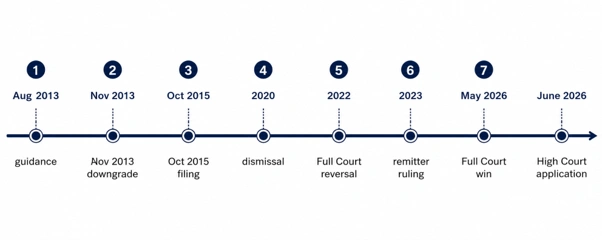
How the Worley class action has zigzagged through the courts since 2013
The damages bill that fits on a coffee receipt
Now for the number that tells the whole story. The court worked out that Crowley’s shares were inflated by 5.92%. His personal loss came to $593, plus interest.
Five hundred and ninety-three dollars. After more than a decade of litigation and four reversals.
Nobody is fighting to the High Court over $593. They are fighting over the rule behind it. If market-based causation stands, the door opens for thousands of class members across this case, and for funders eyeing every future earnings downgrade on the ASX.
Worley could become the defendant in Australia’s first fully successful shareholder class action. That is the prize, and the threat.
There is one more detail buried in the release that explains Worley’s appetite to keep going. Its legal defence has been funded by insurers the whole way, save for an early deductible it paid years ago. When someone else holds the chequebook, fighting on costs you far less.
Worley has now flagged this matter to the market nine separate times since 2015. The latest filing was authorised by group company secretary Nuala O’Leary.
What the ruling means for every ASX board
The lesson for listed companies is sharper than the dollar figure suggests.
The Full Court made clear that a forecast is judged by what the whole company knew, not just the board.
If executives below board level knew the budget was stretched and stayed quiet, the company still carries that knowledge. Sign-off from the directors is not a shield.
Worley is not alone here. A separate decision in the Brambles class action went the applicants’ way earlier in 2026.
The High Court is also expected to rule on the long-running CBA shareholder case in the second half of the year. Read together, the wind is at the plaintiffs’ backs.
Special leave is hard to get. The High Court takes only a slice of the cases that knock on its door, and Worley already had a special leave bid refused on the first appeal years ago. Getting a second one across the line is a steep ask.
For now, the case sits in limbo. If the High Court says no, the May ruling stands and the damages process grinds on for the class.
If it says yes, the whole question of how Australian shareholders prove loss gets reopened at the top.
The Worley shares were last traded at A$10.94 per share as of 23 June 2026, within the 52 week price range of A$14.85 and A$9.80 per share, for a market capitalization of about A$6.01 billion.
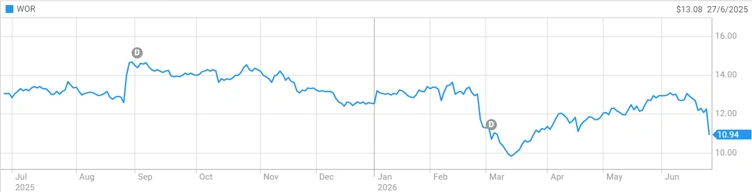
Worley Limited (ASX: WOR) share price over the past year. [ASX]
The forecast that triggered all this was wrong by a few hundred million dollars in 2013. The bill for getting it wrong is still being counted.
Also Read: CSL Share Price Prediction 2026: Strong Buy?
FAQs
Q: What is the Worley class action about?
A: A 2013 earnings forecast that Worley cut three months later, sending its shares down about 25%.
Q: Who is suing Worley?
A: Lead applicant Larry Crowley, on behalf of shareholders, with law firm Maurice Blackburn running the case.
Q: How much did the lead shareholder lose?
A: The court put Crowley’s personal loss at $593 plus interest.
Q: Has any shareholder class action fully succeeded in Australia?
A: Not yet. This case could be the first if the ruling holds.
Q: Who is paying Worley’s legal costs?
A: Insurers have funded the defence, apart from an early deductible.
Q: What happens if the High Court refuses leave?
A: The May 2026 ruling stands and the damages process for class members continues.
Disclaimer: This article is for informational purposes only and is based on publicly available court records and ASX disclosures. It does not constitute financial, investment, or legal advice, nor is it a recommendation to buy or sell any securities. Readers should conduct their own research and seek independent professional advice before making any investment decisions. COLITCO LLP accepts no responsibility for any claim, loss or damage arising from the information provided or its accuracy.
Source:

Luke Carlino is a seasoned Copywriter, Content Strategist, and Social Media Manager specialising in Mining, Finance, and Business journalism. With more than a decade of industry experience, he brings rigorous editorial standards and commercial acuity to every project.