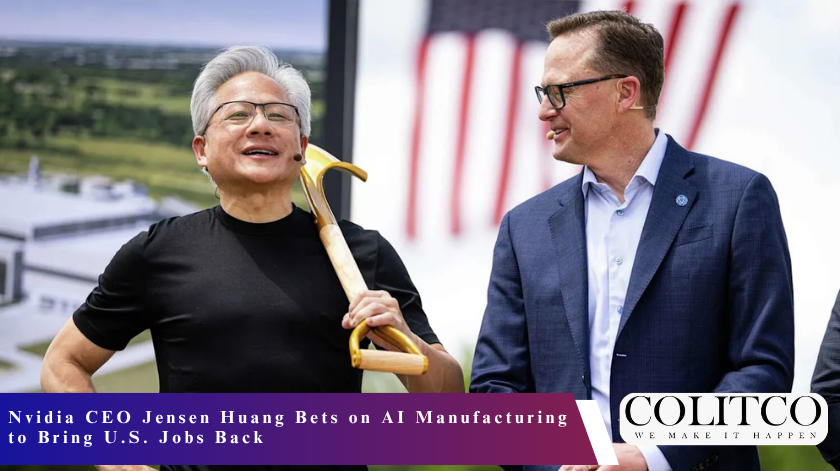
Nvidia CEO Jensen Huang says AI will power a new wave of U.S. manufacturing and job creation. A factory groundbreaking in Sherman, North Texas, on Tuesday, June 16, 2026, put that claim to a direct test.
Nvidia and Coherent Break Ground in North Texas
Nvidia formally unveiled plans Tuesday for a major upgrade to its AI infrastructure, tied to its $2 billion partnership with Coherent. The event was held about an hour north of Dallas at the Sherman, Texas factory. It marked a key step in Huang’s push to shift AI production to American soil.
Huang signed a ceremonial construction beam alongside Coherent CEO Jim Anderson before the groundbreaking ceremony. The move drew wide attention as part of Nvidia’s effort to build domestic AI supply chains. Huang has called these setups “AI factories,” framing them as the backbone of a new industrial era in the U.S.
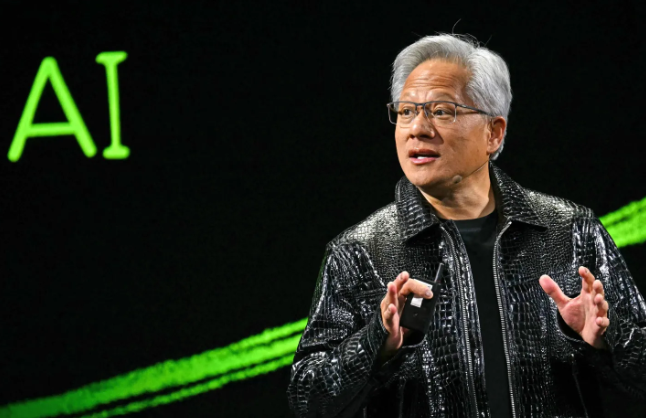
Nvidia CEO Jensen Huang
What the Factory Actually Produces
The factory will produce material for a laser that transmits data among computer chips. This allows those chips to work as a single system with more power, speed, and efficiency. That technology sits at the core of Nvidia AI manufacturing on U.S. soil.
The factory expansion will increase production of Indium Phosphide, used to make a laser with the optical intensity of the surface of the Sun. Second by second, that light flashes hundreds of billions of times down that fiber glass cable, no thicker than a human hair, a path which allows chips to share data and work as a system.
The Jobs Claim and What the Numbers Actually Say
Overall, Coherent projects about 1000 jobs from the factory; this count includes construction workers. Approximately 550 positions are designated as advanced manufacturing/engineering and technician roles. This 550 figure represents the permanent, skilled jobs directly associated with the Nvidia AI manufacturing production.
The broader argument from Huang is that AI systems placed on factory floors will help U.S. manufacturers reduce dependence on foreign suppliers. One Nvidia executive described the company as selling both “brains and a nervous system” to customers. Those tools could open new product lines and identify savings across industries including logistics, energy, and production.
Power Efficiency as a Cost Driver
Power consumption at these AI factory setups would be cut by up to 50%, enabling faster computation at a much lower cost. Reducing the cost of AI usage would make it easier for the technology to expand across more sectors and industries.
That cost reduction matters for Nvidia AI manufacturing’s commercial case. Cheaper AI access means wider adoption across manufacturing, logistics, and energy. These are the exact areas where U.S. reshoring has stalled in recent years due to cost pressure.
Government Funding and Bipartisan Backing
The Sherman factory did not arrive through private investment alone. The Biden administration approved $33 million from the CHIPS and Science Act to help fund the factory’s buildout. The Trump administration then added a further $17 million grant to keep a key part of the AI supply chain on American soil. Together, that totals $50 million in public funding from two administrations.
Coherent CEO Jim Anderson said the investment “expands America’s capacity to manufacture critical AI-enabling technologies, creates high-value jobs, and reinforces U.S. leadership in advanced manufacturing, photonics, and innovation.” The bipartisan money trail shows how central Nvidia AI manufacturing has become to both parties’ economic plans.
Nvidia’s Domestic Strategy at Scale
One Nvidia executive said the company was moving from developing computer chips to providing entire AI systems. Chipmaking is increasingly centered in Arizona while assembly is increasingly in Texas, forming a reliable domestic supply chain. That structure places Texas at the center of Nvidia AI manufacturing going forward.
Huang has described himself as probably the first CEO to back Trump’s plan to re-shore manufacturing in America. Nvidia has committed to $500 billion in direct U.S. investments and has pushed customers and partners to build domestically as well.
AI, Jobs, and Policy Tensions in 2026
The backdrop to Tuesday’s event is more complex than the groundbreaking suggested. The Trump administration recently placed export controls on AI company Anthropic’s latest models. That led Anthropic to shut down all public access to those models over security concerns. That move sits in direct tension with the administration’s support for Nvidia AI manufacturing expansion at the same time.
Meanwhile Huang has pleaded with the public to accept, and even welcome, AI, saying in an interview with the AP, that the age of AI necessitates “new social contract.” He stated that the technology will bring forth new work and new industries.
In a recent paper published this month Jessica Wachter, an economist, and Jonathan Wachter, also an economist, claimed the five biggest U.S. Tech firms spent $380 billion dollars on the infrastructure of AI in 2017, while in 2016 only $35 billion were invested.
By 2026 it is estimated that AI could consume up to double that, at a rate of $700 billion a year. Wachter and Wachter believe AI could grow from 3% of the U.S. GDP today to 8-39%. (The 39% is merely a hypothetical maximum, not something expected in the near future.)
Key Facts at a Glance
| Detail | Figure |
| Nvidia and Coherent partnership value | $2 billion |
| Total estimated jobs at factory | 1,000 |
| Skilled and permanent roles | About 550 |
| Biden CHIPS Act funding | $33 million |
| Trump administration grant | $17 million |
| Total public funding | $50 million |
| Nvidia total U.S. investment pledge | $500 billion |
| AI current share of U.S. GDP | About 3% |
| Projected AI GDP share upper range | Up to 39% |
Key Insights
- Nvidia AI manufacturing is now anchored to a two-state domestic strategy, with chips made in Arizona and assembly done in Texas.
- The 1,000-job headline includes temporary construction workers. The permanent skilled figure is 550.
- Public funding from two administrations totaling $50 million backed what is framed as private-sector investment.
- The Trump administration is both expanding AI infrastructure funding and restricting AI model exports at the same time.
- Indium Phosphide laser technology enables Nvidia chips to function as unified AI systems at lower power cost.
Also Read: ByteDance in Talks to Buy AI Chips From Iluvatar CoreX and Baidu as Nvidia Loses Ground in China
FAQs
Q: What is Nvidia AI manufacturing and why does it matter?
Nvidia AI manufacturing basically involves creating AI infrastructure such as chip systems and AI factories on American soil. This is significant in that it shows where AI jobs, supply chains and profits will be created.
Q: How many jobs will the Sherman, Texas factory create?
Coherent estimates 1,000 jobs in total, including construction workers. Around 550 of those will be in advanced manufacturing, engineering, and technical roles.
Q: What government money backed the Coherent factory in Sherman?
The Biden administration provided $33 million through the CHIPS and Science Act. The Trump administration added a $17 million grant. Total public support comes to $50 million.
Q: What does Indium Phosphide do in Nvidia’s AI systems?
It produces a high-intensity laser that transmits data between chips at hundreds of billions of pulses per second. This allows multiple chips to function as one unified and more powerful AI system.
Disclaimer
The above information is for reference purposes only, it has been compiled from information available to the public from Nvidia and other respective companies. This is not any form of financial, investment, business or legal advice; readers are advised to make their own further research and obtain advice from appropriate professionals before making any decisions based on this article. This information is subject to updates and changes depending on developments and progress within the said sector and industries.

Luke Carlino is a seasoned Copywriter, Content Strategist, and Social Media Manager specialising in Mining, Finance, and Business journalism. With more than a decade of industry experience, he brings rigorous editorial standards and commercial acuity to every project.