
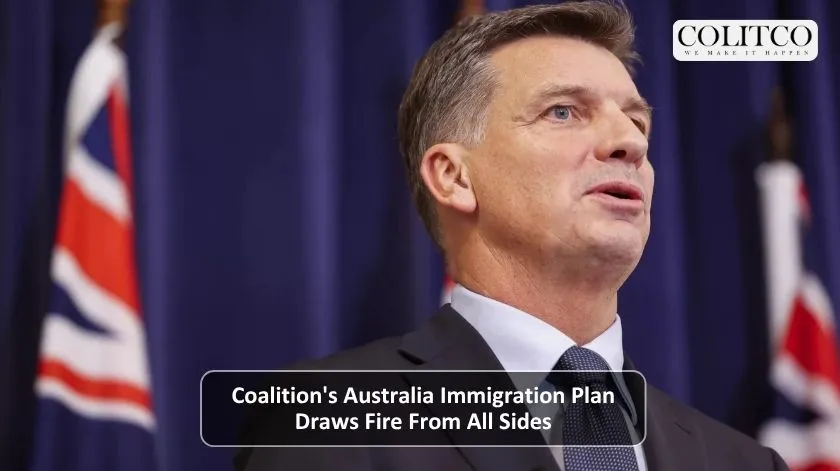
The Coalition leader used a speech at the Liberal-aligned Menzies Research Centre in Sydney to outline a sweeping overhaul of Australia’s immigration system. The proposal immediately drew fire from Labor, the Greens, legal experts, and human rights advocates, while drawing mixed reactions from the Coalition’s own voter base.
Coalition’s Australia Immigration Proposal Targets Values, Overstayers, and Social Media Screening
Taylor’s plan centres on three key measures aimed at what he described as lowering the numbers and lifting the standards of Australia’s migration intake.
The centrepiece is a legally binding values test embedded in the Migration Act as a visa condition. Applicants who do not demonstrate a commitment to what Taylor described as an Australian “fair go” could face visa refusal or cancellation.
The second measure involves mandatory social media vetting for all visa applicants. A new enhanced screening coordination centre, set up within the Department of Home Affairs, would cross-check applicants’ accounts to identify security risks and extremist ties before entry is granted.
Third, a joint agency taskforce combining the Australian Federal Police, ASIO, and Border Force would target an estimated 65,000 visa overstayers and people who have exhausted legal appeals but remain in the country. Non-citizens would also lose access to taxpayer-funded legal aid to appeal visa cancellations under the proposal.
The Coalition also flagged the restoration of Temporary Protection Visas, which Labor abolished in 2023, and the creation of a “safe countries” list to fast-track the rejection of what Taylor called unfounded protection claims.
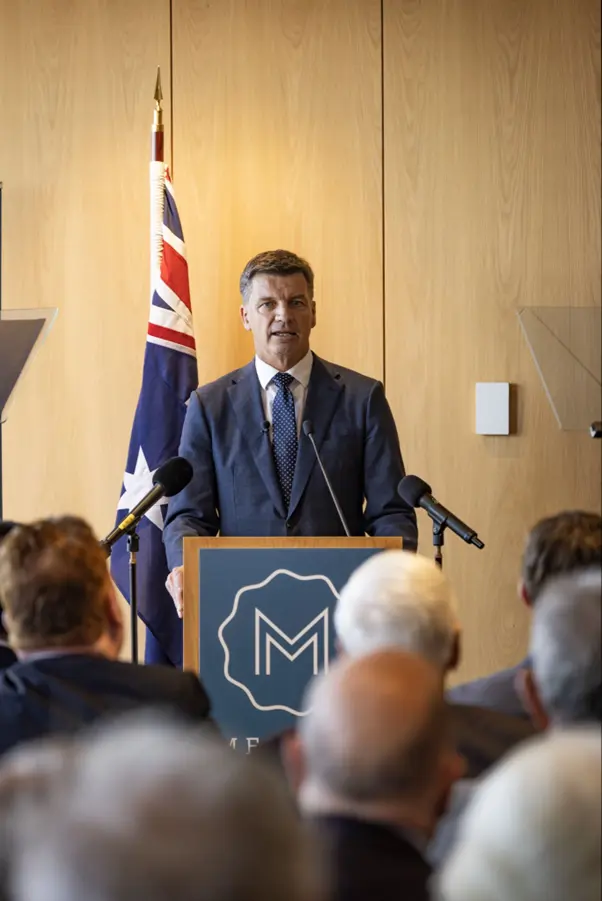
Opposition Leader Angus Taylor addressing the Menzies Research Centre in Sydney, where he outlined the Coalition’s immigration policy overhaul. [@AngusTaylorMP]
Labor and Legal Experts Warn the Policy Is Political Posturing, Not Practical Reform
The political response was swift and severe. Home Affairs Minister Tony Burke called the speech a “diatribe” aimed at recapturing voters drifting toward Pauline Hanson’s One Nation party. Defence Industry Minister Pat Conroy described it as “desperate dog-whistling.”
Immigration law expert Professor Mary Crock warned the proposal was largely a political gesture, saying legislation already allowed the government to refuse or cancel visas on character grounds. She said enshrining a values statement into law would embed “indeterminate concepts” into legislation.
Greens Senator David Shoebridge went further, saying the plan echoed the discriminatory intent of the White Australia policy, which was formally abandoned in 1966.
Victorian Premier Jacinta Allan said the policy was “straight out of the Donald Trump playbook,” singling out its implied targeting of migrants from China, Vietnam, Muslim-majority countries, and Lebanon.
Amnesty International Campaigner Zaki Haidari argued that Australia’s immigration system was already robust, with people who migrate already going through thorough security and character assessments. He said there was no need for fear-driven policies that seek to divide communities or stigmatise people based on where they come from.
No Migration Cap and No Country Bans Leave Many Voters Unsatisfied
Despite the hardline tone, the proposal stops short of a numerical migration intake target. Taylor declined to put a specific figure on how many people a Coalition government would admit annually.
That absence of a firm target frustrated some conservatives, with responses on social media calling the policy “weak” and “too little too late,” with some vowing to vote One Nation instead. One Nation leader Pauline Hanson has already committed to capping arrivals at 130,000 per year, which she says would result in net overseas migration of around minus 100,000.
The Coalition also maintained it would not discriminate based on nationality, race, gender, or faith. Taylor told reporters the policy focused on values, not country of origin. Opposition immigration spokesperson Jonathon Duniam insisted the plan was not copying the United States. “We’re looking at Australian law for Australian circumstances,” he said.
Australia’s migration debate sits against a significant backdrop. Since the 2022 census, Australia has become a majority migrant nation, with over 50 per cent of residents born overseas or having at least one immigrant parent. Taylor cited Labor’s record of 1.4 million people arriving in three and a half years, arguing this had placed extreme pressure on housing and essential services.
For context on how Australia’s population boom has intersected with housing supply, see Colitco’s earlier coverage of Australia’s migration policy debate and the housing shortage deepening in 2026.
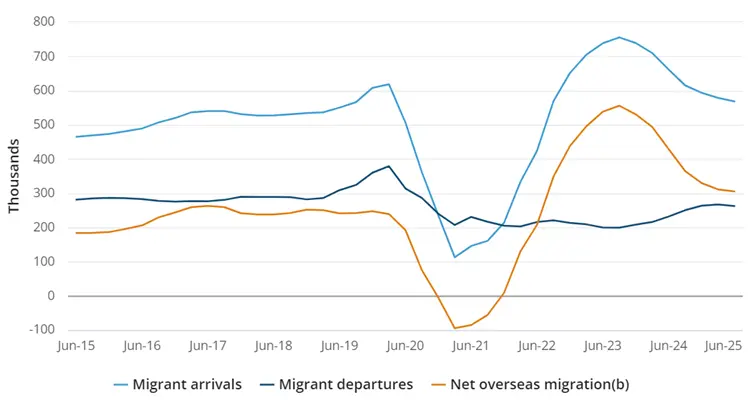
Net overseas migration to Australia, 2015 to 2025. [ABS]
Coalition’s Immigration Push Tests the Party’s Pitch Beyond One Nation Voters
The political calculation is fairly transparent. The Coalition shed votes to One Nation at the 2025 federal election and is now chasing them back ahead of an upcoming Farrer by-election.
But the pitch carries real risks. Sectors including healthcare, aged care, and agriculture depend heavily on skilled and temporary migrant workers. Several Labor ministers pressed Taylor to explain which industries would lose workers if the plan were implemented.
Taylor’s policy also proposes creating a dedicated centre to screen potential migrants and blocking non-citizens from using legal aid to appeal visa cancellations, adding further layers to an already complex system.
The proposal is described as a first phase, with more detail expected before the next election. Whether the combination of values tests, social media checks, and tougher deportation measures will translate into a coherent legislative package remains to be seen.
Also Read: After 125 Years, the Australian Army Is Getting Its First Female Commander
FAQs
Q: What is Angus Taylor’s Australia immigration policy?
A: Taylor has proposed a legally binding values test for visa applicants, mandatory social media screening, a joint agency taskforce to deport 65,000 overstayers, the return of Temporary Protection Visas, and a “safe countries” list to reject unfounded protection claims.
Q: Does the Coalition’s immigration policy include a cap on migration numbers?
A: No. Taylor did not commit to a specific annual migration intake target. The proposal focuses on screening and enforcement rather than a fixed number.
Q: Why is the Coalition’s immigration proposal controversial?
A: Critics, including Labor, the Greens, legal experts, and rights groups, argue the policy mimics Trump-era approaches, risks discriminating based on country of origin, and could deprive industries of essential skilled workers.
Q: What is a values test in Australia immigration law?
A: A values test would require visa applicants to formally agree to and demonstrate adherence to Australian values as a legally enforceable visa condition. Experts warn the concept is legally vague and open to misuse.
Q: How does Australia’s current immigration system handle character and security checks?
A: Australia’s existing migration law already allows visa refusal or cancellation on character and security grounds. Critics say the Coalition’s proposal largely duplicates protections that already exist.
Disclaimer: This article is for informational purposes only and does not constitute political, legal, or immigration advice. Readers should refer to official government sources for guidance on Australia’s immigration laws and policies.
Source:
- https://www.theguardian.com/australia-news/2026/apr/14/angus-taylor-immigration-speech-australia-backlash-ntwnfb


