
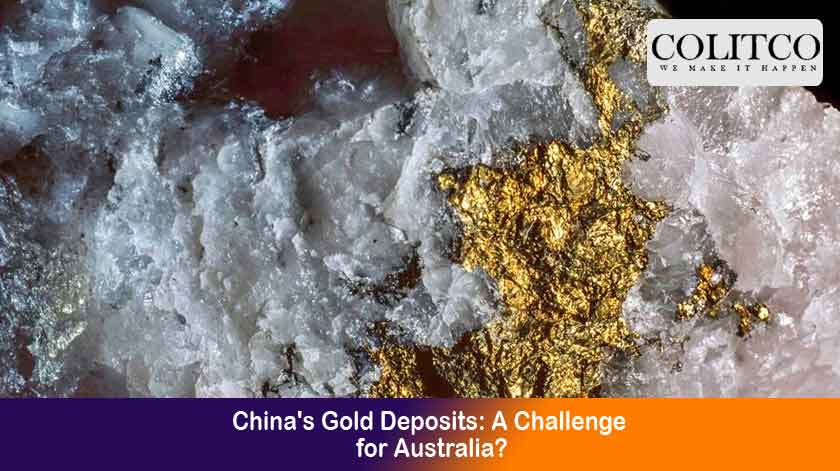
China already produces more gold than any other country. Its discoveries at Dadonggou and Wangu add to the resources available for future development, but a deposit announcement does not immediately change the supply reaching buyers.
In this article, China gold production, Australia’s position and the work needed to turn discoveries into operating mines are examined.
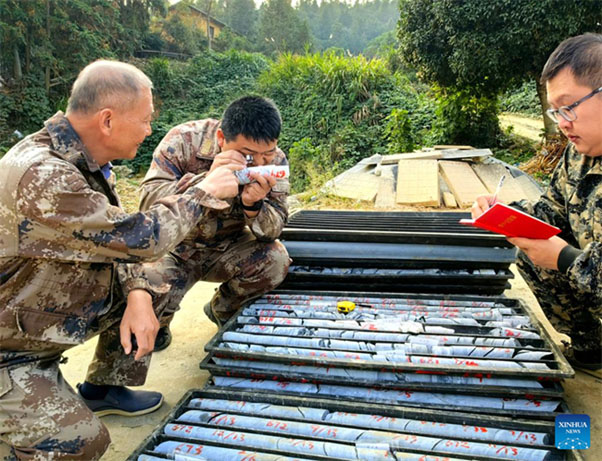
Figure 1: Technicians examine rock samples at the Wangu gold field in Pingjiang County, Hunan, on 5 November 2024. Archive photograph. Credit: Xinhua/Su Xiaozhou, via the Hunan Provincial Government.
Dadonggou’s Size Comes With a Low Average Grade
China’s Ministry of Natural Resources announced the Dadonggou discovery in Liaoning on 14 November 2025.
Those figures describe a very large amount of relatively low-grade material.
That does not automatically make the deposit uneconomic. Large deposits can support high-throughput operations, and the official announcement said Dadonggou had passed an economic assessment for development and utilisation.
However, the announcement alone does not provide the annual production and cost schedule needed to measure its future effect on competitors.
Wangu’s Headline Figure Needs a Different Reading
The Wangu gold field in Hunan attracted international attention in November 2024.
The provincial government reported approximately 300.2 tonnes of identified gold resources in the core exploration area. It also described deeper potential exceeding 1,000 tonnes.
Those numbers represent different levels of geological understanding. The larger estimate should not be treated as though it were already a fully defined, economically recoverable mine reserve.
The same caution applies to grade. Reports highlighted samples reaching 138 grams per tonne. That was a maximum reported grade, rather than an average for the entire deposit.
Wangu is therefore evidence of substantial geological potential. Its headline size does not establish how quickly additional gold could enter the market.
Compare Annual Mine Output With Annual Mine Output
The simplest mistake in a China vs Australia gold production comparison is putting a deposit’s total contained gold beside one country’s yearly output.
A deposit might be mined over decades. National production measures gold extracted during a particular year.
For a consistent historical comparison, the US Geological Survey’s February 2026 publication estimated the following:
| Country | 2024 mine production | 2025 estimated mine production |
| China | 377 tonnes | 380 tonnes |
| Australia | 284 tonnes | 280 tonnes |
These are rounded USGS estimates from that publication, not final 2026 results. Other statistical series may differ because of reporting methods, timing and subsequent revisions.
China’s lead therefore predates the latest discoveries. The question is whether new developments help it maintain or extend that lead as existing mines age.
A Large Resource Still Needs a Mine Plan
Before a discovery becomes a reliable source of supply, several practical questions need answers.
How much material can the plant process? What proportion of the gold can it recover? How much waste must be removed to reach the ore? What infrastructure must be built before the first sale?
Some material may fall outside the eventual economic mine plan, and processing does not recover every gram. Production would also be spread across the operating life.
This is why assigning a headline dollar value to all contained gold can mislead. It leaves out construction, operating expenses, taxes, recovery losses and the time taken to receive revenue.
More Chinese Gold Would Not Automatically Displace Australian Sales
China is both a major producer and a major gold buyer.
The World Gold Council reported net Chinese gold imports of 118 tonnes in July 2026. Its September market update also described continuing investment demand alongside weaker jewellery demand.
That combination matters. Additional domestic production could meet part of China’s own requirements rather than immediately become metal competing for export buyers.
Holding demand and other supply constant, more domestic output could reduce import needs. But those conditions do not stay fixed. Jewellery purchases, investment flows, recycling and official-sector buying can all change.
A discovery announcement consequently offers no reliable basis for predicting a matching decline in Australian exports or a particular fall in the gold price.
Australia’s Immediate Test Is Still Mine Performance
For an Australian producer, a new Chinese deposit does not alter tomorrow’s ore grade, maintenance schedule or wages bill.
Those operating details remain central to Australia gold production and company earnings. A mine can benefit from a favourable selling price and still disappoint if output falls or development spending rises.
Geoscience Australia notes that much of the country’s mined gold occurs at concentrations below five grams per tonne. The economics depend on more than grade alone, including the gold price and the characteristics of the deposit.
Existing processing facilities can give nearby Australian developments a useful starting point. They still require suitable ore, available capacity and investment.
Colitco’s coverage of how Telfer supports Greatland’s expansion examines that relationship between an operating mine and a new development.
The Competitive Challenge Is Cost and Delivery
China’s discoveries deserve attention because they create options for future supply. Whether those options become a material challenge to Australia depends on the projects that are actually built.
The more useful comparison would put expected annual output, capital requirements, recoveries and operating costs side by side. A large deposit with expensive development may have a different competitive position from a smaller deposit near existing infrastructure.
Australian shareholders can apply the same checks to local companies. Reserve growth is helpful, but it needs to be followed by a workable production schedule and funding plan.
Colitco’s Evolution Mining gold-margin analysis looks at why production costs and the mix of metals sold matter when assessing operating performance.
What Would Turn the Discoveries Into a Clearer Challenge?
Detailed development plans would make the comparison more meaningful.
For Dadonggou and the deeper Wangu discoveries, investors should watch for defined mining schedules, construction commitments, processing plans and expected annual recoverable output. These would help establish the scale and timing of additional Chinese supply.
Colitco’s assessment is that the discoveries present a longer-term competitive possibility, rather than proof of an immediate threat to Australian production. Their size is significant. The commercial test comes when developers show how they intend to extract the gold and what doing so will cost.
ALSO READ: ASX GGP: How Telfer Supports Greatland’s Expansion
FAQs
Q1. Does China produce more gold than Australia?
Ans. Yes. The USGS February 2026 publication estimated 2025 mine production at 380 tonnes for China and 280 tonnes for Australia.
Q2. Does Dadonggou’s reported gold content equal future production?
Ans. No. Contained gold measures the metal estimated in the deposit. Recoverable production depends on the mine plan, economics and processing performance.
Q3. Is Wangu’s reported 138g/t its average grade?
Ans. No. It was a maximum reported grade. It should not be applied to the whole deposit.
Q4. Could Chinese discoveries lower Australian gold miners’ earnings?
Ans. Additional supply may affect market conditions, but demand, currency rates, output, costs, and business expenditure affect profitability.
Disclaimer
This is general information, not financial advice. Development expectations, resource estimations, and production data may vary. Geological reporting terminology varies by jurisdiction. Investing risks loss.

Luke Carlino is a seasoned Copywriter, Content Strategist, and Social Media Manager specialising in Mining, Finance, and Business journalism. With more than a decade of industry experience, he brings rigorous editorial standards and commercial acuity to every project.