Guidance for FY27 stays at 1,650kt to 1,800kt. The first quarter did not make that look easy. Multiply 400.7kt by four and the answer is 1,603kt. That is below the bottom of the range.
BHP’s operational review for the September quarter blames planned grade declines, maintenance and bad weather in Chile. Some of that was on the calendar. Some of it was not.
The BHP copper production decline started at Escondida
Escondida did most of the damage. Output fell 23% to 252.6kt on a 100% basis.
Feed grade at the concentrator slid to 0.81%, from 0.94% a year earlier. BHP warned about that slide when it set FY27 guidance.
Throughput deserves a second look. The concentrator processed 31.4 million tonnes, down 14% on last year, so less rock went through at a lower grade.
Payable copper in concentrate dropped 30%. Cathode rose 18%, which only softened the blow.
Then came the days nobody schedules. A BHP employee died at Escondida on 23 September, and all mining stopped for a time. Storms in July and August also hit truck use and logistics.
A second worker died at Peak Downs, a BMA coal mine in Queensland. Chief executive Brandon Craig called the two deaths “a profound loss”.
Spence, also in Chile, fell 15% to 47.4kt. Its feed grade dropped to 0.53% from 0.65%, and ore variability kept getting in the way.
| Asset | Q1 FY27 (kt) | vs Q1 FY26 | FY27 guidance (kt) | Needed per quarter, Q2 to Q4 (kt) |
| Escondida (100%) | 252.6 | -23% | 1,000 to 1,100 | 249 to 282 |
| Spence | 47.4 | -15% | 210 to 230 | 54 to 61 |
| Copper South Australia | 60.7 | -16% | 290 to 320 | 76 to 86 |
| Antamina | 40.0 | +18% | 120 to 140 | 27 to 33 |
| BHP group | 400.7 | -19% | 1,650 to 1,800 | 416 to 466 |
Guidance holds, but the maths asks for a quicker pace
To land on the bottom of the range, BHP needs about 416kt a quarter for the next three. The midpoint needs about 441kt.
That is 4% and 10% above the first quarter. Last financial year’s quarters ran between 477kt and 494kt, so neither target is fantasy.
The catch is grade. Escondida’s first-quarter feed grade of 0.81% sits well above the roughly 0.70% BHP guides for the full year. On equal throughput, the remaining quarters must average about 0.66%.
Escondida needs 249kt to 282kt a quarter from here to hit its 1,000kt to 1,100kt range. The low end is about what a stormy, interrupted first quarter delivered. The high end looks harder.
Antamina points the other way. It already banked 40kt of a 120kt to 140kt year, so it has to cool off to roughly 27kt to 33kt a quarter.
Copper South Australia has the clearest path. The failed Carrapateena conveyor belt was replaced within seven weeks and now runs at full capacity. Net output of 60.7kt must lift to 76kt to 86kt a quarter, and last year’s quarters ran from 73kt to 90kt.
Brokers took it in their stride. RBC called the result a strong quarter, though analysts looked to have underestimated how fast grades are falling at Escondida and Pampa Norte. Barclays put copper-equivalent output down only 1% and kept its neutral view.
BHP shares closed 1.6% lower at A$59.50.
The realistic landing zone looks like the bottom half of the range. Reaching the top end would need clean quarters from Escondida, and grade is working against it.
Record iron ore volumes met a softer price
Iron ore looked fine on volume. Western Australia Iron Ore made 64.3Mt, up 4%, with first-quarter records at both the mine and the port.
That came while the Car Dumper 4 rebuild at Port Hedland cost about 1.4Mt on a 100% basis. The rebuild is roughly 40% done and due in the first half of FY27.
Price went the other way. Realised iron ore fell 9% to US$76.27 a wet tonne.
Colitco’s rough maths: sales volume up about 6% and price down about 9% leaves iron ore revenue near 4% lower. A record quarter that earned a little less.
Copper is the mirror image. Realised price jumped 53% to US$7.01 a pound, and sales fell only 7% to 417kt because sales ran ahead of production. On the same crude maths, that is roughly 40% more copper revenue.
Steelmaking coal sold at US$242.82 a tonne, up 34%, on flat output of 4.9Mt.
Prices can swing in weeks. Grades take years to fix.
Olympic Dam adds a big number with a small grade
Alongside the quarterly numbers, BHP reported its first block cave resource at Olympic Dam in South Australia. It totals 10,730Mt at 0.59% copper.
The existing stoping resource grades 1.56% copper. The new rock runs at just over a third of that.
Block caving is a bulk method that suits large, low-grade rock. BHP says the development timeframe is not yet known, and none of the new resource has been converted to reserves, which stay at 609Mt at 1.80% copper.
The resource sits behind BHP’s goal of lifting Copper South Australia to about 500ktpa by 2035, and up to 650ktpa by 2040. More detail is promised at a November site visit.
Spending continues around it. BHP approved US$0.8bn (100% basis) of pre-commitment funding for the Escondida New Concentrator, and Jansen Stage 1 potash is 87% complete for first production in mid-2027.
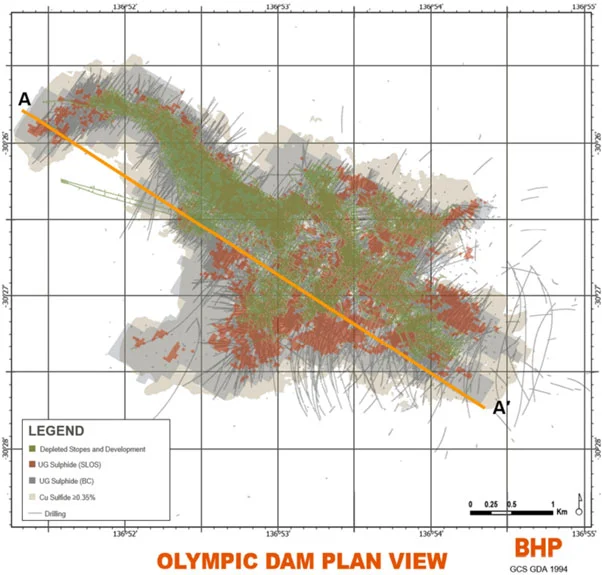
Plan view of the Olympic Dam deposit, showing the spatial relationship between a 0.35% Cu envelope, the outlines of mineral resource block cave and sublevel stoping. Mined stope, development and drilling provided for context. [BHP]
A resource says the rock is there. Only a reserve says it pays.
Peers are working through the same grade question. South32 also held its FY27 outlook as copper growth gained pace, and Evolution Mining’s copper-gold growth plans put another ASX name in the same conversation.
The next real test is the December quarter report. If Escondida’s throughput stays near 31 million tonnes while grade slides toward 0.66%, even the bottom of the range gets tight.
More ASX production updates sit in our mining announcements.
Also Read: Challenger Faces a Daiichi Life Takeover at A$11.80
FAQs
Q: What do BHP’s Q1 production results 2026 show?
A: Copper fell 19% to 400.7kt, while iron ore rose 4% to 66.5Mt.
Q: Did BHP change its FY27 copper guidance?
A: No. It stays at 1,650kt to 1,800kt.
Q: Why did BHP’s copper output fall?
A: Lower grades at Escondida and Spence, maintenance, Chilean storms, safety stops and the Carrapateena conveyor failure.
Q: Is Olympic Dam’s new block cave resource mineable yet?
A: No. It has not been converted to reserves, and BHP has not set a development timeframe.
Disclaimer: This article is general information only and is not financial product advice. It does not take into account your objectives, financial situation or needs. Commodity and share prices move, and company guidance can change. Speak to a licensed financial adviser before making any investment decision.

Luke Carlino is a seasoned Copywriter, Content Strategist, and Social Media Manager specialising in Mining, Finance, and Business journalism. With more than a decade of industry experience, he brings rigorous editorial standards and commercial acuity to every project.