Lynas Rare Earths Ltd (ASX: LYC) signed a binding deal on 1 October 2026 to buy Meteoric Resources Ltd (ASX: MEI). The all-share transaction is valued at about A$968 million.
The prize is Caldeira, Meteoric’s rare earths project in Minas Gerais, Brazil.
St George Mining Limited (ASX: SGQ) (“St George” or the “Company”) owns Araxá, a rare earths and niobium project in the same state.
Same state. A very different deposit.
The Company’s own comparison study now sets the two projects side by side. Its argument is that SGQ looks undervalued against the Lynas price.
Here are the numbers behind that argument, and what still has to happen.
The Lynas deal puts a price on Brazilian rare earths
The key terms come from the joint Lynas and Meteoric announcement.
- Structure: a court-approved scheme of arrangement, paid in shares only
- Exchange ratio: 0.0207 new Lynas shares for each Meteoric share
- Implied value: about A$968 million, fully diluted, using Lynas’ 60-day average share price
- Ownership after the deal: Lynas holders about 94.1%, Meteoric holders about 5.9%
- Timing: Meteoric expects to send its scheme booklet in December 2026
Caldeira is an ionic clay deposit. Meteoric’s July 2026 resource is 1,631 million tonnes at 2,317 parts per million of total rare earth oxides.
That equals 0.2317% TREO, the number the rest of this comparison turns on.
Western buyers want more supply outside China. The International Energy Agency says China accounts for more than 90% of refining and nearly 95% of permanent magnet production.
John Prineas, the Company’s Executive Chairman, called the deal “a vote of confidence by Lynas in Brazil as a jurisdiction”.
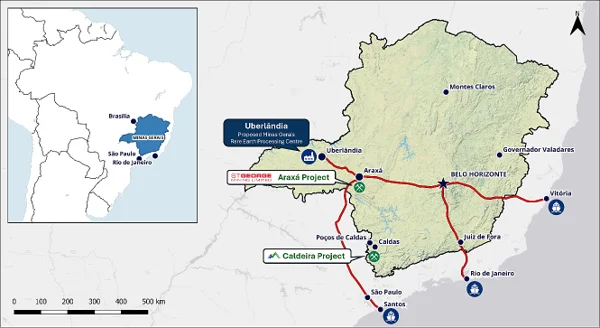
Figure 1: Map of Minas Gerais showing the Araxá and Caldeira projects and the proposed Minas Gerais Rare Earth Processing Centre at Uberlândia. [Source: St George Mining]
Araxá’s grade is about 15 times Caldeira’s
Araxá’s total resource grades 3.57% TREO. Caldeira grades 0.2317%.
That makes Araxá about 15.4 times richer, according to the study. The gap holds across the other measures it compares.
| Grade | Caldeira | Araxá | Araxá vs Caldeira |
|---|---|---|---|
| TREO, total | 0.23% | 3.57% | 15.4× higher |
| TREO, M&I | 0.26% | 3.64% | 13.9× higher |
| NdPr, total | 0.05% | 0.68% | 13.8× higher |
| NdPr, M&I | 0.06% | 0.69% | 12.4× higher |
| MREO, total | 0.05% | 0.70% | 13.5× higher |
| DyTb, total | 25 ppm | 136 ppm | 5.4× higher |
Table 1: Grade comparison between Meteoric’s Caldeira and the Company’s Araxá. M&I means Measured and Indicated. NdPr is neodymium-praseodymium, DyTb is dysprosium-terbium and MREO is magnet rare earth oxides. [Sources: St George Mining; Meteoric Resources]
Higher grade means less rock to move for each tonne of product.
The arithmetic is simple. At Caldeira’s resource grade, about 430 tonnes of rock hold one tonne of TREO. At Araxá’s average grade, about 28 tonnes do. Both figures are before processing losses, so treat the comparison as a guide.
The study says this leaner profile could shield Araxá from bulk mining cost inflation.
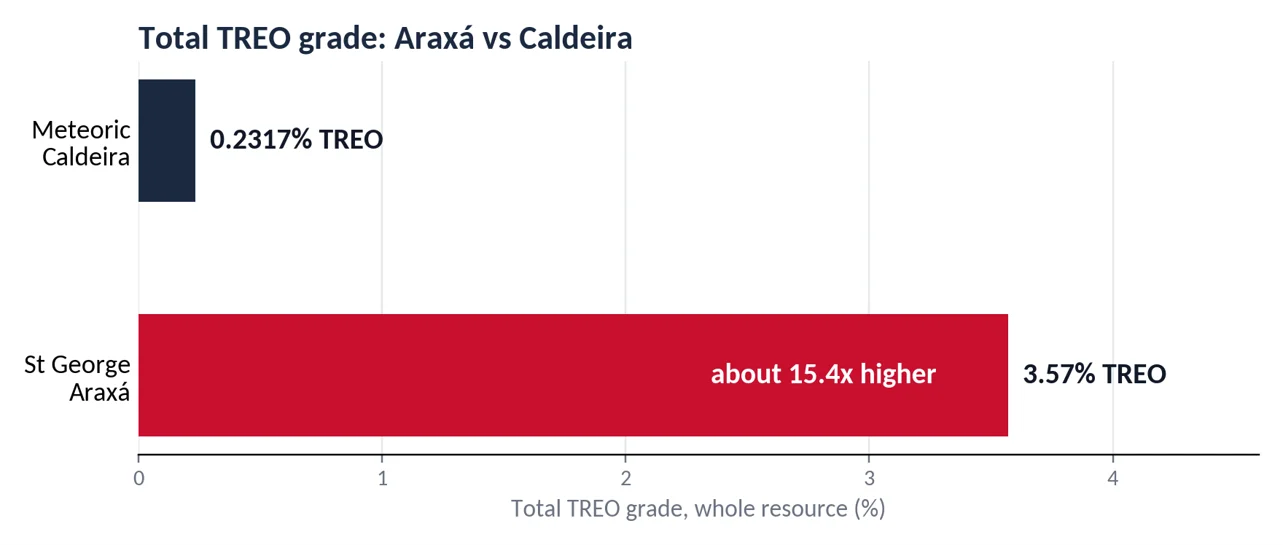
Figure 2: Total TREO grade at Caldeira and Araxá. [Source:St George Mining and Meteoric Resources data]
Araxá holds more NdPr where confidence is highest
Grade is only half the argument. Confidence in the tonnes matters just as much.
Measured and Indicated tonnes are the ones that feed feasibility studies. At Araxá they make up 68% of the total. At Caldeira the share is 43%.
| Metric | Meteoric: Caldeira | St George: Araxá |
|---|---|---|
| Deposit style | Ionic adsorption clay | Carbonatite-hosted, weathered and residual |
| Location | Minas Gerais, Brazil (Poços de Caldas alkaline complex) | Minas Gerais, Brazil (Barreiro complex) |
| Total resource | 1,631 million tonnes | 111.2 million tonnes |
| TREO grade, total | 0.2317% (2,317 ppm) | 3.57% (35,700 ppm) |
| Contained TREO, total | 3.78Mt | 3.98Mt |
| Contained TREO, M&I | 1.84Mt | 2.74Mt |
| Contained NdPr, M&I | 391kt | About 520kt |
| Contained Nb₂O₅, total | Nil reported | 630,000 tonnes |
| M&I share of total resource | 43% | 68% |
| Measured share of total resource | 7.8% | 30% |
Table 2: Resource comparison between Caldeira and Araxá. Mt means million tonnes and kt means thousand tonnes. [Sources: St George Mining; Meteoric Resources]
- 2.74Mt of M&I TREO at Araxá, against 1.84Mt at Caldeira
- About 520kt of M&I NdPr at Araxá, against 391kt at Caldeira
- Similar total TREO, 3.98Mt against 3.78Mt, from about 15 times less rock (111.2Mt against 1,631Mt)
The Company says Araxá’s M&I categories hold more NdPr than Mountain Pass or Mt Weld. It describes those two as the largest producing rare earths mines outside China.
Both are carbonatite deposits, the same style as Araxá. Mt Weld is Lynas’ own mine, and Mountain Pass belongs to MP Materials.
The study notes that large-scale mining has run beside Araxá for more than 40 years. CBMM runs a niobium mine there, and Mosaic a phosphate mine.
Niobium gives Araxá a second product
Araxá’s rock holds niobium as well as rare earths. Niobium is mainly used to strengthen steel.
The total resource contains 630,000 tonnes of niobium pentoxide (Nb₂O₅). The M&I categories hold about 440,000 tonnes.
Caldeira reports no niobium.
Brazil supplies roughly 92% of the world’s niobium, according to the US Geological Survey.
The resource also has a higher-grade subset. It holds 830,000 tonnes of TREO above 6.29% and 120,000 tonnes of Nb₂O₅ above 0.90%.
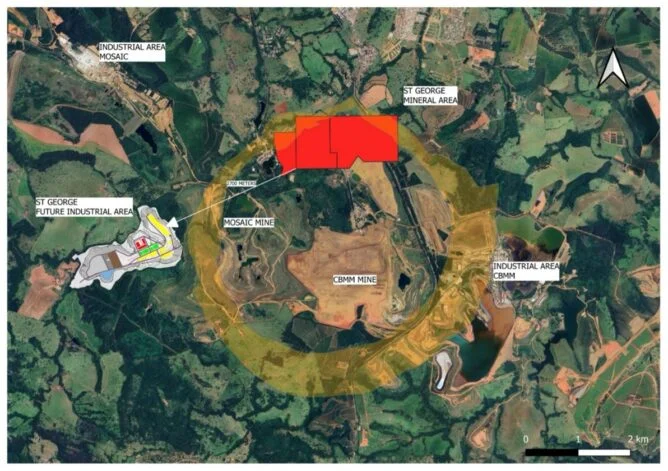
Figure 3: Aerial image of the Barreiro carbonatite complex showing the Araxá Project (red outline), the adjacent CBMM niobium mine and the Mosaic phosphate mine. [Source: St George Mining]
The study also compares expected output. Caldeira’s figures come from Meteoric’s feasibility study and the Lynas presentation.
Araxá’s are independent, pre-scoping estimates. They are not a Company forecast.
| Metric | Caldeira | Araxá (independent estimate) |
|---|---|---|
| Annual NdPr production (average) | 3,862t | 4,557t |
| Annual samarium production (average) | 297t | 304t |
| Annual HREO production (average) | 947t | 270t |
| Annual FeNb production (average) | Nil | 10,000t |
Table 3: Average annual production estimates. HREO means heavy rare earth oxides. FeNb is ferroniobium, the alloy steelmakers buy. [Sources: Meteoric Resources; St George Mining]
Caldeira leads on heavy rare earths, at 947 tonnes a year against 270 tonnes. Araxá’s edge sits in NdPr and in the ferroniobium line that Caldeira does not have.
What the Lynas price implies for SGQ
One simple way to compare projects is value per contained tonne. Divide the price by the tonnes of metal in the resource.
On that basis, Lynas is paying A$256 for each tonne of TREO at Caldeira. For M&I TREO, the figure is A$526.
The study then applies an illustrative A$300 million market value to Araxá. That equals A$76 per tonne of total TREO and A$110 per tonne of M&I TREO. The A$300 million is below the Company’s current market capitalisation, which comes up further down.
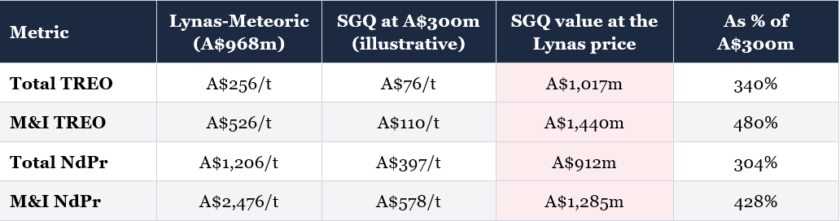
Table 4: Illustrative equity value per contained tonne of TREO and NdPr. [Source: St George Mining]
Contained tonnes used: Caldeira 3.779Mt and 1.840Mt TREO, 0.802Mt and 0.391Mt NdPr (total and M&I). Araxá 3.970Mt and 2.737Mt TREO, 0.756Mt and 0.519Mt NdPr (total and M&I), calculated from tonnes and grade.
Applied to Araxá’s tonnes, the Lynas price gives A$1,017 million on total TREO. On M&I TREO it gives A$1,440 million.
Those values are about 3.4 and 4.8 times the illustrative A$300 million.
The reference market capitalisation is higher, at about A$357.10 million. Against that figure, the same four values compare as follows (our calculation using the study’s values).
- Total TREO: A$1,017 million, about 2.8 times
- M&I TREO: A$1,440 million, about 4.0 times
- Total NdPr: A$912 million, about 2.6 times
- M&I NdPr: A$1,285 million, about 3.6 times
None of these figures include niobium. The study says niobium would add further value, but it does not put a number on it.
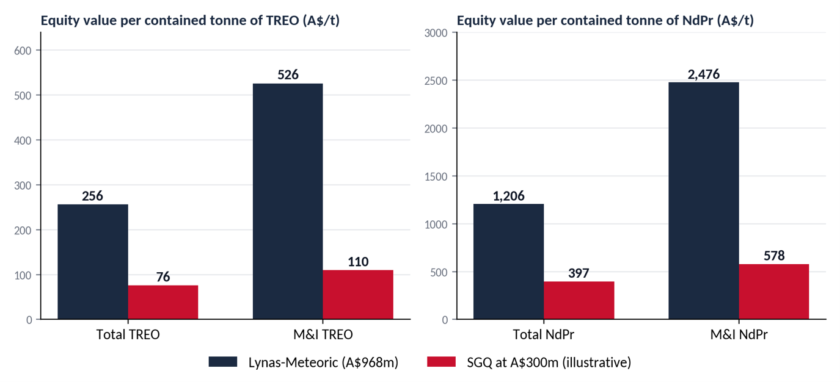
Figure 4: Equity value per contained tonne, Lynas-Meteoric against SGQ at an illustrative A$300 million. [Source: St George Mining]
This is arithmetic, not a valuation. Caldeira has a completed feasibility study, and Araxá’s studies are at an earlier stage.
The Company’s current work program is aimed at closing that gap.
Why carbonatite projects can be cheaper to run
Project Blue is an independent critical minerals consultancy. It assessed 32 rare earths operations and projects on a 2030 basis.
Its chart shows carbonatite deposits with the lowest production cost of the six deposit types it covers. Ionic adsorption clay, the style at Caldeira, sits higher.
Araxá’s weathered ore starts at surface. The whole resource sits within 120 metres of surface.
The study describes the ore as free digging, with no blasting needed.
The Company expects mining costs to rank among the lowest in the world.
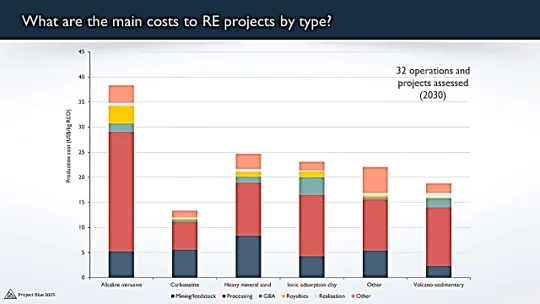
Figure 5: Main costs of rare earths projects by deposit type, US$/kg REO, 32 operations and projects assessed (2030). [Source: Project Blue 2025, via St George Mining]
From resource to project: backing, permits and processing
Ore in the ground becomes a project only with funding, permits and a way to process it. Here is where Araxá stands on each.
Backing
Hancock Prospecting holds 10.3% of the Company, according to the study. It also holds 8.2% of Lynas and 8.4% of MP Materials, the companies behind those two benchmark mines.
Hancock put A$20 million into the Company’s A$60 million placement at A$0.10 per share in June.
Permits
The Company lodged its Preliminary Licence application in August 2026. Meteoric is further along.
| Status | Meteoric: Caldeira | St George: Araxá |
|---|---|---|
| Feasibility | Definitive feasibility study completed 31 July 2026 | Feasibility work under way with technical adviser Worley |
| Preliminary Environmental Licence | Granted | Application submitted August 2026 |
| Installation Licence | Targeted for 2026 | Targeted for H1 2027 |
Table 5: Licensing and development status. [Sources: Meteoric Resources; St George Mining]
Processing
The Company’s pilot-scale processing work tests how Araxá’s two metals can be separated into saleable products.
- About 9 tonnes of near-surface saprolite are being processed at CIT-SENAI in Belo Horizonte
- Four to six weeks is the planned length of the pilot-scale beneficiation study
- December 2026 quarter is when results are expected
- Up to 300kg per hour is the planned capacity of the Company’s own pilot plant at CEFET-MG
- January 2027 is the target for first operation of that plant
A 2012/13 pilot plant on Araxá mineralisation made rare earth oxalate at more than 99% purity. Overall TREO recovery was 86%.
Downstream
In August 2026 the Company signed a Protocol of Intent. The partners are the State of Minas Gerais and Lima & Pergher Group’s START division.
The parties are assessing a Minas Gerais Rare Earths Processing Centre in Uberlândia. The study says it would handle rare earth products from mines across the state.
The plan remains subject to further agreements, investment decisions and approvals.
SGQ share price and Investors’ Outlook
Since the June placement, the Company has lifted its Measured and Indicated resource by 155% and started pilot-scale processing work.
| Metric | Current reference |
|---|---|
| SGQ share price | A$0.059 |
| Market capitalisation | About A$282.07 million |
| Lynas-Meteoric implied value | About A$968 million |
| Araxá total MRE | 111.2Mt @ 3.57% TREO; 0.57% Nb₂O₅ |
| Araxá M&I MRE | 75.2Mt @ 3.64% TREO; 0.58% Nb₂O₅ |
| June institutional placement | A$60 million at A$0.10/share |
| Hancock Prospecting holding | 10.3% |
Table 6: SGQ market and resource reference points at the time of drafting. Market data is time-sensitive. [Source: ASX]
On those reference figures, SGQ’s market capitalisation is about 37% of the Lynas price. Araxá holds more contained TREO than Caldeira, 3.98Mt against 3.78Mt.
Whether the market closes that gap depends on the milestones below.
Upcoming catalysts
- Late October 2026: the Company’s September quarterly report is expected
- December 2026 quarter: CIT-SENAI pilot-scale beneficiation results
- December 2026 quarter: maiden Mineral Resource Estimate targeted for East Araxá
- December 2026: targeted completion of the St George Technological Centre at CEFET-MG
- December 2026: Meteoric expects to send its scheme booklet to shareholders, with an independent expert’s report on the deal
- January 2027: targeted first operation of the Company’s pilot plant
- H1 2027: Installation Licence targeted
- Ongoing: feasibility and development studies with technical adviser Worley
Lynas has now set a price for Brazilian rare earths. Against it, Araxá offers the higher grade, more M&I rare earths and a second metal, at a market value that is a fraction of the deal.
A resource is not a reserve, and Caldeira holds the lead on studies and permits. Closing that distance is the Company’s job from here.
Disclaimer
This report has been prepared by Colitco in collaboration with St George Mining Limited as part of a commercial content and investor communications arrangement. Colitco may receive compensation for the production and distribution of this content. This article is intended for informational purposes only and does not constitute financial product advice, investment advice, or a recommendation to buy or sell any securities. The content reflects information available at the time of publication and may not be updated. All figures, data and statements have been sourced from St George Mining Limited’s official ASX announcements and publicly available sources. Valuation comparisons in this article are illustrative arithmetic and are not a forecast or price target. Readers should conduct their own independent research and seek professional financial advice before making any investment decisions. Past performance is not a reliable indicator of future results. Exploration results are not a guarantee of future resource definition or commercial production.

Luke Carlino is a seasoned Copywriter, Content Strategist, and Social Media Manager specialising in Mining, Finance, and Business journalism. With more than a decade of industry experience, he brings rigorous editorial standards and commercial acuity to every project.