The final investment decision came on 16 October. A new plant called Jimmagunya will rise beside the existing Pilgan plant, 140km by road from Port Hedland. Nyamal elders named it, and the word translates to spring country.
PLS (ASX: PLS) says in its announcement that the spodumene expansion should lift concentrate output to about 2 million tonnes a year. That is roughly double what the mine is rated for today. First output is targeted for the September quarter of 2029.
Most coverage will lead with that headline figure. The number worth chewing on is the cost.
The bill grew 46% and the plant grew with it
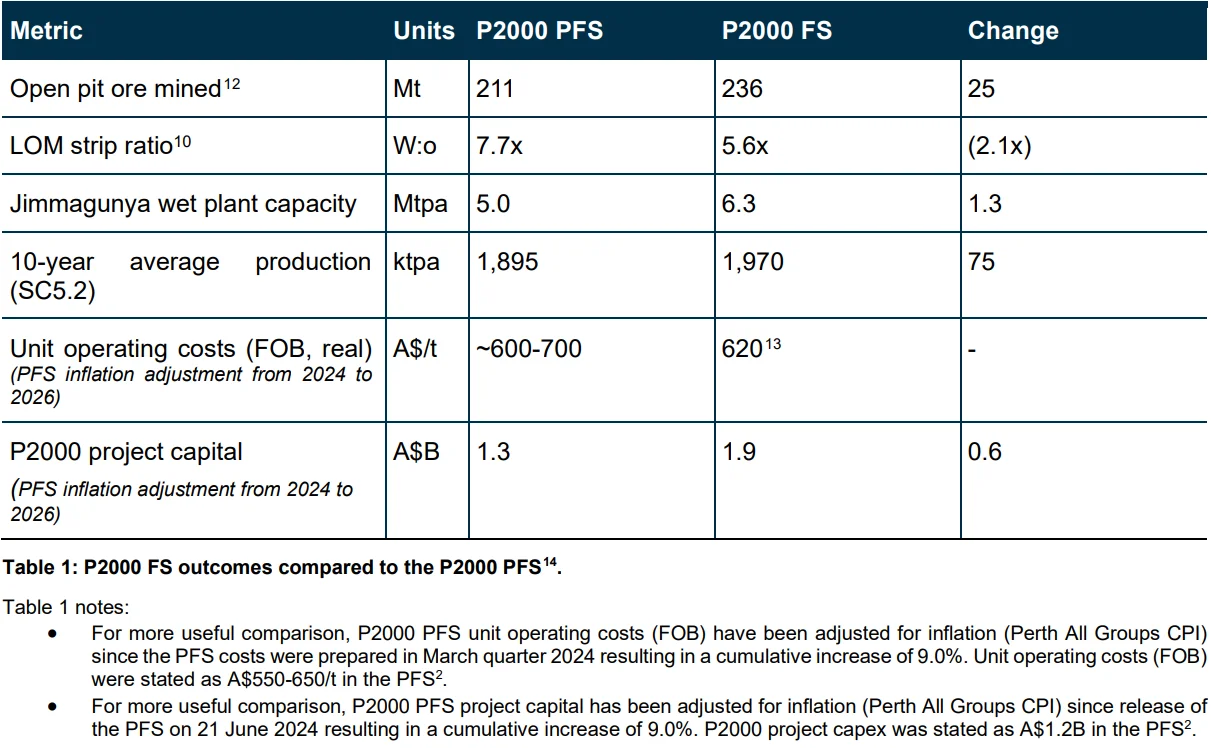
PLS spends about A$600 million more than the 2024 study allowed and expects lower unit costs in return. [PLS]
The 2024 study priced the project at A$1.2 billion. Adjusted for inflation, that is about A$1.3 billion. The final figure is A$1.9 billion.
The extra A$600 million does not buy much more concentrate. Average output over the first ten years moves from 1,895 kilotonnes a year to 1,970, a gain of about 4%.
What it buys is a different mine. The wet plant grows 26%, from 5.0 to 6.3 million tonnes a year. About 67 million tonnes of rock once labelled waste now counts as ore. The strip ratio (waste moved for every tonne of ore) drops from 7.7 to 5.6.
Unit costs land near A$620 a tonne, against roughly A$650 in the inflation-adjusted study. On 1.97 million tonnes, that A$30 gap is worth about A$59 million a year.
That will not repay A$600 million by itself. The rest of the case leans on a longer mine life and a kind lithium price.
CEO Dale Henderson framed it simply: “scale matters, but cost position matters more.” Read against the table, the extra money mostly buys a cheaper tonne rather than a bigger one.
PLS Group’s lithium reserve increase arrives with a smaller resource
The same day, PLS lifted its ore reserve to 249.2 million tonnes at 1.24% lithium oxide. Contained lithium oxide rises 31% to about 3.1 million tonnes.
The mineral resource moved the other way. It fell 8% to 403 million tonnes, although the grade improved to 1.33%.
That cut is a paperwork result, not a geology result. PLS kept its geological model and retested the rock against open pit and underground mining separately. The material that dropped out averaged just 0.77%, which is why the average grade rose.
One quirk deserves a look. The reserve is now counted after crushing and ore sorting, which strips out waste. That could look like a flattering change. The old-basis table in the release still shows about 3.1 million tonnes of contained lithium oxide, on 297 million tonnes at 1.05%.
Two soft spots sit underneath. Only 6% of the reserve is in the top “proved” category. And Jimmagunya is designed to recover about 70% of the lithium oxide in its feed, against a 75% life-of-mine target at the Pilgan plant.
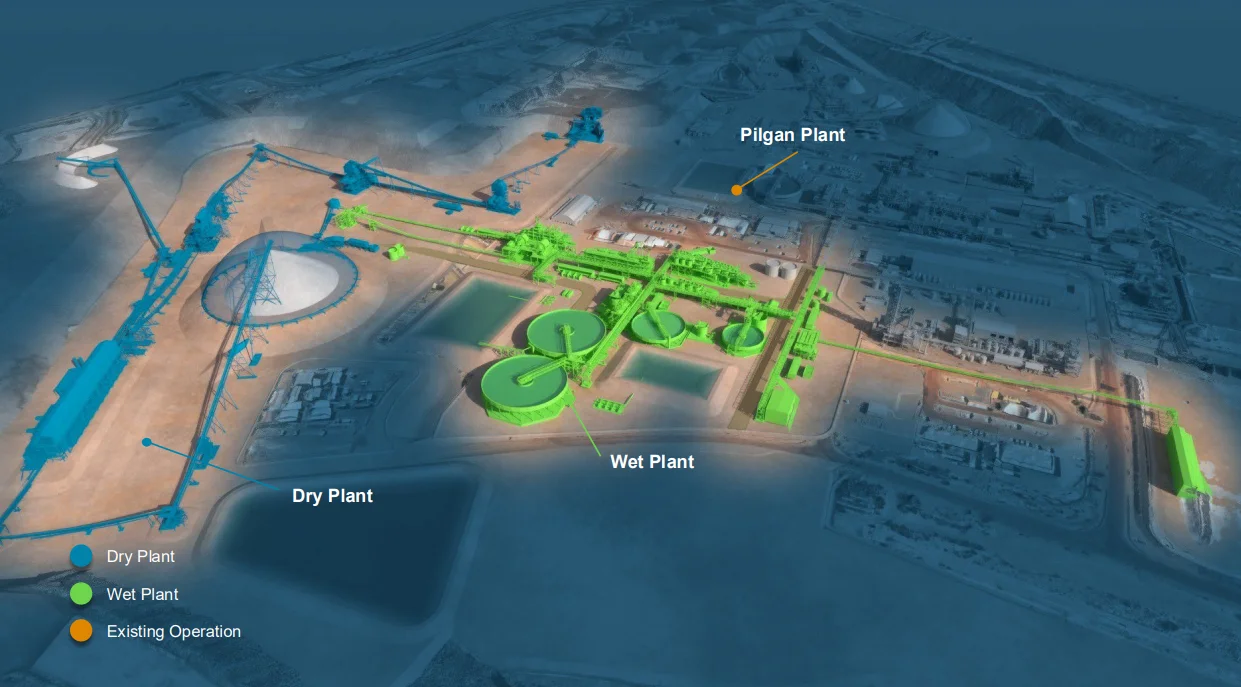
The Jimmagunya plant. [PLS]
Underground mining comes later. A maiden underground reserve of 46.5 million tonnes at 1.50% sits beneath the pits. A separate study points to about 2.2 million tonnes a year and a mine life beyond 25 years. The A$1.9 billion does not cover any of it.
The PLS Group Pilgangoora expansion runs on cash and one price call
Funding comes from A$2.3 billion of cash at 30 June plus operating cash flow. No new debt or equity is announced, though PLS says it will look at debt from time to time.
P2000 is not the only cheque. A separate A$600 to 650 million goes to a sealed 24km access road, a 1,200-bed village and a new mine services workshop. Together the spend reaches about A$2.55 billion through FY29 and peaks near A$1.3 billion in FY28.
That is more than the June cash balance, so earnings from the existing mine carry real weight. Macquarie’s numbers, as reported by Market Index, show a forecast net cash position of about A$210 million in FY29. That turns into roughly A$280 million of net debt if the extra spend flows through.
The base case uses a long-term spodumene price of US$1,620 a tonne, the average of 11 analyst forecasts. Each US$250 a tonne on top adds about A$900 million to the project’s value. Benchmark Mineral Intelligence sits far higher, at US$2,580.
Shares sat just above A$3 on Friday, up about 3% on the day. That still left PLS among the weakest ASX lithium stocks of the week, down nearly 19%. It is also about half the A$6.17 it traded at when the pre-FID spend was approved in June.
Building into a soft market can still be smart. PLS cites S&P Global figures putting new mine development at about 18 years, so a plant working by 2029 has scarcity value. The risk is simple: the cash goes out now, and the price that pays for it arrives later.
Half the FY30 volume has a buyer, and the rest is open
Contracted placement capacity covers about 50% of forecast P2000 volume in FY30. The rest is unallocated, and PLS says unsolicited customer interest is heavy. That works in a rising market and feels loose in a falling one.
Several boxes also sit open. Approvals for the full life-of-mine plan are being referred under state and federal environmental law, and updates should land through ASX announcements. Port handling at Lumsden Point leans on a third-party storage solution, and the extra power supply is still being optimised.
One small detail shows how the mine has grown. The old Carlindi Village once sat well outside the pit footprint, but mining has crept toward it and now cramps the waste dump plans. The new village, with first beds from late 2027, is partly a way to move the camp out of the way.
Circle FY28. That is when the cheque is biggest, the road works are still under way, and the price has had time to show whether those 11 analysts got it right.
Also Read: WiseTech Global: ASIC Closes Two Probes, Not the Story
FAQs
Q: How much does the PLS P2000 expansion cost?
A: About A$1.9 billion, funded from cash and operating cash flow.
Q: When does Jimmagunya start producing?
A: First production is targeted for the September quarter of 2029, followed by roughly six months of ramp-up.
Q: How much will Pilgangoora produce?
A: About 2 million tonnes of spodumene concentrate a year, averaging 1.97 million over the first decade.
Q: Did the lithium reserve really rise 31%?
A: Contained lithium oxide rose 31% to about 3.1 million tonnes, while the resource fell 8%.
Q: Is underground mining part of the decision?
A: No. It sits in a separate study and needs its own investment decision.
Disclaimer:
General information only, not financial advice. Mining projects carry risks, including cost, approval and commodity price risk. Figures come from company announcements and market data at the time of writing. Readers should check the original releases and seek licensed advice before investing.

Elizabeth Jones is a finance and mining content specialist with over 10 years of experience creating clear, SEO-driven content across fintech, investing, banking, insurance, cryptocurrency, and resource markets. She transforms complex financial data and industry trends into engaging, reader-focused articles that improve understanding and audience engagement.