The Mesoblast CEO investment landed on the ASX platform early on 21 July 2026, Melbourne time. Dr Silviu Itescu handed the company A$2,733,734 to exercise 1,885,334 options at A$1.45 each. His holding went from 78,958,928 shares to 80,844,262.
That is the whole announcement. Two paragraphs and a quote. But the numbers underneath it say more than the wording does.
The timing was not a choice, and that changes the read
Here is the part most coverage skipped. These A$1.45 puts expired on 19 July 2026.
This isn’t some dude getting up in bed on Monday morning thinking he’ll put his money behind his business. It was a deadline. Exercise or watch them lapse.
With Mesoblast valued at about A$2.38 in mid-July, walking away would mean leaving an A$1.75 million pile of money. No one leaves money like that. Any executive on the planet exercises in-the-money options before expiry.
Which means the headline word “investment” is doing some heavy lifting. This was not an on-market purchase at the prevailing price. It was a scheduled event with a hard cut-off date.
So why write about it at all?
What he did next is the actual signal
Because of one line in the release: he has not sold any of the newly acquired shares.
That matters more than the exercise itself.
The standard move is a cashless exercise. The executive sells enough of the new shares on market to cover the strike price and the tax bill, then keeps whatever is left over. It costs them nothing out of pocket. It is tidy, it is common, and it quietly puts stock into the market.
Itescu did not do that. He wrote a cheque for A$2.73 million in real money and kept every share.
For a founder who has been at this since 2004, through two decades of trials, knockbacks and capital raises, that is a genuinely different decision from the one most people in his seat make.
“The investment reflects my strong confidence in Mesoblast’s continued growth trajectory and its value proposition,” Itescu said in the release.
Executives always say that. The cash outlay is what backs it.
Mesoblast increases share ownership at its founder’s own expense
Run the maths on the position. At A$2.38 a share, 80,844,262 shares is worth about A$192 million. Against a market capitalisation near A$2.9 billion, that is a bit over 6% of the company sitting with one man.
Set A$2.73 million against A$192 million and the fresh outlay looks small. It is roughly 1.4% of what he already had on the table.
But the direction of travel is what counts. He put money in. He took nothing out.
There is a second detail worth noting. Itescu still holds well over 16 million options after this exercise, with strike prices running up through A$2.46, A$2.90 and A$3.39. Every one of those is currently worthless unless the share price climbs.
His incentive structure is stacked above today’s price, not below it.
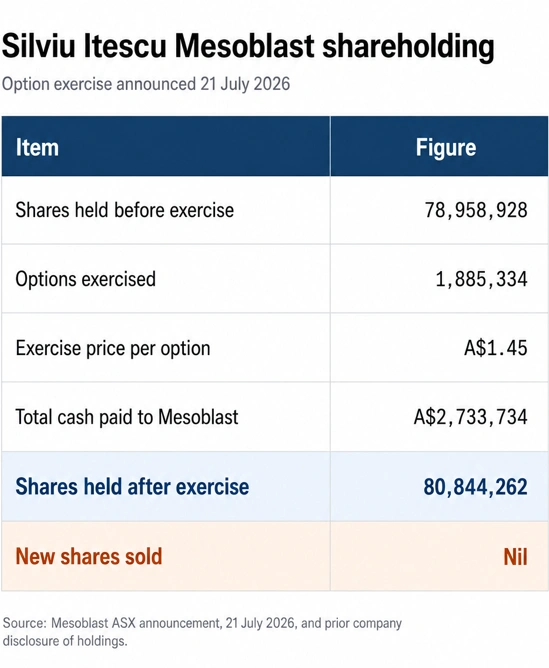
Change in Dr Silviu Itescu’s Mesoblast shareholding following the July 2026 option exercise.
The share price still has not caught up to the revenue
Now for the awkward bit.
Mesoblast reported preliminary Ryoncil net revenue of US$36 million for the June 2026 quarter, and US$115 million for its first full year on the US market. That is the mid-point of company guidance of US$110 million to US$120 million.
Compare that with the US$11.3 million recorded in the first three months after Ryoncil became commercially available. The ramp is real.
Ryoncil is the first mesenchymal stromal cell therapy the US Food and Drug Administration has ever approved for any indication. It treats steroid-refractory acute graft versus host disease in children from two months of age. Before it existed, those families had nothing approved to turn to.
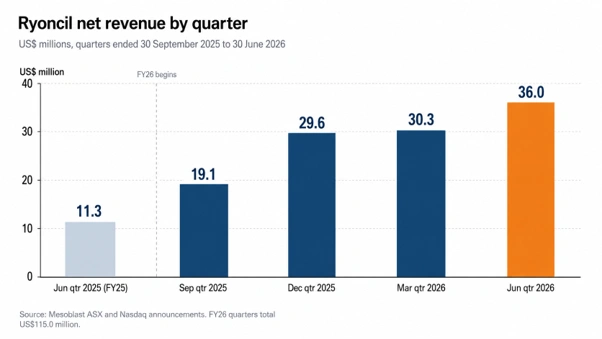
Ryoncil net revenue by quarter for the year ended 30 June 2026.
And yet, in spite of all that, Mesoblast closed the week ending 13 July at A$2.38, having risen by 6.25% over the course of the session, but still down almost 19% YTD and substantially off the A$3.37 hit in January.
It is a business reporting its best-ever sales, with an approved market-leading drug, trading at a lower valuation than the business opened the year with. That gap is the story the market has not resolved.
Bell Potter is forecasting US$275 million of Ryoncil sales in FY27 against an annualised exit rate of US$144 million. That requires about 27% quarterly compounding growth. Achievable, on their read, because the key account manager team is expanding into the north-east and California, and the largest US transplant centres have only recently started ordering.
Big if. Big number if it lands.
What a reader should actually take from this
Insider buying is one of the noisier signals in equity markets. Half the time it is theatre, half the time it is tax planning, and occasionally it tells you something.
The test worth applying: did the person spend money they could have kept?
Itescu did. He could have sold down to fund the strike and pocketed shares for free. He paid cash instead.
That does not make Mesoblast a buy. The company burned through two decades getting one product approved. It has partnerships in Japan, Europe and China, a chronic low back pain Phase 3 trial fully recruited, an adult graft versus host disease label extension underway, and a cash position that needs watching against all of it.
What the exercise does tell readers is that the person with the most information about Mesoblast, and the most to lose, chose not to reduce his exposure at A$2.38 when he had every opportunity to.
Worth filing away. Not worth mistaking for a forecast.
We have previously covered Mesoblast’s half-year result and the Ryoncil revenue inflection, which sets out the gross-to-net adjustments behind the headline sales figures. For broader context on how insider holdings behave as a signal, see our pieces on ASX growth stocks with high insider ownership and ASX companies with strong insider backing. Readers weighing the sector against other opportunities can also review our list of top ASX growth stocks for long-term investors in 2026.
Also Read: BHP Operational Review June 2026: Records Mask a Dip
FAQs
Q: How much did the Mesoblast CEO pay?
A: A$2,733,734.
Q: How many options did he exercise?
A: 1,885,334, at A$1.45 each.
Q: How many Mesoblast shares does Silviu Itescu now hold?
A: 80,844,262.
Q: Did he sell any of the new shares?
A: No.
Q: Was this an on-market purchase?
A: No. It was an option exercise ahead of a 19 July 2026 expiry.
Q: What is Ryoncil?
A: The first FDA-approved therapy for mesenchymal stromal cells, used to treat steroid refractory pediatric acute graft vs. host disease.
Q: What did Ryoncil earn last financial year?
A: US$115 million net revenue for the year ended 30 June 2026.
Disclaimer: This article is general information only and is not financial product advice. It does not take into account your objectives, financial situation or needs. Investing in shares carries risk, including loss of capital. Seek advice from a licensed financial adviser before making any investment decision. COLITCO LLP accepts no responsibility for any claim, loss or damage arising from the information provided or its accuracy. There may be a conflict of interest present with commercial arrangements with companies and/or stock held.
Source: https://investorsmedia.mesoblast.com/static-files/04cd6b1c-64b7-4c29-98e4-66a25ce06107

Elizabeth Jones is a finance and mining content specialist with over 10 years of experience creating clear, SEO-driven content across fintech, investing, banking, insurance, cryptocurrency, and resource markets. She transforms complex financial data and industry trends into engaging, reader-focused articles that improve understanding and audience engagement.