The Amplitude Energy FID landed on 30 September. A second decision came with it and got less airtime. The Nestor exploration well was also sanctioned.
Amplitude Energy FID rests on gas that is already sold
The project ties the Annie, Juliet and Artisan fields into existing infrastructure in Victoria’s offshore Otway Basin. Artisan only counts once Amplitude closes its $58.3 million purchase from Beach Energy.
The target is up to 90 TJ a day gross, held for at least four years from first gas.
Amplitude’s 50% share of point-forward costs is $190 million to $210 million across FY27 and FY28, counted from 1 September. Most of that is fixed-price or fixed-rate work, paid from cash and operating cash flow.
That is a tidy budget. The number that matters more is smaller.
Amplitude has already contracted 35 PJ of its share to EnergyAustralia and AGL, and FID is the trigger that switches those agreements on.
Here is the back-of-envelope version. Half of 90 TJ a day is 45 TJ. That is about 16 PJ a year, or roughly 65 PJ net over four years.
So around half the plateau is pre-sold. The rest goes to whatever the 2028 market pays, which is a comfortable spot if the southern states are short.
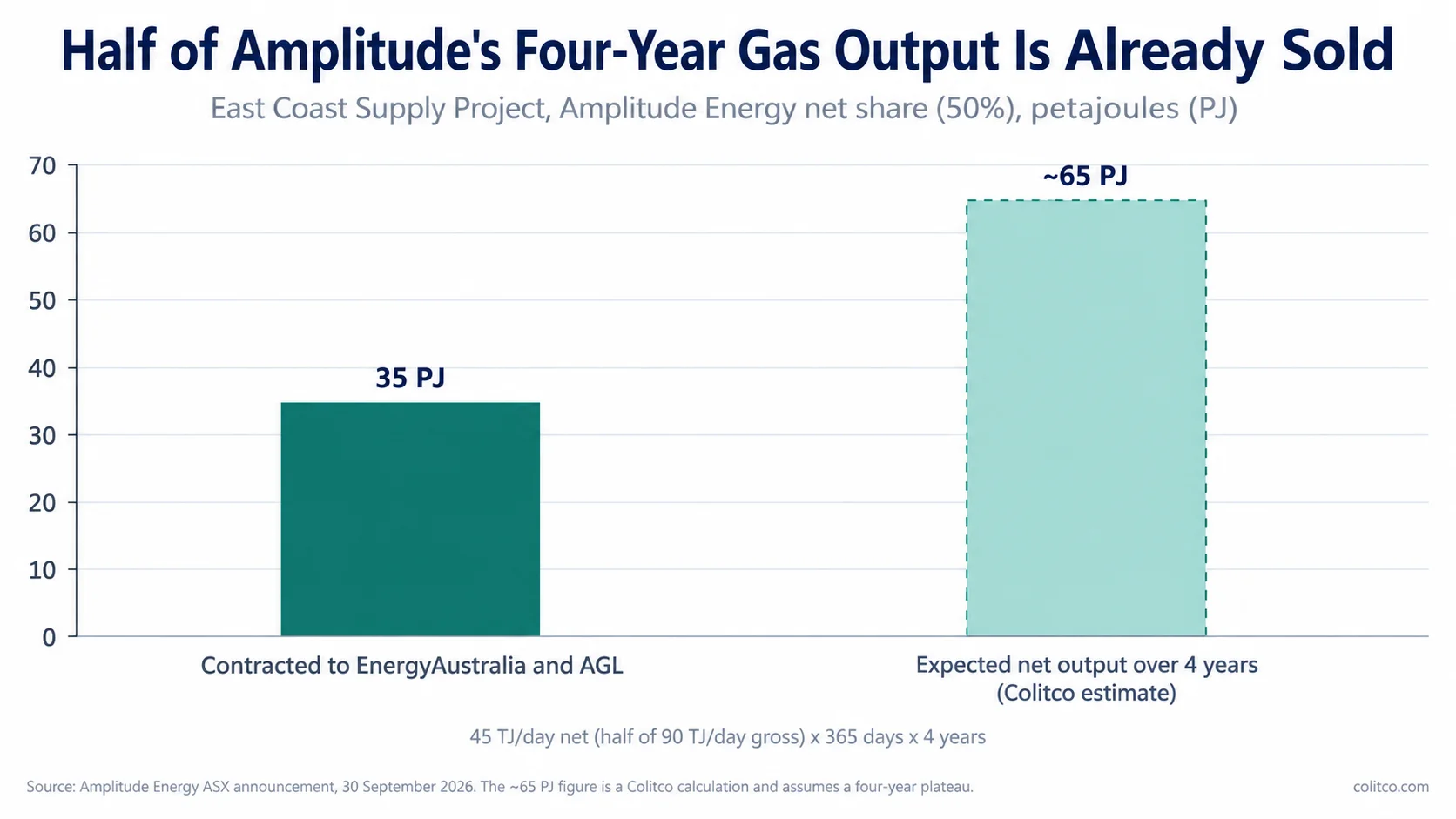 About half of Amplitude’s expected four-year net output is already under contract.
There is a second sum worth doing. Annie and Artisan together hold over 120 PJ of gross 2C contingent resources. Ninety TJ a day for four years is about 131 PJ gross.
The base case already asks for a little more gas than the 2C figure holds. And 2C is not booked reserves. That gap is why Juliet and Nestor carry so much weight.
Juliet-1 flowed 56.7 MMscf a day, but that is a test number
The well found 61 metres of gross pay, 52 of it net, and the clean-up ran on 27 and 28 September. The headline figures:
- Peak flow of 56.7 MMscf a day, with a stabilised average of 54.5
- Carbon dioxide near 1 mol% and nitrogen near 2 mol%
- No formation water recovered
That peak converts to roughly 60 TJ a day on a rough conversion of my own. It came from one well over a short test. Field rates settle lower over the years, and the pipes and plant set the ceiling anyway.
Amplitude says the results match pre-drill expectations. In a year like this one, boring is good.
Earlier in 2026 the campaign had a rougher start. The Elanora target turned out to be water-bearing, and a sidetrack into Isabella found gas instead.
The market noticed the difference. Jarden moved Juliet from roughly nothing to about 18 cents a share in its valuation, and lifted its target price to $2.03 from $1.85.
Nestor is a $70 million to $80 million punt with the rig already on site
Nestor costs $70 million to $80 million net to Amplitude. FY27 capex guidance therefore jumps to $320 million to $390 million, up from $250 million to $310 million. Amplitude says that lift is Nestor and nothing else.
The timing is the argument. The Transocean Equinox is moving on to Annie-2, and a drilling slot for Nestor sits right behind it. Long-lead items were ordered months ago.
Managing director Jane Norman put the logic plainly. She said the planned “one-touch” drilling and completion approach maximises capital efficiency.
Fair enough. But exploration wells miss, and the Elanora result above is the proof. Anyone modelling Amplitude should treat that money as spent and any Nestor gas as a bonus.
The upside is real if it works. Jarden reckons a successful Nestor could add up to another 24 cents a share, unrisked. A discovery could also reach the market as early as 2028 through the same infrastructure.
Otway Basin gas arrives as the southern market gets tighter
The ACCC’s gas inquiry still projects structural shortfalls on the east coast from 2028 unless new supply comes online. Amplitude’s East Coast Supply Project is aimed squarely at that window.
The pitch is speed. The gas goes through a plant and pipes that already exist, so there is no greenfield build. Ms Norman says both the Federal and Victorian governments want answers on tightness from 2028.
Demand is not a straight line, though. Beach Energy’s Otway output fell 9% in the March quarter on lower customer nominations. Amplitude’s gas will sell into that same pool, and weather and price can swing it.
Four things are worth watching from here:
- Whether the Artisan purchase closes
- What Annie-2 delivers
- Whether Nestor finds gas
- Whether further contracts follow once drilling wraps up
The FID is done. What remains is execution, and a 2028 start date leaves little slack.
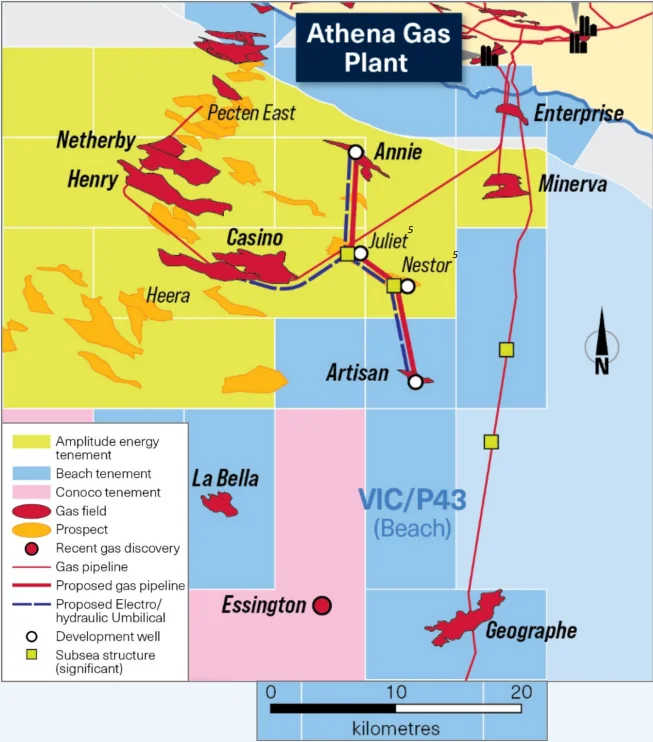 The East Coast Supply Project ties four Otway Basin fields into one existing gas plant. [AEL]
Also Read: Orica Locks In Ammonium Nitrate Supply, But Land Sale Slips
FAQs
Q: What does the Amplitude Energy FID approve?
A: The development phase of the East Coast Supply Project, including subsea tie-ins and plant upgrades.
Q: When is first gas?
A: Calendar 2028.
Q: What will it cost Amplitude?
A: $190 million to $210 million net over FY27 and FY28.
Q: What is Nestor?
A: A drill-ready Otway Basin prospect sanctioned alongside FID at $70 million to $80 million net.
Q: Who has bought the gas?
A: EnergyAustralia and AGL, for 35 PJ of Amplitude’s share.
Disclaimer: This article is general information only and is not financial product advice. It does not consider anyone’s objectives, financial situation or needs. Exploration and development outcomes are uncertain. Readers should do their own research and speak to a licensed adviser before making investment decisions. Colitco does not hold a position in the securities mentioned unless disclosed.

Elizabeth Jones is a finance and mining content specialist with over 10 years of experience creating clear, SEO-driven content across fintech, investing, banking, insurance, cryptocurrency, and resource markets. She transforms complex financial data and industry trends into engaging, reader-focused articles that improve understanding and audience engagement.