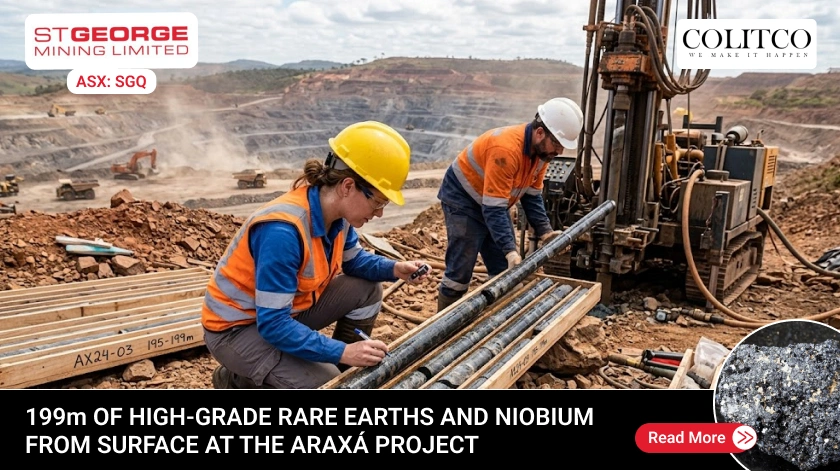
St George Mining Limited (ASX: SGQ) (“St George” or the “Company”) has released a fresh set of drill results from its 100%-owned Araxá Rare Earths and Niobium Project in Minas Gerais, Brazil.
The results cover 23 diamond drill holes. Every hole hit mineralisation starting right at surface.
One hole stands out. Hole AXDD120 returned 199.5 metres of continuous mineralisation from surface. That is the thickest intercept drilled at Araxá to date.
Rare earths and niobium are two metals used in electric vehicles, wind turbines, steel and defence equipment. The Company is working to prove up how much of each sits in the ground at Araxá.
AXDD120 Delivers the Thickest Hit Yet at Araxá
Hole AXDD120 returned 199.5 metres at 2.86% TREO and 0.44% Nb₂O₅ from surface.
Inside that long run of ore, the hole hit richer bands:
- 60 metres at 3.96% TREO and 0.52% Nb₂O₅ from surface
- 15 metres at 3.30% TREO and 0.97% Nb₂O₅ from 36 metres
- 28.8 metres at 1.76% TREO and 0.70% Nb₂O₅ from 116.2 metres
The hole reached fresh rock at a depth of 198 metres. The very bottom of the hole still returned 1 metre at 4.8% TREO from 198.5 metres.
That last figure matters. It means the ore body has not run out at depth. It is still open below the deepest point drilled.
“The remarkable result for AXDD120, which delivered almost 200 metres of continuous mineralisation from surface, highlights the tremendous scale and consistent high grade of the mineral system at Araxá,” said John Prineas, Executive Chairman of St George Mining.
He added: “The deposit remains open at depth, with the high-grade mineralisation at the end of hole for AXDD120 indicating that we have yet to see the limit of this large mineral system.”
Thick Mineralisation Runs Across the Deposit
AXDD120 is not a one-off. Seven holes in this batch each returned more than 150 metres of mineralisation from surface.
“Importantly, this result is not isolated. Many drill holes in our program, including seven drill holes in the latest batch of results, have returned more than 150 metres of mineralisation from surface,” said Mr Prineas.
The table below lists the widest intercepts from the 23 holes, measured from surface.
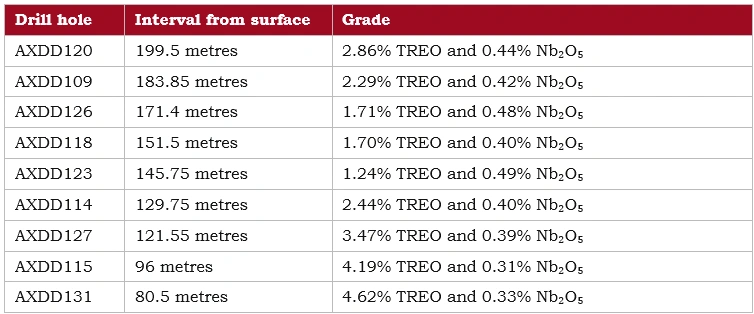
Table 1: Widest mineralised intercepts from the 23 diamond drill holes, all from surface. [Source: St George Mining]
Some of the richest bands sit inside these holes. Hole AXDD115 returned 22.95 metres at 8.93% TREO from 37.05 metres. Hole AXDD127 returned 15.5 metres at 8.07% TREO from surface.
The latest holes also show a strong magnet rare earth profile. The neodymium-praseodymium (NdPr) share of total rare earths sits around 20% to 26%. NdPr is the mix used to make the permanent magnets found in electric vehicle motors and wind turbines.
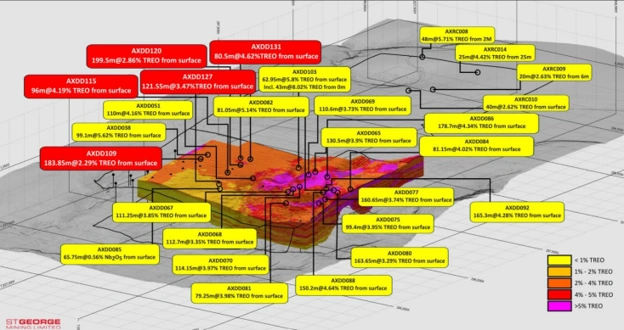
Figure 1: Oblique section showing the latest diamond drill holes across the Araxá deposit, with grades colour-coded. The latest holes are labelled in red. [Source: St George Mining]
Near-Surface Ore Points to Open-Pit Mining
The ore at Araxá starts at surface and lies flat. That shape suits open-pit mining, where the ore is dug from the top down rather than tunnelled underground.
Open-pit mining is usually cheaper to run in the early years. The Company sees this as a clear advantage for the Project.
“The favourable characteristics of the Araxá deposit — the combination of thickness, grade and flat-lying near-surface mineralisation — support the potential for open-pit mining and represent a compelling positive point of difference for Araxá,” said Mr Prineas.
The current resource is modelled to depths of only 120 to 160 metres. Holes like AXDD120, at almost 200 metres, suggest there is room to grow the resource deeper.
Niobium Adds a Second Product to the Story
Araxá is a dual-commodity project. It carries both rare earths and niobium in the same rock.
Niobium is a metal added to steel to make it stronger and lighter. It is also being tested in next-generation battery anodes.
Very high-grade niobium was intersected near-surface in the latest batch of results including:
- 9.2m @ 2.03% Nb₂O₅ from 25m in AXDD123;
- 5.3m @ 1.61% Nb₂O₅ from 12m in AXDD126;
- 25m @ 1.24% Nb₂O₅ from surface in AXDD110; and
- 21.25m @ 1.20% Nb₂O₅ from surface in AXDD123.
The best broad niobium intercepts in this batch include:
- 199.5 metres at 0.44% Nb₂O₅ from surface in AXDD120
- 145.75 metres at 0.49% Nb₂O₅ from surface in AXDD123
- 171.4 metres at 0.48% Nb₂O₅ from surface in AXDD126
- 90 metres at 0.54% Nb₂O₅ from surface in AXDD117
“A key commercial advantage for our project is the dual commodity opportunity, with world-class mineralisation for both rare earths and niobium,” said Mr Prineas.
Drilling Extends the Ore Body to the North
Eight of the 23 holes were drilled outside the current resource boundary.
These holes pushed the known ore body about 200 metres further north. That northern area is still open, meaning it may extend further again.
St George has now completed about 14,500 metres of drilling in the current campaign at the main Araxá deposit.
The Company plans to fold these results into a resource upgrade this quarter.
How the Current Resource Stacks Up
In March 2026, St George announced a major upgrade to the Araxá resource. This is the current Mineral Resource Estimate, an independent count of how much material sits in the ground under the JORC reporting code.
Using a 2% TREO cut-off, the resource stands as follows:
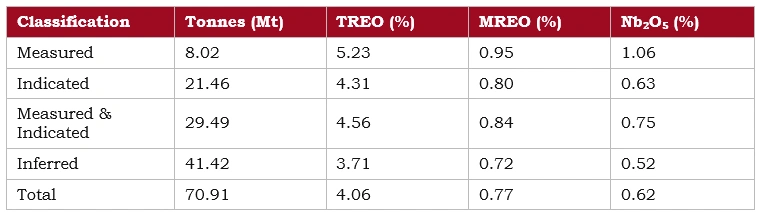
Table 2: Araxá JORC 2012 Mineral Resource Estimate, 2% TREO cut-off, announced 3 March 2026. [Source: St George Mining]
The total resource is 70.91 million tonnes at 4.06% TREO and 0.62% Nb₂O₅. The higher-confidence Measured and Indicated portion alone holds 29.49 million tonnes at 4.56% TREO.
The Company describes Araxá as the largest and highest-grade carbonatite-hosted rare earths resource in South America. It also ranks as the second-highest grade rare earths resource in the Western world.
Historic drilling has returned some of the highest grades seen in the sector, up to 8% Nb₂O₅ and 33% TREO. Earlier this year the Company reported a record 178.7 metres at 4.34% TREO and 0.75% Nb₂O₅ from surface.
Next Focus: The East Araxá Discovery
The drill program at the main deposit will pause soon.
The rigs will then move to East Araxá, a separate discovery about 1 kilometre east of the main deposit.
“We expect resource definition drilling at East Araxá to result in a further MRE upgrade in Q4 2026,” said Mr Prineas.
Why Rare Earths and Niobium Matter
Both metals sit on the critical minerals lists of Australia and the United States. Governments treat them as strategic because supply is concentrated in a few countries.
Brazil supplies roughly 92% of the world’s niobium, according to the United States Geological Survey. The Araxá region is the centre of that production base.
Araxá sits next to CBMM’s niobium operation, the same geological setting that has made this part of Minas Gerais the world’s leading source of niobium.
On the demand side, the niobium market was valued at about US$3.4 billion in 2025 and is forecast to pass US$6.5 billion by 2035, according to Research Nester.
The rare earth oxides market is projected to grow from US$6.2 billion in 2024 to about US$18.2 billion by 2034, a compound annual growth rate of 12.6%, according to Prophecy Market Insights.
Western governments and companies are working to build supply chains outside China. Projects that sit on the same geology as existing commercial mines carry a head start.
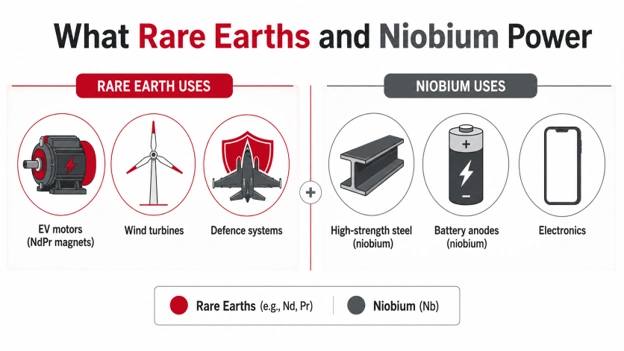
Figure 2: End-uses driving demand for rare earths and niobium.
Investors’ Outlook
St George heads into the second half of 2026 with drilling momentum on its side. The Company has lifted its resource, extended the ore body north, and confirmed near-surface grades across 23 holes.
A resource upgrade is scheduled for this quarter, with a second upgrade from East Araxá expected in the fourth quarter.
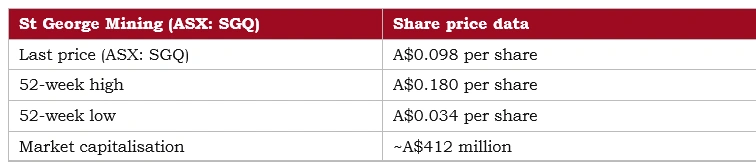
Table 3: SGQ share price data. [ASX]
Key catalysts to watch in the months ahead include:
- Resource upgrade for the main Araxá deposit, scheduled for this quarter
- East Araxá drilling, with a further resource upgrade expected in Q4 2026
- Ongoing assay results from the current drill campaign
- Economic studies advancing toward a potential mining operation
Disclaimer
This article has been prepared by Colitco in collaboration with St George Mining Limited as part of a commercial content and investor communications arrangement. Colitco may receive compensation for the production and distribution of this content. This article is intended for informational purposes only and does not constitute financial product advice, investment advice, or a recommendation to buy or sell any securities. The content reflects information available at the time of publication and may not be updated. All figures, data and statements have been sourced from St George Mining Limited’s official ASX announcements and publicly available sources. Readers should conduct their own independent research and seek professional financial advice before making any investment decisions. Past performance is not a reliable indicator of future results. Exploration results are not a guarantee of future resource definition or commercial production.

Elizabeth Jones is a finance and mining content specialist with over 10 years of experience creating clear, SEO-driven content across fintech, investing, banking, insurance, cryptocurrency, and resource markets. She transforms complex financial data and industry trends into engaging, reader-focused articles that improve understanding and audience engagement.