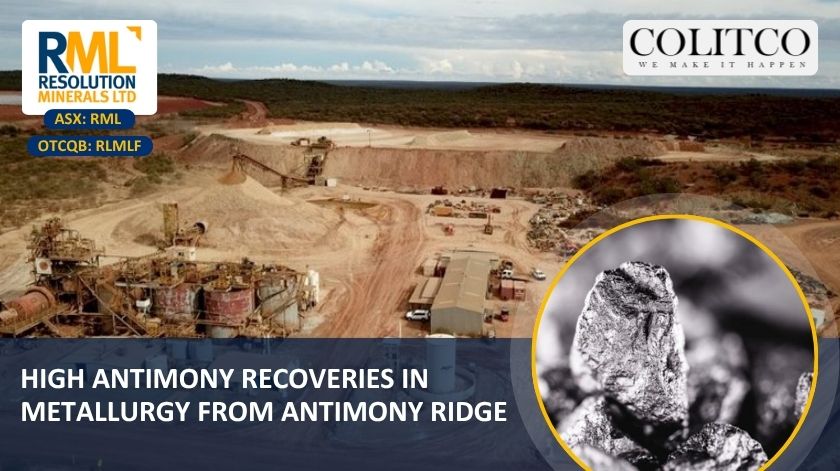
Resolution Minerals Ltd (ASX: RML; OTCQB: RLMLF) (the “Company”) delivered a significant milestone on 6 May 2026, announcing high antimony recoveries from concentrate test work conducted on samples from its Antimony Ridge project in central Idaho, USA. Independent Metallurgical Operations Pty Ltd (IMO), based in Perth, Australia, carried out the rougher flotation tests for stibnite, the primary antimony sulphide mineral, and recorded a combined sulphur recovery of 99.5%. It indicates virtually complete capture of stibnite in this initial concentration stage.
The result is particularly encouraging because the Company achieved these high recoveries from lower-grade samples assaying approximately 10.5% antimony, material that simulates the kind of dilution from surrounding waste or gangue that any future large-scale mining operation would typically encounter.
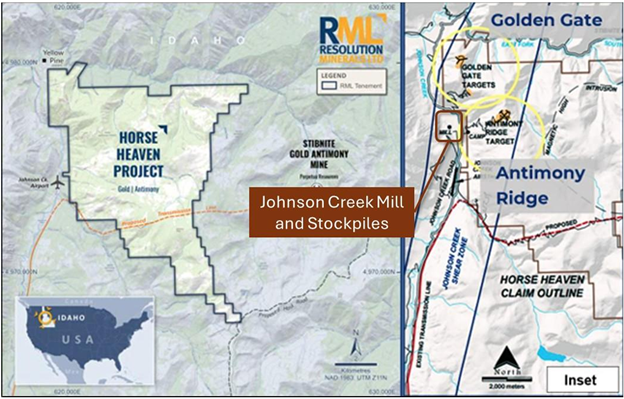
Figure 1: Horse Heaven Project location plan showing the locations of the three most important components of the project: Golden Gate, Antimony Ridge, and Johnson Creek Mill. [Source: Resolution Minerals]
What the Test Work Involved
IMO prepared an Antimony Ridge composite sample from 15 kg of rock chip material taken from the area of past workings, including historical open pits and trenches developed during World War I, World War II, and the Korean War. The composite sample carried an assay of 10.50% antimony (Sb), alongside 2.41 g/t of gold (Au) and a range of gangue minerals including silicon (34.4%), sulphur (3.2%), and aluminium (2.71%).
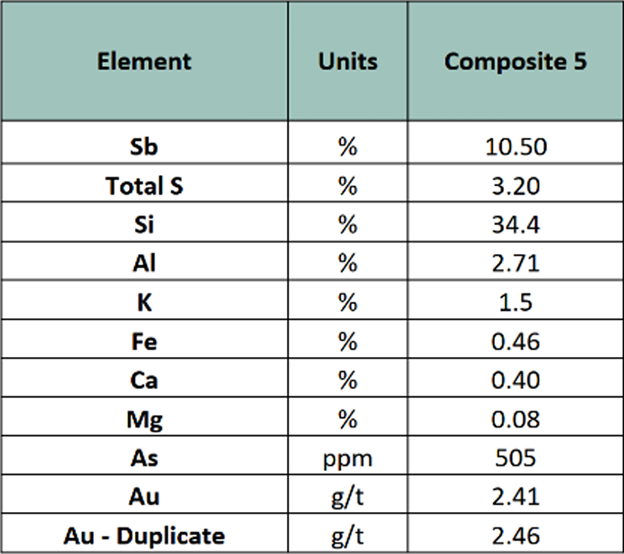
Table 1: Composite Assay Summary from Antimony Ridge [Source: Resolution Minerals]
Because the surface samples had been exposed to air over recent decades, some antimony was present in oxide form (cervantite) rather than purely as sulphide (stibnite). The composite was milled to a P80 of 75 μm, meaning 80% of the milled material passed through a 75-micron screen, before undergoing two five-stage rougher flotation tests at different pH levels: the slurry’s natural pH of 3.8 and an adjusted pH of 7.
Key Results at a Glance
Increasing the slurry pH from 3.8 to 7 delivered the following improvements:
- Antimony grade and recovery: Rose from 23.6% Sb at 72.2% recovery (FT01) to 27.3% Sb at 76.0% recovery (FT02).
- Gold recovery: Remained broadly consistent, with FT01 returning 4.3 g/t Au at 49.3% recovery and FT02 returning 4.4 g/t Au at 52.0% recovery.
- Sulphur recovery: Held constant at 99.5% across both tests, the headline figure that confirms near-complete stibnite capture.
- Sulphur grade in rougher concentrate: Reduced slightly from 16.5% S to 15.9% S, attributed to increased oxide gangue mineral recovery rather than any loss of stibnite.
IMO noted that 24% of the antimony in the head sample resides within oxide minerals rather than sulphide-locked stibnite within gangue minerals, which is consistent with the surface oxidation observed in the sample. The calculated percentage of antimony present as stibnite from XRD/SEM analysis was 71%, closely matching the measured rougher antimony recovery of 76.0%.
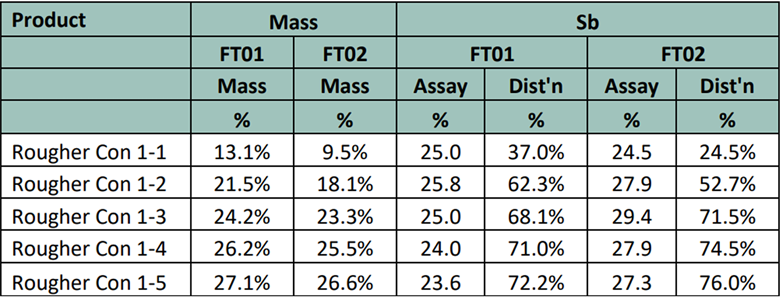
Table 2: Combined Rougher Antimony Grades and Recoveries (FT01 and FT02, Rougher Con 1-1 through 1-5) [Source: Resolution Minerals]
Why This Matters: Processing Confidence in a Diluted Ore Scenario
One of the key challenges any future antimony mining operation faces is ore dilution, the inevitable mixing of high-grade mineralisation with lower-grade or barren host rock during extraction from vein swarms. The Company deliberately selected lower-grade composite samples for this test work to simulate that real-world scenario.
The fact that virtually all the stibnite reports to the rougher concentrate, even from diluted 10.5% Sb material, gives the Company strong confidence that the processing flowsheet will be robust and simple. This is a critical foundation for any future feasibility work.
The rougher concentrate, which currently grades approximately 30% Sb, will now advance to rougher-regrind-cleaner flotation stages, with the aim of lifting the grade to above 50% Sb in the cleaner concentrate.
“The initial concentration results in rougher flotation test work are very encouraging from Antimony Ridge samples. Capturing virtually all the antimony sulphides is an excellent sign of a simple and robust processing flowsheet for antimony. I’m looking forward to discussing further results in the coming weeks. — Dr. Adam Roper, In-house Senior Metallurgist, Resolution Minerals Ltd”
Support from Prior Metallurgy Test Work
These rougher flotation results complement the Company’s earlier metallurgy announcement on 14 April 2026, in which Resolution reported the production of a 99.38 wt.% Antimony Trioxide product from large stibnite samples sourced from the Antimony Ridge historical open pits. That material was processed using the conventional pyrometallurgical process of volatilisation, demonstrating that Antimony Ridge stibnite responds exceptionally well to established processing routes.
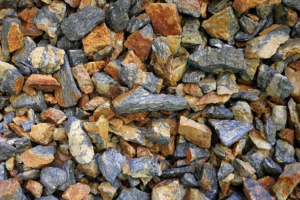
Figure 2: Sample images of stibnite sourced from the historic open pits at Antimony Ridge. [Source: LinkedIn/Resolution Minerals]
Together, the two datasets, one showing near-complete sulphide recovery via flotation and the other demonstrating high-purity Antimony Trioxide production via pyrometallurgy, present a compelling dual-pathway processing picture for the project.
The Company is also advancing hydrometallurgical processing test work on Antimony Ridge samples at ANSTO in Australia, with results to be released once available. Resolution’s broader plan involves developing a hydrometallurgy processing hub for antimony in Idaho, a strategically important step given the near-total absence of modern antimony processing infrastructure in the United States.
Project Scale and Strategic Context
Antimony Ridge sits within Resolution’s larger Horse Heaven Antimony-Tungsten-Gold-Silver Project in Idaho, a property comprising 729 US Federal lode mining claims covering 14,580 acres. The project is immediately adjacent to Perpetua Resources’ Stibnite Gold Project (NAS: PPTA), a large, recently permitted Antimony-Gold project already in the construction phase.
The region has deep historical significance as an antimony-producing district. During World War II, the local district, including the adjoining Stibnite Mine, is estimated to have produced more than 90% of the United States’ entire antimony supply (Source: Perpetua Resources Stibnite Feasibility Study, January 2021). Antimony Ridge itself was a key contributor to the US military’s war effort across three conflicts.
Resolution’s 3D modelling of Antimony Ridge, announced on 10 April 2026, has already demonstrated the project’s scale potential, revealing a 1,000 m x 700 m (170-acre) footprint containing numerous antimony and silver-bearing veins, vein swarms, and stockworks. That extensive mineralised system now has the backing of robust early-stage metallurgical data.
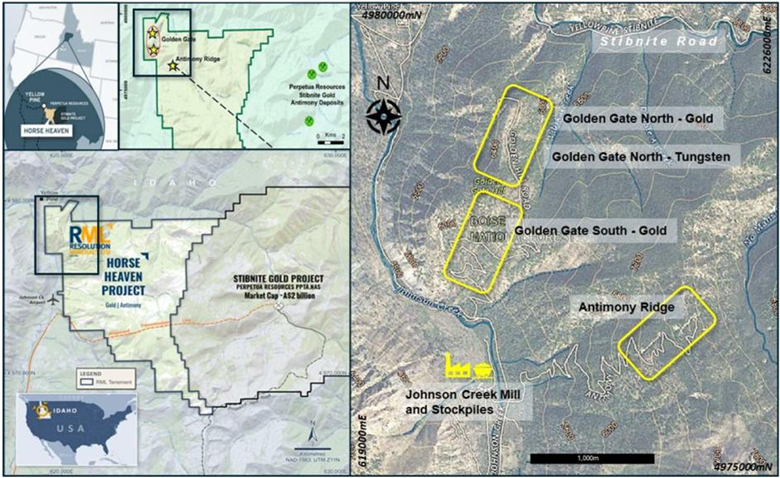
Figure 3: Antimony Ridge, a key component of Resolution’s Horse Heaven Antimony–Tungsten–Gold–Silver Project, highlights the geological and strategic connection between antimony mineralisation at Antimony Ridge (Sb) and the gold (Au) and tungsten (W) systems at Golden Gate. [Source: Resolution Minerals]
FAST-41 and Permitting Momentum
The strategic importance of the Horse Heaven Project received formal US government recognition on 8 April 2026, when it was selected for FAST-41 Transparency Coverage by the US-based Permitting Council. This designation is expected to accelerate permitting timelines, particularly for the Company’s application covering 250 drill holes and large-scale bulk sampling at Antimony Ridge.
Antimony is a critical metal for US defence, energy storage, and industrial applications, and domestic supply is essentially non-existent at present. Resolution’s Horse Heaven Project positions the Company at the forefront of efforts to rebuild American antimony self-sufficiency.
Broader Horse Heaven Activity: Golden Gate Drilling Commences
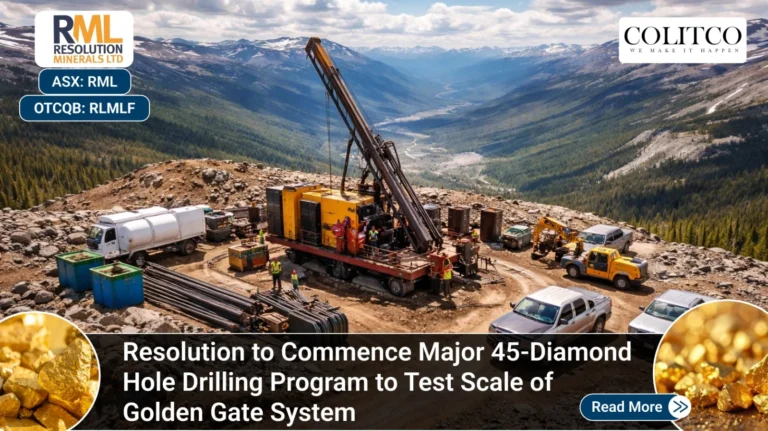
While Antimony Ridge advances through metallurgical test work, the Company is simultaneously kicking off a major Phase 2 drilling programme at its Golden Gate Target, also within Horse Heaven. Commencing on 7 May 2026, the programme consists of up to 13,700 metres (45,000 ft) of diamond core drilling, designed to:
- Define the scale of gold and tungsten mineralisation at Golden Gate and Golden Gate South.
- Support progression towards a maiden Mineral Resource Estimate.
The Company has recently acquired processing infrastructure and tungsten stockpiles in the area, adding further near-term optionality to the project portfolio.
Investors’ Outlook
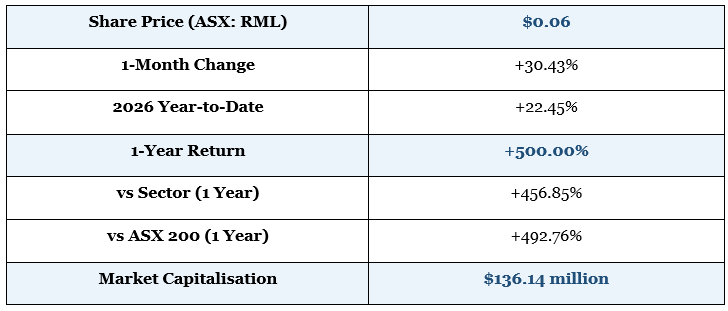
Resolution Minerals’ latest metallurgical results are arriving at a time of exceptional share price momentum. With a 12-month gain of +500.00% and a year-to-date rise of +22.45% as at 10:31 am AEST on 6 May 2026, the Company is trading at $0.06 per share with a market capitalisation of approximately $136.14 million.
The 99.5% sulphur recovery announced today is not merely a technical data point — it is a meaningful de-risking event for the project’s processing economics. Investors will note several converging positives:
- Processing simplicity: Near-complete rougher recovery from diluted, lower-grade samples suggests a robust and potentially low-cost flowsheet, which is critical to project economics at the feasibility stage.
- Multiple metallurgical pathways: The combination of flotation concentration, pyrometallurgical Antimony Trioxide production, and ongoing hydrometallurgical test work at ANSTO gives the Company optionality in how it ultimately processes the ore.
- FAST-41 tailwind: Accelerated permitting for 250 drill holes and bulk sampling at Antimony Ridge could compress the timeline to resource definition significantly.
- Golden Gate drilling: The 13,700-metre Phase 2 programme commencing on 7 May adds a gold and tungsten growth catalyst to the Company’s near-term news flow.
- Critical minerals demand: With antimony a declared critical mineral in both Australia and the United States, Resolution’s Idaho-based project attracts strategic premium in a market increasingly attentive to supply-chain security.
The next catalysts to watch include the cleaner flotation stage results, which will confirm whether the rougher concentrate can be upgraded to above 50% Sb, and the hydrometallurgical results from ANSTO.
Investors should note that the Company remains at the exploration and test-work stage, and all metallurgical results to date are from small, indicative composite samples rather than bulk or resource-scale material. Continued positive results across multiple processing pathways, however, would materially strengthen the investment case ahead of any future resource or feasibility work.
Disclaimer
This editorial is for informational purposes only and does not constitute financial product advice, investment advice, or a recommendation to buy or sell any securities. The information presented is based on publicly available announcements released by Resolution Minerals Limited. Forward-looking statements in this article are subject to risks, uncertainties, and assumptions that may cause actual results to differ materially from those expressed or implied. Readers should not place undue reliance on such statements.
Investors are strongly encouraged to conduct their own independent research, consider their financial situation and objectives, and seek advice from a licensed financial adviser before making any investment decisions. For further information, contact Aharon Zaetz (Executive Director) at ari@resolutionminerals.com or Jane Morgan (Investor Relations) at jm@janemorganmanagement.com.au.