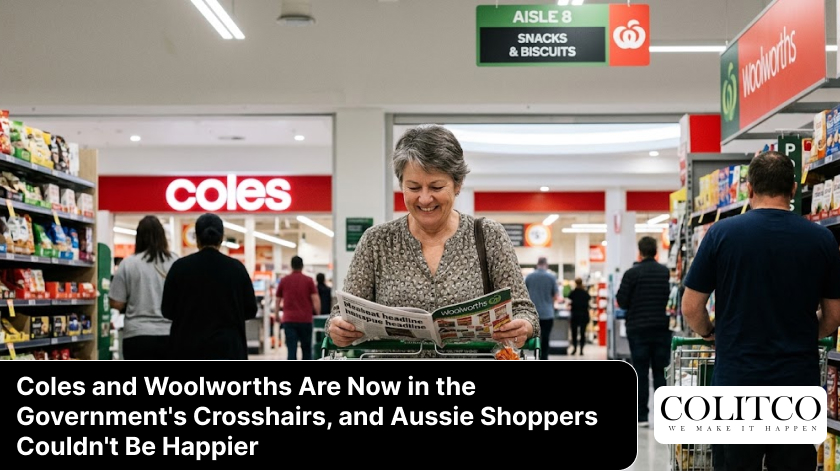
Four in five Australians believe they are getting ripped off every time they push a trolley through a Coles or Woolworths checkout. The federal government has heard them loud and clear. Starting 1 July 2026, new laws will make supermarket price gouging illegal, and both retail giants are already on notice.
A Nation Fed Up With Grocery Prices
Survey Paints a Damning Picture
A fresh Finder survey, shared exclusively with Yahoo Finance, shows the depth of shopper fury across the country. The numbers make for uncomfortable reading for both chains:
- 72% of Australians say supermarkets have been, and still are, price-gouging them
- 7% believe the gouging started recently, even if it didn’t happen before
- Only 4% say supermarkets have never engaged in the practice
- 1 in 3 Australians list grocery shopping among their top three most stressful expenses
The average Aussie household now spends $206 per week on groceries, up sharply from $185 three years ago.
Finder’s personal finance expert Sarah Megginson says families have watched bills climb without any meaningful relief. “When people see supermarket profits reported in the hundreds of millions, or even billions, while they’re cutting back on basics because a tub of butter is $7, it creates a perception that something isn’t right,” she told Yahoo Finance.
This level of distrust connects to a broader pattern. Woolworths and Coles rank among Australia’s most distrusted brands, a reputation that has only deepened as cost-of-living pressures have squeezed household budgets.
Also Read: Are Woolworths and Coles Australia’s Most Distrusted Brands?
The July 1 Price Gouging Ban Explained
What the New Laws Actually Do
Treasurer Jim Chalmers announced the laws as part of sweeping changes to the Food and Grocery Code of Conduct. The ban targets what the government calls “excessive pricing” — any price that strays well beyond the actual cost of supply plus a reasonable margin.
The rules apply only to retailers with annual revenue above $30 billion. Right now, that captures exactly two companies: Coles and Woolworths. Competitors like Aldi, Costco and IGA sit below the threshold and fall outside the new regime.
The Fines Are Steep
Breach the new rules, and the ACCC can come knocking with some of the most severe financial penalties in Australian consumer law. Per contravention, the fine will be the greater of:
- $10 million
- Three times the value of the financial benefit gained from the excessive pricing
- 10% of the company’s annual turnover for the preceding 12 months
Given Woolworths’ market cap sits at $46.1 billion and Coles’ at $30.8 billion, the 10% of turnover provision could translate into truly eye-watering sums.
The government is also providing the ACCC with an extra $30 million in funding to pursue harmful and misleading conduct in the supermarket sector.
ACCC Boss Signals Legal Action Is Coming
ACCC chair Gina Cass-Gottlieb has made no effort to soften her message. She told the Australian Financial Review it was “likely” the watchdog would launch legal action against Coles and Woolworths under the new laws; the only question was timing.
“Whether it happens in the first year or it happens somewhat subsequent from it,” she said.
The ACCC already has its hands full. The watchdog is currently suing both chains for allegedly misleading shoppers through manufactured discount promotions. The allegation is that supermarkets briefly spiked prices on hundreds of products, then placed those same items into Woolworths’ ‘Prices Dropped’ and Coles’ ‘Down Down’ promotions at a price lower than the spike, but still higher than, or equal to, what shoppers had been paying before. Both supermarkets are contesting the claims.
These collusion and misleading pricing allegations against Coles and Woolworths form part of an escalating series of legal and regulatory pressures the two chains now face.
What Coles and Woolworths Say
Neither chain accepts the price gouging label, and both pushed back hard when the laws were announced.
Coles pointed to the ACCC’s own 12-month supermarket inquiry, which found no conclusive evidence of excessive pricing. The company argued that higher grocery prices reflect genuine supply chain cost increases, including energy, fuel, insurance, production, freight and distribution. It also warned the new rules would push prices up, not down.
Woolworths called the laws “unprecedented” and said they create an “uneven playing field” because large foreign-owned retailers face no equivalent restrictions. The chain said average prices in its food retail division had fallen year-on-year for seven consecutive quarters.
The Australian Retailers Association echoed those concerns, calling the excessive pricing framework “subjective” and warning it adds compliance costs and legal uncertainty to an already tight-margin industry.
What It Means for Shareholders
Coles Share Impact & Price Regulation
Investors watching the Coles share price impact of the price regulation debate have so far stayed calm. Coles (ASX: COL) trades at $22.955, up +0.135 (+0.59%) as of 3:11 pm AEST on 21 April 2026.
| Timeframe | Performance |
| 1 Week | +0.86% |
| 1 Month | +6.32% |
| 2026 YTD | +7.07% |
| 1 Year | +7.92% |
| vs Sector (1yr) | +3.28% |
| vs ASX 200 (1yr) | -6.48% |
Market Cap: $30.83 billion
Coles has outperformed its sector peers over the past year, though it trails the broader ASX 200. Analysts are watching closely to see whether compliance costs or pricing restrictions compress margins heading into the second half of 2026.
Woolworths Stock Price News Australia
On the Woolworths stock price news front, the picture looks considerably brighter for shareholders. Woolworths (ASX: WOW) trades at $37.74, up +0.25 (+0.67%) on 21 April 2026.
| Timeframe | Performance |
| 1 Week | +1.56% |
| 1 Month | +3.62% |
| 2026 YTD | +28.45% |
| 1 Year | +19.66% |
| vs Sector (1yr) | +15.08% |
| vs ASX 200 (1yr) | +5.33% |
Market Cap: $46.10 billions
Woolworths has delivered one of the strongest share price runs in the consumer staples sector over the past year, a performance that will strike many shoppers as deeply ironic given the ongoing pricing controversy.
The regulatory environment remains a wild card for both stocks. If the ACCC follows through on its threat of legal action post-July 1, investors could face a very different second half of 2026.
Is the Law Tough Enough?
Consumer group CHOICE argues the July 1 ban doesn’t go far enough. It wants a national, economy-wide prohibition on price gouging — not just a fix for the supermarket aisle.
CHOICE points to the European Union, which already bans excessive pricing across the economy, and notes that more than half of US states impose emergency price gouging restrictions. Australia, by comparison, has historically relied on competition law to deliver fair prices over time rather than regulating individual price levels.
Economists warn that direct price regulation carries risks of its own. If Coles and Woolworths adopt cautious, uniform pricing strategies to sidestep legal exposure, genuine price competition could actually weaken rather than improve.
This debate doesn’t sit in isolation either. Questions about staff underpayment liabilities at Woolworths and Coles and ongoing disputes over pricing comparisons between Woolworths, Coles, and Aldi continue to pile pressure on both chains from multiple directions.
Also Read: Woolworths, Coles vs Aldi: The 2025 Price Comparison That Tells the Real Story
What Happens Next
The ACCC says it will publish guidance for retailers ahead of the July 1 start date. Both Coles and Woolworths have signalled they will adjust pricing practices in response — though Gina Cass-Gottlieb has made clear that compliance changes won’t necessarily head off legal action.
For millions of Australians who simply want to buy milk, bread and vegetables without feeling squeezed, the countdown to July 1 can’t move fast enough.
Frequently Asked Questions (FAQs)
Q1. When does the price gouging ban come into effect, and who does it cover?
The ban takes effect on 1 July 2026 as part of changes to the mandatory Food and Grocery Code of Conduct. It applies only to retailers with annual revenue above $30 billion, which currently means Coles and Woolworths exclusively. Smaller players like Aldi, Costco and IGA fall outside the threshold and face no equivalent restrictions under this legislation.
Q2. How much can Coles and Woolworths be fined for breaching the new laws?
The ACCC can issue a fine per contravention equal to the greatest of three amounts: $10 million, three times the financial benefit the supermarket gained from the excessive pricing, or 10 per cent of the company’s total annual turnover for the preceding 12 months. Given both chains generate tens of billions in revenue each year, the 10 per cent provision could result in the largest penalties.
Q3. Will the new price-gouging laws actually bring grocery prices down?
That depends on how aggressively the ACCC enforces the rules. Economists warn that direct price regulation carries risks. If Coles and Woolworths adopt overly cautious pricing strategies to avoid legal exposure, genuine price competition could weaken rather than improve. Consumer group CHOICE argues the ban needs to sit alongside broader competition reforms and stronger market entry incentives to deliver lasting relief for Australian shoppers.
Sources
- https://inspirepreneurmagazine.com/business/coles-and-woolworths-face-10m-fines-under-new-price-gouging-ban/
- https://au.finance.yahoo.com/news/damning-verdict-for-coles-and-woolworths-as-supermarkets-face-new-price-gouging-ban-190035256.html
Disclaimer: The information in this article is for general informational purposes only and does not constitute financial, legal, or investment advice. Share price data for Coles (ASX: COL) and Woolworths (ASX: WOW) reflect figures as at 3:11 pm AEST, 21 April 2026, and may have changed since publication. Readers should conduct their own research or consult a licensed financial adviser before making any investment decisions. Colitco makes no representations regarding the completeness or accuracy of third-party sources referenced herein.