
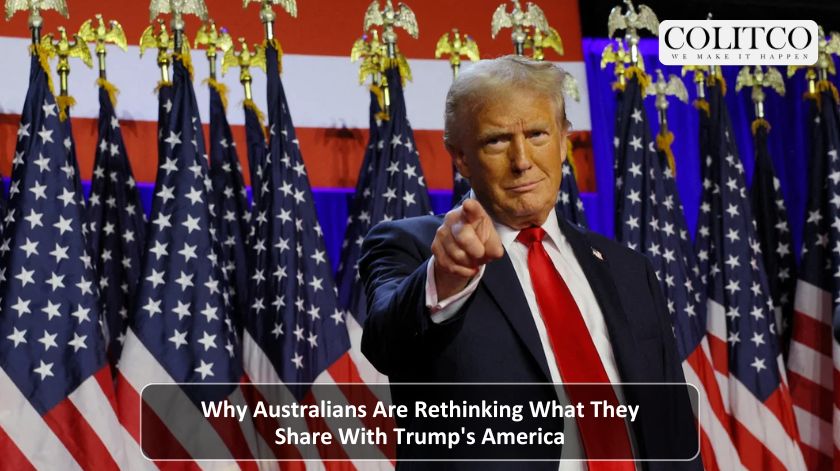
Trust is fragile. Alliance can be tested. And right now, Australians are quietly questioning something once taken for granted.
The idea that Australia and America share fundamental values has been the bedrock of diplomatic rhetoric for decades. But under Trump’s second administration, that foundation is showing cracks.
Recent polling data reveals a stark reality. Only 36% of Australians now trust America to act responsibly. That’s a 20-point drop from last year and the lowest level recorded in two decades, according to the 2025 Lowy Institute Poll.
Yet here’s the paradox. Despite this plummeting trust, 80% still view the US alliance as important to Australia’s security. Even more revealing, 57% believe Australia should remain close to Washington under Trump, while only 40% favour distancing.
What does this tell us? Australians have become pragmatists, not idealists.
New Australia Institute polling reveals only 8% of Australians are convinced Australia “shares values” with Trump’s America.
“It is past time Australia rethinks national security – and focuses on fairness and climate action, not blind fealty to America.’@EmmaShortis #auspol pic.twitter.com/MRehlztAPd
— Australia Institute (@TheAusInstitute) November 4, 2025
Democracy Under Strain
The Australia Institute’s polling paints an even more troubling picture. Three in 10 Australians view Trump as the greatest threat to world peace, surpassing both Vladimir Putin and Xi Jinping at 27% each.
More telling is the gender divide. A majority of women (56%) report feeling less secure in Australia since Trump’s election. Only 13% feel safer.
This isn’t about partisan politics. It’s about something deeper.
When Foreign Minister Penny Wong spoke at Prime Minister Albanese’s victory rally in May 2025, she didn’t mention Trump by name. But her words cut through: “Some might want to mimic the worst of other countries, but Albanese always backs what’s best about our country.”
Albanese himself emphasised that “the Australian people have voted for Australian values.” The subtext was unmistakable.
The Policy Rejection
Australia’s frustration with Trump’s policies extends across multiple fronts.
The Lowy Institute Poll shows overwhelming disapproval:
- 89% oppose Trump’s attempts to acquire Greenland through potential force
- 81% reject his use of tariffs to pressure other countries
- 76% disapprove of withdrawing from the World Health Organization
- 74% oppose exiting international climate change agreements
- 74% disapprove of negotiating Ukraine’s territorial losses with Putin
These aren’t fringe opinions. They represent mainstream Australian sentiment.
Trump’s tariff bombshells particularly stung. When Washington slapped 25% tariffs on Australian steel and aluminium in March 2025, then doubled them to 50% by June, Albanese called it “not the act of a friend.”
Trade Minister Don Farrell was blunter: “They are an act of economic self-harm that will only hurt consumers and businesses who rely on free and fair trade.”
The Values Reckoning
What shared values does Australia have with an America that’s abandoning democratic norms?
The question isn’t rhetorical anymore. Trump’s second term has seen systematic attacks on institutional independence. Career civil servants purged. Military leadership politicised. Constitutional constraints openly defied.
Australia prides itself on being a stable democracy with independent institutions. The contrast with Trump’s America grows starker by the week.
On climate change, the divergence couldn’t be clearer. While Trump withdrew from the Paris Agreement and dismissed climate science as a hoax, the Albanese government is bidding to host the 2026 UN climate summit with Pacific nations. That initiative enjoys 70% public support.
Australia would find itself leading global climate action while the world’s second-largest emitter backtracks on every commitment.
Trade Wars and Economic Reality
The economic impact of US tariffs on the Australian economy extends beyond steel and aluminium.
Trump threatened $2.2 billion in tariffs on Australian pharmaceuticals in September 2025, demanding companies relocate production to America. Health Minister Mark Butler responded firmly that Australia’s health policies “will not be dictated by foreign pressure.”
The Australian dollar hit five-year lows as trade tensions escalated. The ASX braced for selloffs. Business confidence wavered.
Yet Australia’s direct trade exposure to the US remains modest at just 5% of total exports. The bigger worry is indirect impact through China and global growth slowdowns.
Commonwealth Bank estimates GDP could be 0.3% lower over several years. KPMG’s more pessimistic modelling suggests losses of $27 billion, or about 1% of GDP.
The Alliance Paradox
Here’s where Australians views on Trump become complex rather than contradictory.
The Anthony Albanese US visit in October 2025 focused on AUKUS, critical minerals, and maintaining defence ties. Because geography dictates certain realities.
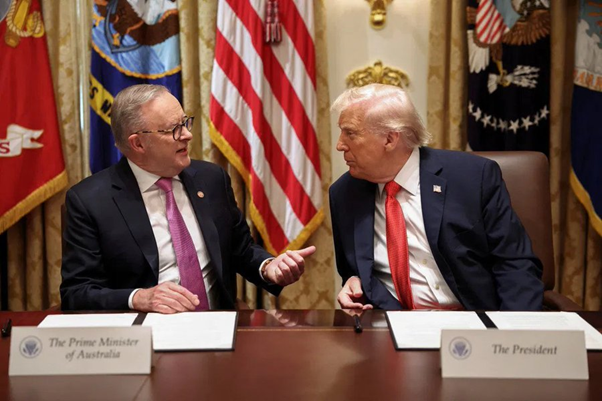
Albanese at a meeting with Trump
Australia sits in the Indo-Pacific. China’s military assertiveness isn’t going away. And no alternative security guarantor exists with America’s reach and resources.
The Pentagon’s review of AUKUS caused anxiety in Canberra. Two-thirds of Australians support acquiring nuclear-powered submarines. Any program jeopardy would represent a strategic setback.
Defence spending pressures are mounting too. Washington wants allies at 3% of GDP, up from Australia’s current 2%. Half of Australians (51%) support increased defence budgets, showing pragmatic acceptance of regional security demands.
But confidence in US reliability is eroding. Only 16% of Australians believe Trump would defend Australia’s interests if threatened. Just 48% lack confidence he would do so at all.
That’s not a vote of confidence in an ally. That’s resignation to necessary strategic dependence.
What’s Changed, What Hasn’t
Australia USA political values were never identical. But common ground once seemed substantial.
Both were British settler democracies. Both valued personal freedoms, rule of law, free markets, and international cooperation. Both believed in meritocracy (however imperfect the reality).
Trump’s America has moved away from all of that.
The “America First” doctrine isn’t just about prioritising national interests. Every country does that. It’s about openly dismissing the rules-based international order that enabled post-war prosperity.
It’s about celebrating strongmen while denigrating democratic allies. Weaponising economic policy against friends. Treating alliances as transactional protection rackets rather than partnerships.
Australian Prime Minister Scott Morrison’s embrace of Trump in 2019, addressing MAGA rallies in Ohio, looks politically toxic in hindsight. When Labor won the 2025 federal election with its highest two-party preferred vote ever, Trump’s shadow loomed large.
Opposition Leader Peter Dutton had appointed Senator Jacinta Nampijinpa Price as shadow minister for “government efficiency,” directly importing Elon Musk’s DOGE concept. The tactic backfired spectacularly with voters.
The Broader Democratic Question
Trump’s impact extends beyond bilateral relations. His presidency represents a test case for democratic resilience.
Can institutions withstand sustained assault from the executive? Do constitutional guardrails hold when a leader openly defies them? What happens when loyalty trumps competence in appointments?
Australians are watching these experiments with alarm. The United States Studies Centre polling found 73% of Australians worry about the future of American democracy. An even higher 82% express concern about political violence in the US.
These aren’t abstract concerns. They’re questions about whether liberal democracy itself remains viable when one of its strongest exemplars appears to be abandoning core principles.
Australia’s 2025 election result suggested voters explicitly rejected Trump-style politics when given the choice. Minor parties and far-right movements failed to gain traction despite favourable voting systems.
The verdict seems clear. Australians don’t want what America has become.
Looking Forward
Where does this leave Australia USA political values convergence?
The alliance will endure because strategic necessity demands it. Geography, China, and lack of alternatives ensure continued military cooperation. AUKUS will likely proceed despite Trump’s transactionalism.
But the values rhetoric is dead. You can’t credibly claim shared democratic principles when one partner systematically undermines them.
Australian officials now speak of “shared interests” rather than “shared values.” That semantic shift matters. It acknowledges reality without pretending common ground that no longer exists.
The Lowy Institute’s research director summed it up: Australians are “by no means fans of Donald Trump,” but they perceive the alliance as strategically indispensable amid rising regional tensions.
That’s alliance out of necessity, not affinity. Partnership by calculation, not conviction.
And perhaps that’s the most honest foundation possible in 2025. Australians have stopped expecting America to be what it once was. They’re dealing with the America that is.
The question isn’t whether Australia shares values with Trump’s America anymore. The answer is clearly no. The question is whether Australia can maintain an alliance with a country whose government no longer represents the democratic ideals Australians thought they shared.
So far, Australians are saying yes to the alliance and no to the values. How long that paradox remains sustainable is anyone’s guess.
Also Read: One Simple Error Could Cost Sydney Resident $20 Million Oz Lotto Prize
FAQ
Q: Has Australian trust in America declined under Trump?
A: Yes, dramatically. Trust in America dropped to 36% in 2025, down 20 points from the previous year and the lowest in two decades, according to the Lowy Institute Poll.
Q: Do Australians still support the US alliance despite concerns about Trump?
A: Yes, 80% view the alliance as important to Australia’s security. However, this represents strategic pragmatism rather than values alignment, with many Australians maintaining the relationship out of necessity.
Q: What Trump policies do Australians most oppose?
A: The 2025 Lowy Institute Poll shows 89% oppose Greenland acquisition attempts, 81% reject tariffs on allies, 76% oppose WHO withdrawal, and 74% disapprove of abandoning climate agreements and negotiating Ukraine territorial losses.
Q: How have Trump’s tariffs affected Australia?
A: Trump imposed 25-50% tariffs on Australian steel and aluminium, threatened $2.2 billion in pharmaceutical tariffs, and applied a 10% baseline tariff. These actions strained trade relations despite the Australia-US Free Trade Agreement.
Q: Did Trump influence Australia’s 2025 federal election?
A: Yes, significantly. Labor won with its highest two-party preferred vote, while the Coalition’s attempts to emulate Trump-style politics failed. Voters explicitly rejected MAGA-inspired policies, demonstrating Australia’s political divergence from Trump’s America.


