
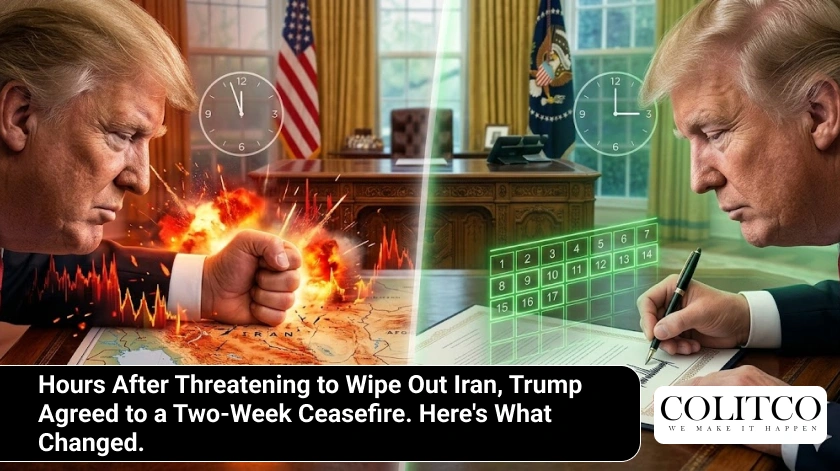
US President Donald Trump announced a two-week ceasefire with Iran on Tuesday night, stepping back from what had been one of the most explosive ultimatums of his presidency. The deal came after Pakistani Prime Minister Shehbaz Sharif appealed directly to Trump to hold off military action and allow diplomacy to run its course.
The ceasefire is conditional on Iran fully reopening the Strait of Hormuz to international shipping. Iran’s foreign minister confirmed Tehran’s acceptance of the agreement, saying the country would allow safe passage through the strait via coordination with its armed forces.
What Changed in the Final 90 Minutes
Just hours before the ceasefire was announced, Trump had posted on Truth Social warning that “a whole civilization will die tonight” if Iran failed to reach an agreement before his 8pm Eastern deadline.
Pakistani Prime Minister Shehbaz Sharif urged Trump to extend his deadline by two weeks to allow diplomacy to run its course, writing on X that “diplomatic efforts for peaceful settlement of the ongoing war in the Middle East are progressing steadily, strongly and powerfully.”
Trump listened. He posted on Truth Social shortly before the deadline:
“Subject to the Islamic Republic of Iran agreeing to the COMPLETE, IMMEDIATE, and SAFE OPENING of the Strait of Hormuz, I agree to suspend the bombing and attack of Iran for a period of two weeks. This will be a double sided CEASEFIRE!”
He also said the US had received a 10-point peace proposal from Iran, calling it a “workable basis on which to negotiate.”
🚨 President Donald J. Trump makes a statement on Iran: pic.twitter.com/9mqTayL0Q3
— The White House (@WhiteHouse) April 7, 2026
What’s In the US-Iran Ceasefire Deal
Iran’s Foreign Minister Abbas Araghchi confirmed Tehran’s acceptance and said Iran would allow “safe passage” of the Strait of Hormuz during those two weeks “via coordination with Iran’s armed forces.”
Israel has also agreed to the ceasefire and will suspend its strikes. Pakistan’s prime minister said the ceasefire would also apply in Lebanon, where Israel has been conducting an invasion.
The US and Iran are expected to hold peace talks on Friday in Islamabad, with Vice President Vance likely to lead the US delegation.
Iran’s 10-point proposal, according to reports, includes a guarantee against future attacks on Iran, an end to Israeli strikes on Hezbollah in Lebanon, and removal of sanctions in exchange for the Strait reopening.
However, the two sides appear to be framing the deal very differently. While Trump called it a framework for negotiations, Iran’s statement released through its Tasnim News Agency claimed the agreement included “continued Iranian control over the Strait of Hormuz.” That gap in interpretation is likely to be tested over the coming two weeks.
Why the Strait of Hormuz Is the Centre of All This
The Strait of Hormuz is why global markets have been in turmoil since this conflict began. The waterway facilitates the transit of around 20 million barrels of oil per day, representing roughly 20% of global seaborne supply.
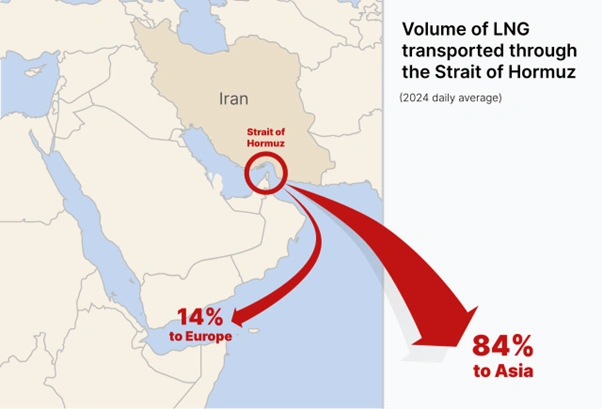
The Strait of Hormuz, through which roughly 20% of global oil supply passes, has been effectively closed since late February 2026. [Wikipedia]
Brent crude oil prices surpassed US$100 per barrel on 8 March 2026 for the first time in four years, rising to US$126 per barrel at its peak. The closure of the strait has been described as the largest disruption to the energy supply since the 1970s energy crisis.
Markets responded sharply to Tuesday’s ceasefire news. Oil plunged below $100 a barrel after the US and Iran agreed to the two-week ceasefire. Brent fell as much as 16% to less than $92 a barrel, while West Texas Intermediate slumped the most in almost six years.
US stock futures also rallied hard. S&P futures surged more than 1.6%, Nasdaq 100 futures soared 1.8%, and Dow futures climbed 725 points.
The Political Fallout at Home
Trump’s threats earlier in the day drew fierce bipartisan backlash. House Minority Leader Hakeem Jeffries said Trump was “completely unhinged” and called for Congress to come back into session immediately. Senate Minority Leader Chuck Schumer and a group of Democratic ranking members issued a rare joint statement warning Trump that “he must not follow through on this threat.”
International legal experts weighed in too. Kenneth Roth, former executive director of Human Rights Watch, said that threatening strikes on civilian infrastructure such as power plants constitutes a potential war crime under the Fourth Geneva Convention.
Pope Leo XIV said the threats were “truly unacceptable” and that such attacks would violate international law. French Foreign Minister Jean-Noël Barrot said that attacks targeting civilian and energy infrastructure could constitute a war crime.
Trump said he was “not at all” concerned about committing war crimes.
What Happens Next
The two-week window is now a countdown clock for diplomacy. If talks in Islamabad on Friday go well, there is a path toward a broader agreement. If they stall or one side walks away, markets and the region face renewed volatility.
The US and Israel launched major combat operations against Iran on February 28, with massive joint strikes targeting military and government sites, including the killing of Iran’s Supreme Leader Ali Khamenei. More than 1,900 people have been killed in Iran since the war began.
Both sides have incentive to make something stick. Iran’s economy has been hammered. Oil-dependent Gulf states are bleeding. And US petrol prices hit a national average of $4.14 a gallon this week, up nearly 39% since the war began in late February.
The ceasefire is fragile. Reports emerged that after the ceasefire came into force, missiles were still launched from Iran towards Israel and several Gulf states. A US Defence official said it may take time for the order to filter down to lower ranks of the Revolutionary Guards.
The next two weeks will determine whether this is a genuine off-ramp or just a pause before a more destructive phase of the conflict.
Also Read: BOQ Announces Capital Partnership with Challenger
FAQ
Q: What is the Iran ceasefire agreement?
A: The US and Iran have agreed to a two-week pause in military hostilities, brokered by Pakistan. The deal is conditional on Iran reopening the Strait of Hormuz to international shipping. Peace talks are expected to begin in Islamabad on Friday.
Q: Why did Trump suspend US attacks on Iran?
A: Pakistan’s Prime Minister Shehbaz Sharif personally requested that Trump extend his deadline by two weeks to allow diplomacy to progress. Trump agreed, citing a 10-point peace proposal from Iran that he described as a workable basis for negotiation.
Q: What is the Strait of Hormuz, and why does it matter?
A: The Strait of Hormuz is a narrow waterway between Iran and Oman that channels roughly 20% of global oil supply. Iran’s closure of the strait since late February 2026 has triggered the largest energy supply disruption since the 1970s oil crisis.
Q: How did markets react to the Iran ceasefire?
A: Oil prices dropped sharply, with Brent crude falling more than 16% and WTI sliding the most in nearly six years. US stock futures rallied, with the S&P 500 and Nasdaq both surging over 1.6% on the news.
Q: What happens if the ceasefire breaks down?
A: If talks in Islamabad fail or either side violates the terms, analysts warn oil prices could spike back above $115 per barrel, potentially reaching $140 in a worst-case scenario involving fresh US air strikes on Iranian infrastructure.
Disclaimer: This article is for informational purposes only and does not constitute financial advice. Readers should conduct their own research before making any investment decisions.
Source: