St George Mining Limited (ASX: SGQ) has released an updated resource estimate for its 100% owned Araxá Project in Minas Gerais, Brazil.
The update, dated 11 August 2026, lifts the total resource to 111.2 million tonnes.
For the Project, the higher-confidence Measured and Indicated portion rose 155% to 75.2 million tonnes.
What the Araxá Resource Upgrade Delivers
The estimate covers rare earths and niobium. These are critical minerals used in magnets, electronics and steel.
Independent consultancy SRK Consulting Pty Ltd (Australasia) prepared the updated model.
The headline numbers are:
- Total resource of 2 million tonnes at 3.57% TREO and 0.57% Nb₂O₅
- A 57% increase in the total resource from the previous estimate
- Measured and Indicated resources of 2 million tonnes, up 155%
- Measured and Indicated now make up 68% of the total resource
- Contained metal of 98 million tonnes of TREO, 760,000 tonnes of NdPr oxides and 630,000 tonnes of Nb₂O₅
| Resource Classification | Million Tonnes (Mt) | TREO (%) | NdPr (%) | Nb₂O₅ (%) |
| Measured | 33.2 | 3.81 | 0.72 | 0.63 |
| Indicated | 42.0 | 3.50 | 0.67 | 0.54 |
| Measured & Indicated | 75.2 | 3.64 | 0.69 | 0.58 |
| Inferred | 36.0 | 3.43 | 0.66 | 0.53 |
| Total | 111.2 | 3.57 | 0.68 | 0.57 |
Figure 1: Total Araxá Mineral Resource Estimate at a 2% TREO cut-off, effective 11 August 2026. [Source: St George Mining]
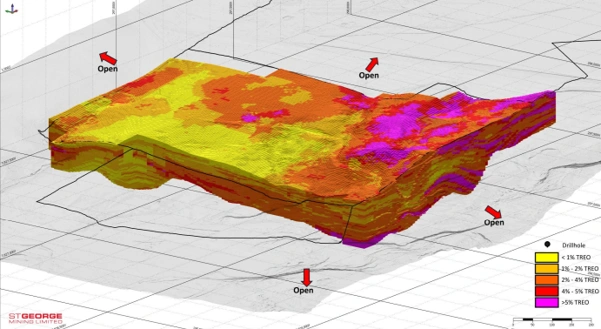
Figure 2: 3D view of the updated Araxá resource showing TREO grades, looking north-east. [Source: St George Mining]
Measured and Indicated Resource Grows to 75.2 Million Tonnes
The clearest change in the update sits in the higher-confidence categories.
The Measured and Indicated resource grew from 29.49 million tonnes to 75.2 million tonnes.
The Measured category alone rose from 8.02 million tonnes to 33.2 million tonnes. That is an increase of about 314%.
Within Measured and Indicated, the Company reports about 522,000 tonnes of contained NdPr oxides and about 435,000 tonnes of contained Nb₂O₅.
Figure 3: Araxá resource growth by category, March 2026 compared with August 2026. [Source: St George Mining announcement data]
The table below compares the previous estimate with the update.
| Category | Previous MRE (March 2026) | Updated MRE (August 2026) |
| Measured | 8.02 Mt @ 5.23% TREO, 0.95% NdPr, 1.06% Nb₂O₅ | 33.2 Mt @ 3.81% TREO, 0.72% NdPr, 0.63% Nb₂O₅ |
| Indicated | 21.46 Mt @ 4.31% TREO, 0.80% NdPr, 0.63% Nb₂O₅ | 42.0 Mt @ 3.50% TREO, 0.67% NdPr, 0.54% Nb₂O₅ |
| Measured & Indicated | 29.49 Mt @ 4.56% TREO, 0.84% NdPr, 0.75% Nb₂O₅ | 75.2 Mt @ 3.64% TREO, 0.69% NdPr, 0.58% Nb₂O₅ |
| Inferred | 41.42 Mt @ 3.71% TREO, 0.72% NdPr, 0.52% Nb₂O₅ | 36.0 Mt @ 3.43% TREO, 0.66% NdPr, 0.53% Nb₂O₅ |
| Total | 70.91 Mt @ 4.06% TREO, 0.77% NdPr, 0.62% Nb₂O₅ | 111.2 Mt @ 3.57% TREO, 0.68% NdPr, 0.57% Nb₂O₅ |
Figure 4: Comparison of the March 2026 and August 2026 Araxá resource estimates. [Source: St George Mining]
How Araxá Compares With the World’s Largest Rare Earths Mines
The Company set its updated resource against the biggest hard-rock rare earths mines outside China.
The comparison covers Lynas Rare Earths (ASX: LYC), MP Materials (NYSE: MP) and Arafura Rare Earths (ASX: ARU).
According to the Company, Araxá’s Measured and Indicated NdPr tonnes are larger than the same category at each of Lynas’ Mt Weld and MP Materials’ Mountain Pass.
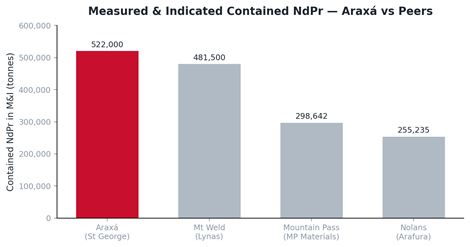
Figure 5: Contained NdPr in the Measured and Indicated category, Araxá compared with peer mines. [Source: St George Mining / Terra Studio]
| Metric | St George | Lynas | MP Materials | Arafura |
| Market cap / exchange | A$385m / SGQ | A$16.4b / LYC | US$9.1b / MP | A$1.18b / ARU |
| Project | Araxá, Brazil | Mt Weld, Aust. | Mountain Pass, USA | Nolans, Aust. |
| Stage | Development | Producing | Producing | Development |
| Total TREO (Mt) | 111.2 | 106.6 | 40.6 | 56 |
| Total TREO grade | 3.57% | 4.1% | 5.9% | 2.6% |
| M&I contained NdPr (t) | 522,000 | 481,500 | 298,642 | 255,235 |
| Total MRE NdPr (t) | 760,000 | 1,023,397 | 394,025 | 383,618 |
| Nb₂O₅ reported (t) | 630,000 | Nil | Nil | Nil |
Figure 6: Peer benchmarking of hard-rock rare earths mines outside China. Market caps as at 7 August 2026. [Source: St George Mining]
John Prineas, Executive Chairman of St George Mining, said the update strengthened the project’s standing.
“Today’s announcement of such a major upgrade to the size and quality of the resource at our 100%-owned Araxá Project further stamps the credentials of the project as the most significant undeveloped rare earths and niobium project worldwide.”
“Our Araxá MRE now compares even more favourably in scale and grade to the two largest producing rare earths mines outside of China – the Mountain Pass mine of MP Materials (NYSE: MP) and the Mt Weld mine of Lynas Rare Earths (ASX: LYC) – both of which have the same carbonatite-hosted style of mineralisation as our Araxá deposit.”
A Niobium Resource of Global Scale
Alongside rare earths, Araxá holds a large niobium resource.
The Company reports the deposit as the world’s largest undeveloped Measured niobium resource.
Under a separate niobium measure, the resource totals 143.8 million tonnes at 0.53% Nb₂O₅.
Araxá sits in Brazil’s main niobium district, where more than 80% of the world’s niobium is mined.
The project is next to CBMM, the world’s largest niobium producer.
“In regard to niobium, the Araxá MRE is the largest undeveloped niobium Measured Resource in the world. Our location in the world’s premier niobium producing district – where more than 80% of niobium is currently mined – further supports our Araxá Project as potentially the next globally significant niobium producer,” said Mr Prineas.
Shallow, Weathered Ore Suited to Open-Pit Mining
The shape and depth of the resource support low-cost mining.
The Company says 100% of the resource within 120 metres of surface sits in a weathered, free-digging layer that supports low-cost open-pit mining.
The resource stays open in all directions, leaving room for further growth.
The update also flags a high-grade core within the resource:
- 830,000 tonnes of TREO above a 29% grade
- 120,000 tonnes of Nb₂O₅ above a 90% grade
The Company says this provides options for mine scheduling, including targeting high-grade zones in the early years of mining.
“The open-pit mine potential of the large resource at Araxá together with enviable project logistics – a location in a region with a long history of commercial mining, access to existing infrastructure, availability of an experienced and skilled workforce and a well-understood regulatory framework – underpin our potential to build a globally significant business in niobium and rare earths,” said Mr Prineas.
East Araxá Adds a Second Growth Front
The updated resource covers only the main Araxá deposit. It does not include East Araxá, a separate zone about 1 kilometre to the east.
Drilling there has returned rare earth grades of up to 12.34% TREO from surface. Five diamond rigs are now working around the clock at East Araxá.
The Company aims to deliver a maiden resource for the area during the December quarter of 2026.
Why the Rare Earth Mix at Araxá Matters
Not every rare earth carries the same value. A deposit is judged less on its total tonnes and more on how much of the high-value material it holds.
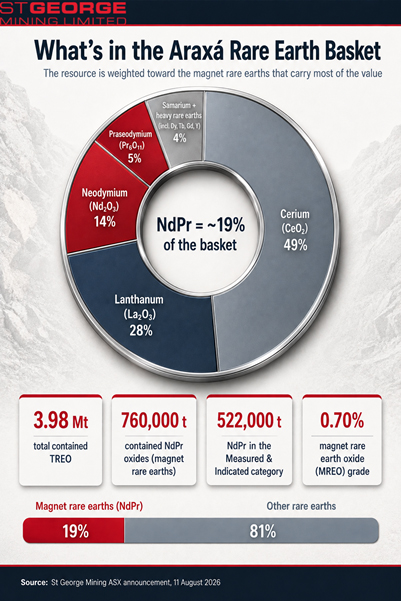
Figure 7: Rare earth basket composition at Araxá, showing the share weighted to magnet rare earths. [Source: St George Mining]
The most sought-after are neodymium and praseodymium, together called NdPr. These are the rare earths used in the strong permanent magnets inside electric motors and wind turbines.
Araxá is weighted toward this end of the basket. The Company reports the total resource at 0.70% magnet rare earths, and about 19% of the rare earth content is NdPr.
That translates into 760,000 tonnes of contained NdPr oxides across the resource.
The Measured and Indicated portion alone holds about 522,000 tonnes of NdPr. That is more than the same category at Lynas’ Mt Weld and MP Materials’ Mountain Pass.
The deposit also carries heavy rare earths such as dysprosium, terbium, gadolinium and yttrium. These are scarcer than the light rare earths and support magnet performance at high temperatures.
For a project still in development studies, this mix is what places Araxá next to two of the largest producing mines outside China.
St George’s Araxá story has moved quickly through 2026. The Company earlier reported record drill results and high-grade niobium intercepts at the project.
Investors’ Outlook
The resource upgrade follows an active year for the Company.
In the June 2026 quarter, St George Mining completed a A$60 million placement and held cash of about A$98 million.
The Company appointed Worley as feasibility technical adviser for Araxá.
Hancock Prospecting lifted its stake in the Company to 10.3%. Battery maker Amperex Technology Limited (ATL) agreed to invest at A$0.16 per share.
The table below sets out the Company’s market data.
| Metric | Value |
| Last Price | A$ 0.090 (as at 11 August 2026) |
| Market Capitalisation | A$408,238,687 |
| 52-Week Range | 0.037 – 0.180 |
| 1 Year | +125.64% |
| vs Sector / vs ASX 200 | +80.77% / +120.95% |
Figure 8: SGQ market data. [Source: ASX / St George Mining]
Catalysts ahead:
- Maiden resource estimate for East Araxá, targeted for the December 2026 quarter
- Ongoing metallurgical testwork and feasibility studies with Worley
- Further drilling to grow and convert the resource
Disclaimer
This article has been prepared by Colitco in collaboration with St George Mining as part of a commercial content and investor communications arrangement. Colitco may receive compensation for the production and distribution of this content. This article is intended for informational purposes only and does not constitute financial product advice, investment advice, or a recommendation to buy or sell any securities. The content reflects information available at the time of publication and may not be updated. All figures, data and statements have been sourced from St George Mining official ASX announcements and publicly available sources. Readers should conduct their own independent research and seek professional financial advice before making any investment decisions. Past performance is not a reliable indicator of future results. Exploration results are not a guarantee of future resource definition or commercial production.